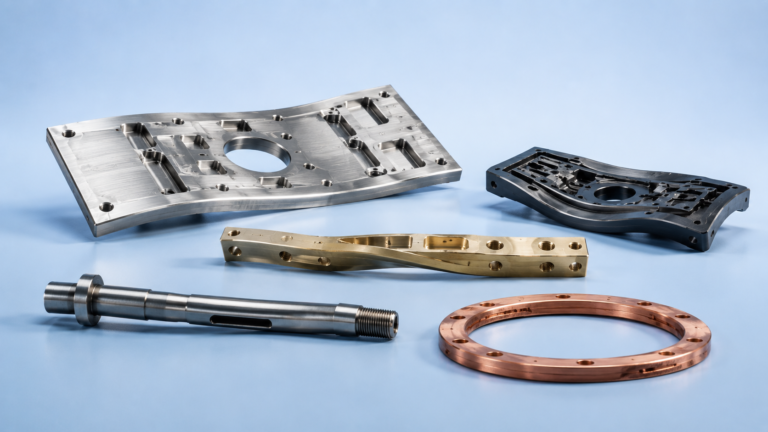
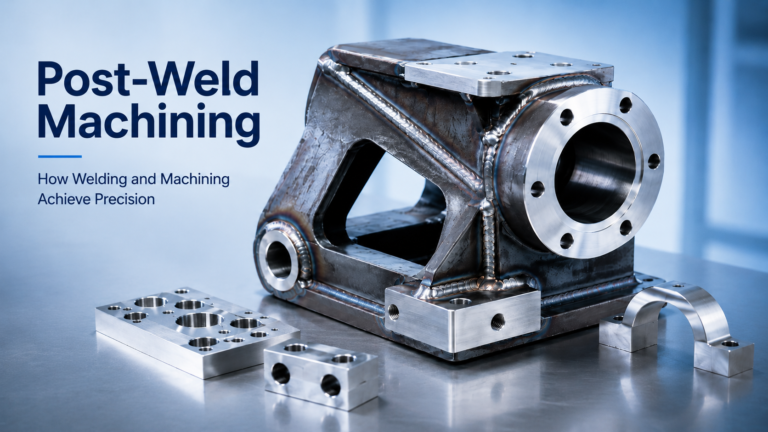
Metal die casting is a systematic process that produces a wide range of metal parts. This technique makes it easier to produce strong, precise, lightweight metal components at lower costs. The parts or components manufactured through die casting process facilitate the production of both consumer and industrial components.
Though metal die casting is a flexible production process, it is recommended to be well-versed in the technique before independently using it or hiring companies that provide related services. So, what is die casting, how does die casting work, and its different types and advantages. Read on to find out.
What is Die Casting?
The die casting involves forcing melted metal into a mold through the use of high pressure. A hydraulic press, ensuring the closure faces almost perfectly meet as a seal, forces the hardened tool-steel pieces that make up the cavity together.
Metal die casting allows for the production of precision metal parts with excellent finishes and precise dimensions. It is ideal for large-scale product manufacturing because of its ability to create complex parts.
Aluminum
Aluminum is a primary metal in die casting, which in alloys is utilized for the cold-chamber die casting process. These aluminum alloys typically comprise elements such as magnesium, copper, and silicon.
Aluminum-based die casting alloys are a superb choice for intricate, finely detailed pieces as they are lightweight and provide excellent dimensional stability. They have robust resistance to temperature fluctuations, corrosion, electrical, and thermal conductivity. Here are some commonly used aluminum alloys for die casting.
- Aluminum Alloy 380: An all-purpose aluminum alloy with an equilibrium of castability and mechanical characteristics, 380 is widely used to make engine brackets, furniture, electronic enclosures, frames, handles, gearboxes, power tools, and more.
- Aluminum Alloy B390: This alloy has exceptional vibration and wear resistance. It’s commonly used for pump housings, valve bodies, and impellers.
- Aluminum Alloy 413: It possesses outstanding casting properties thanks to its high-pressure compressibility. AL413 is commonly applied in the making of architectural parts, food machinery, and hydraulic cylinders.
- Aluminum Alloy 443: Out of all the aluminum alloys used in die casting, AL443 provides the best ductility. This makes it perfect for consumer goods, particularly those that require plastic deformation after casting.
Magnesium
- Magnesium is another popular choice for die casting. Other elements in magnesium alloys include aluminum, zinc, manganese, and silicon. It’s not only lighter than aluminum but also more machinable, making it a good fit for objects that require additional machining or surface finishing post-casting.
- Die casting magnesium alloys are easier to cast compared to metals like aluminum mainly due to their fit with the hot-chamber die casting process. Here are some typical magnesium alloys used in die casting.
- AZ91D: An ideal combination of high strength-to-weight ratio, serious corrosion resistance, and castability makes this alloy popular for powertrain components and mechanical parts.
- AM60: A mix of strength, ductility, vibration damping, and good castability makes AM60 the go-to choice for automotive parts like panels and seat frames.
- AS41B and AE42: These unique rare earth alloys exhibit high-temperature resistance and offer great creep, corrosion, and ductility resistance. But they are expensive.
Zinc
Zinc alloys comprise a significant portion of die casting metals. They make manufacturing easy, are suitable for casting in a hot-chamber die casting machine, and offer additional benefits like impact strength, ductility, and compatibility for plating. Here are some typical alloys used in zinc die casting.
- An all-purpose zinc alloy known for its dimensional stability and ease of casting. Zamak 3 is used in the making of plumbing parts and ceiling fans.
- Enriched with extra copper, this alloy, while slightly more expensive, brings greater strength.
- A zinc-based alloy, Zamak 5 is similar to Zamak 3 but offers less ductility and higher tensile strength. Hence, it’s the preferred alloy for products like wheel balancing weights.
Steps Involved in the Die Casting Operation
High pressure is vital for injecting molten metal into a die mold during die casting. Here are the multi-step processes involved in die casting.
1. Create Mold
First, computer-aided design (CAD) software is employed to design the die mold. This software allows the creation of a three-dimensional (3D) model of the die mold. Once the design is finalized, the actual die mold can be created. This involves machining the mold from a metal block using a CNC machine. After cutting, the mold usually need to a heat-treating process to harden the mold.
2. Clamping
Clamping is the initial stage in die casting. To ensure an efficient injection and removal of the solidified product, it’s important to lubricate and clean the die beforehand to eliminate any impurities. Once it’s clean and lubricated, apply strong pressure to clamp and close the
3. Casting
For the injection of melted metal, it should be poured into the shot chamber. This step varies depending on the process in use. For instance, in cold chamber die casting and hot chamber die casting. It is crucial to note that a high pressure produced by a hydraulic system is necessary for this stage.
4. Cooling
After the casting has been set, it must be cooled and removed from the mold. This step is essential for maintaining the casting’s structural integrity. Manufacturers usually employ forced or natural cooling during this stage of die casting. However, the type of cooling used often depends on the size and complexity of the casting.
5. Ejection
Following cooling, manufacturers use ejector pins to expel the casting from the mold chamber and remove it from the mold. Ensure that the final product is solid before ejecting it.
6. Trimming
The final stage involves removing any excess metal that might be present in the sprue and runner of the finished product. Trimming can be done with a saw, grinder, trim die, or other tools. The beauty of the process is that the removed parts can be recycled and reused. During this process, to prevent damage to the casting, one must pay great attention and care.
Types of Die Casting and Their Variations
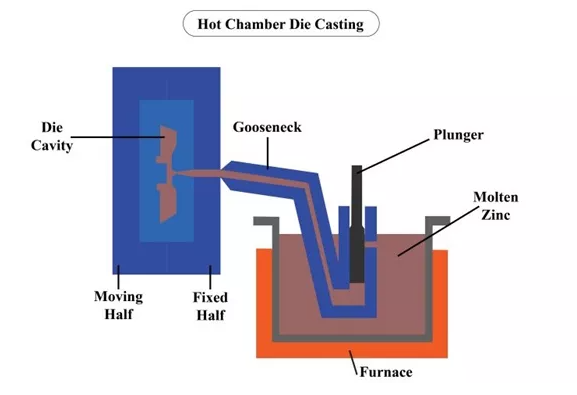
Hot Chamber Die Casting
The hot chamber die casting process is ideal for materials with low melting points, such as magnesium alloys, tin, zinc, and lead. This is done to prevent damaging the pump, which could occur when it comes into contact with metals or alloys with a higher melting point. The injection of the melted metal into the die is achieved by applying pressure from a hydraulic system.
Cold Chamber Die Casting
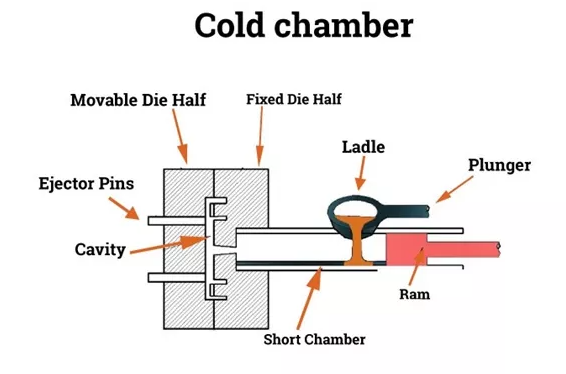
Cold chamber die casting is the ideal method when working with materials that have a high melting point, like aluminum. Since the high temperature required to melt these materials can damage the pumping system, this procedure is perfect for such metals.
This is a high-pressure die casting process that involves pouring the melted material into a cold chamber and then injecting it into the die. The hydraulic system used in a cold chamber process is similar to that used in a hot chamber process. However, a higher pressure of between 2000 and 20000 psi could be necessary.
Different Variations of Die Casting
The following variations were suitable to tackle defects, mishaps, distortions, and other problems that might arise during the casting process.
Semisolid Die Casting(SSDC)
This process, also known as thixoforming, involves heating the shot, which consists of small pieces, to the liquid-solid phase transition temperature (the thixotropic state). This allows the pressure to feed the material into the cavity. Since most of the melt expansion occurs at or shortly after phase change, this process minimizes shrinkage, shortens processing times, and increases precision due to the lower operating temperature.
Vacuum Die Casting
It is a special way to make high-quality metal parts with better precision. The charge is sucked up by a tool placed above the molten reservoir, using a vacuum delivered to the cavity. They remove the air and gases from the mold before pouring in the hot metal. This makes the parts better and more precise.
Vacuum die casting is commonly done with aluminum and magnesium. It helps create strong and detailed parts that are used in cars, airplanes, and electronics.
Squeeze Die Casting
In this process, the tool is filled and then squeezed shut, forcing the fill into small cavity sections that wouldn’t typically fill easily. This casting is ideal for use with metals with a high level of viscosity like zinc, nickel, and copper.
Gravity or Low-pressure Die Casting
This less intricate method reduces tooling costs and equipment complexity by allowing parts with thicker portions to be low-pressure cast using gravity-fed (or even hand-ladled) fill. Ideally, this method should be used with symmetrical, round aluminum die casting components.
Benefits and Limitations of Die Casting Process
Die casting is one of the fastest and least expensive production methods. A single mold can produce hundreds of thousands of pieces that are both precise and dimensionally perfect. Below are some benefits and limitations of die casting.
Optimize Die Design
Optimizing your die design is one way to ensure high-quality products. Factors such as wall thickness, draft angles, and filets should be taken into account to ensure that your part can be easily ejected from the mold. Also, take into consideration the positioning of gates and runners to ensure the molten metal can smoothly enter the cavity and doesn’t leave any gaps or flaws.
Quality Control
Putting into practice efficient quality control procedures in producing high-quality die cast parts. This entails keeping an eye on the process parameters, checking the parts for flaws, and acting appropriately as necessary. Additionally, to see trends and make data-driven choices, think about putting statistical process control (SPC) techniques into practice.
Surface Finish Options for Die Casting
To ensure longevity, protection, or an appealing appearance, die cast parts need to be well-finished on the exterior. Various finishing options are available for die-cast items.
Powder Coating
Powder coating involves placing charged particles on the surface of the die-cast component. This method is ideal because it is uniform, offers better control over thickness, and hides minor imperfections on the die-cast surface.
Plating
Plating is another way to give die-cast parts a desirable surface finish. Like ceramic coating, the finish here is a thin layer. Both plating processes can enhance the product’s aesthetics and sometimes its conductivity.
Antiquing
This type of surface finishing, best suited for zinc casting, gives the cast an aged look. It involves coating the casting with a colored material, such as copper sulfide after it has been electroplated with copper or other alloys.
Painting
For many materials, It serves as additional protection or simply for decoration. Before applying the paint, it is optimal to clean the metal surface to remove any contaminants like oil and apply an undercoat (primer), which aids in adherence.
Die Casting Products in Different Industries
Die casting is a process used to create a range of highly functional and truly unique parts. Here are a few applications of these products.
- Automotive: Transmission cases gladhands, miniature engines, gears, and other specialized parts required in the automotive industry are made using this technology.
- Aerospace: The aerospace industry requires metal components to be lightweight, of superior quality, and capable of meeting strict quality standards. Die casting is an affordable way to meet this requirement.
- Consumer and Industrial Products: Using this method, consumer parts such as heat sinks, connecting rods, compressor pistons, and sink faucets can all be made.