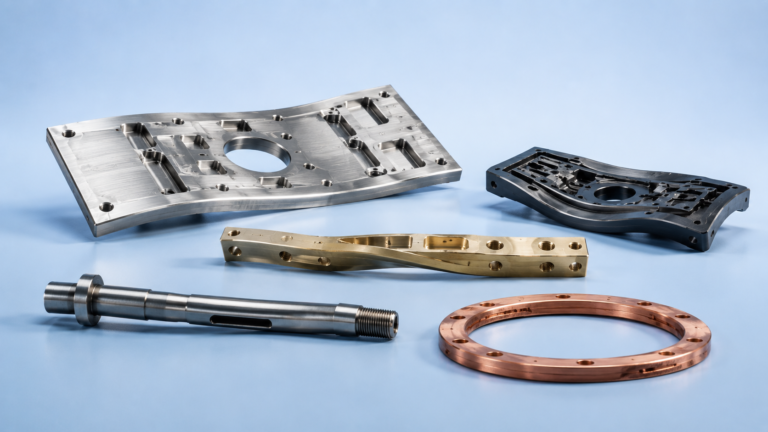
Material density is one of the most important physical properties used in engineering, manufacturing, and product design. It tells us how much mass is contained in a certain volume of material.
In simple words, density helps answer one practical question:
How heavy will this material be for a given size?
This is important when choosing materials for CNC machining, sheet metal fabrication, casting, injection molding, 3D printing, construction, transport, aerospace, and many other applications.
Two parts may have the same shape and size, but if they are made from different materials, their weight can be very different. A steel part will be much heavier than an aluminum part of the same volume. A plastic part will usually be lighter than both.
Understanding density helps engineers, buyers, and manufacturers estimate weight, compare material options, reduce costs, improve performance, and avoid design problems.
What Is Material Density?
Material density is the amount of mass in a specific volume of material.
The basic formula is:
Density = Mass / Volume
Or:
ρ = m / V
Where:
- ρ = density
- m = mass
- V = volume
Density is usually expressed in:
- kg/m³ — kilograms per cubic meter
- g/cm³ — grams per cubic centimeter
- lb/in³ — pounds per cubic inch
- lb/ft³ — pounds per cubic foot
For engineering and manufacturing, kg/m³ and g/cm³ are the most common units.
Simple Example of Density
Imagine two blocks with exactly the same size:
- one block is made from aluminum
- one block is made from steel
Both blocks have the same volume, but the steel block will be much heavier because steel has a higher density.
Typical values:
- Aluminum: about 2.7 g/cm³
- Steel: about 7.85 g/cm³
This means steel is almost three times heavier than aluminum for the same part volume.
That is why aluminum is often chosen when weight reduction is important, while steel is selected when strength, stiffness, and cost are more important.
Why Density Matters in Manufacturing
Density is not just a theoretical material property. It directly affects real manufacturing decisions.
In production, density helps calculate:
- part weight
- shipping weight
- raw material usage
- material cost
- structural load
- machine handling requirements
- product performance
- energy efficiency
- assembly weight
- packaging and transport cost
For example, if a company needs to produce 10,000 machined parts, even a small difference in material density can strongly affect total material cost and logistics.
A lightweight material may reduce shipping cost and improve product usability. A denser material may improve durability, stability, or vibration resistance.
Density and Material Selection
Density is often one of the first properties checked during material selection.
Engineers rarely choose a material based only on density, but density strongly influences the final decision together with:
- strength
- hardness
- stiffness
- corrosion resistance
- temperature resistance
- machinability
- weldability
- surface treatment options
- price
- availability
For example:
- Aerospace parts often need low-density materials.
- Machine bases may need high-density materials for stability.
- Automotive parts often require a balance of strength and low weight.
- Plastic parts may be selected to reduce weight and cost.
- Stainless steel may be chosen when corrosion resistance is more important than weight.
The correct material is not always the lightest or the strongest. It is the material that best fits the application.
Density of Common Engineering Materials
Different material groups have very different density ranges.
| Material | Approximate Density |
|---|---|
| Aluminum | 2.7 g/cm³ |
| Magnesium | 1.7–1.8 g/cm³ |
| Titanium | 4.5 g/cm³ |
| Steel | 7.85 g/cm³ |
| Stainless steel | 7.7–8.0 g/cm³ |
| Copper | 8.9 g/cm³ |
| Brass | 8.4–8.7 g/cm³ |
| Bronze | 7.4–8.9 g/cm³ |
| Zinc | 7.1 g/cm³ |
| Lead | 11.3 g/cm³ |
| ABS plastic | 1.0–1.1 g/cm³ |
| Nylon | 1.1–1.2 g/cm³ |
| POM / Acetal | 1.4 g/cm³ |
| PTFE | 2.1–2.2 g/cm³ |
These values are typical reference values. Actual density can vary depending on alloy grade, composition, porosity, temperature, filler content, and manufacturing method.
Density of Metals
Metals usually have higher density than plastics, wood, foam, and composite materials. However, there are big differences between different metals.
Steel Density
Steel has a typical density of around 7.85 g/cm³.
It is strong, widely available, relatively affordable, and suitable for many manufacturing processes. Because of its density, steel parts are heavier than aluminum or plastic parts of the same size.
Steel is often used for:
- machine frames
- brackets
- shafts
- gears
- structural parts
- welded assemblies
- heavy-duty components
Steel is a good choice when strength, stiffness, cost, and durability are more important than weight.
Stainless Steel Density
Stainless steel usually has a density of around 7.7–8.0 g/cm³, depending on the grade.
It is similar in weight to carbon steel but offers much better corrosion resistance. This makes stainless steel useful for food processing, medical equipment, marine parts, chemical equipment, and outdoor applications.
Common uses include:
- machined components
- tanks
- fittings
- fasteners
- medical tools
- food industry parts
- marine hardware
Stainless steel is heavier than aluminum but provides excellent durability in demanding environments.
Aluminum Density
Aluminum has a density of about 2.7 g/cm³.
This makes it much lighter than steel. Aluminum is widely used when weight reduction is important but the part still needs good strength and machinability.
Common uses include:
- aerospace components
- automotive parts
- machine covers
- brackets
- housings
- profiles
- fixtures
- electronic enclosures
Aluminum is also easy to machine and can be anodized for improved corrosion resistance and appearance.
Titanium Density
Titanium has a density of about 4.5 g/cm³.
It is heavier than aluminum but much lighter than steel. Titanium has an excellent strength-to-weight ratio and very good corrosion resistance.
It is commonly used in:
- aerospace parts
- medical implants
- racing components
- marine parts
- chemical industry parts
- high-performance fasteners
Titanium is more expensive and more difficult to machine than aluminum or steel, but it is valuable where performance is critical.
Copper Density
Copper has a density of about 8.9 g/cm³.
It is heavier than steel and aluminum, but it has excellent electrical and thermal conductivity.
Copper is used for:
- electrical contacts
- busbars
- heat exchangers
- connectors
- conductive parts
- plumbing components
- decorative parts
Copper is selected when conductivity is more important than weight.
Brass and Bronze Density
Brass and bronze are copper-based alloys. Their density is usually around 8.4–8.9 g/cm³, depending on composition.
They are heavier than steel in many cases and much heavier than aluminum.
Common uses include:
- bushings
- bearings
- fittings
- valves
- decorative parts
- marine components
- gears
- electrical parts
Brass and bronze are valued for machinability, corrosion resistance, low friction, and appearance.
Density of Plastics
Plastics usually have much lower density than metals. This is one reason they are widely used for lightweight and cost-effective products.
Typical plastic densities:
- ABS: around 1.0–1.1 g/cm³
- Nylon: around 1.1–1.2 g/cm³
- POM / Acetal: around 1.4 g/cm³
- Polycarbonate: around 1.2 g/cm³
- PTFE: around 2.1–2.2 g/cm³
- Polypropylene: around 0.9 g/cm³
Plastics are often selected for:
- lightweight parts
- electrical insulation
- low-friction components
- consumer products
- housings
- covers
- gears
- wear pads
- chemical-resistant parts
However, plastics generally have lower stiffness, lower temperature resistance, and lower strength than metals. The final choice depends on the part requirements.
Density and Weight Calculation
Density is very useful for calculating part weight before manufacturing.
The basic formula is:
Mass = Density × Volume
For example, if you know the volume of a CNC machined part and the density of the material, you can estimate the final weight.
This is useful for:
- RFQs
- material purchasing
- transport planning
- packaging
- cost estimation
- structural analysis
- comparing material alternatives
Example Calculation
Suppose a part has a volume of 100 cm³.
If the part is made from aluminum:
Mass = 2.7 g/cm³ × 100 cm³ = 270 g
If the same part is made from steel:
Mass = 7.85 g/cm³ × 100 cm³ = 785 g
The steel part is almost three times heavier than the aluminum part.
This simple calculation can strongly influence material selection.
Density and CNC Machining
In CNC machining, density affects both the final part weight and sometimes the machining process.
High-density materials may require stronger workholding, more careful handling, and more energy during machining. Low-density materials are easier to handle but may still require careful cutting conditions depending on hardness, strength, and thermal behavior.
Density also affects quoting. A heavier material may increase raw material cost and shipping cost, even if the machining time is similar.
For CNC machined parts, density matters when calculating:
- blank weight
- finished part weight
- shipping cost
- machine load
- fixture design
- assembly weight
- material cost
- product performance
For example, replacing steel with aluminum can significantly reduce part weight, but the design must still meet strength and stiffness requirements.
Density and Casting
In casting, density helps estimate the amount of molten metal needed to fill a mold. It also affects final casting weight and material cost.
High-density metals produce heavier castings. This may be good for stability, but it can increase handling and transport costs.
Density is also important when checking casting defects. Porosity, shrinkage, and voids can reduce the actual density of a cast part. If a casting is lighter than expected, it may indicate internal defects or incomplete filling.
Common casting materials include:
- aluminum alloys
- cast iron
- steel
- bronze
- brass
- zinc alloys
Each has a different density and therefore a different final part weight.
Density and Injection Molding
In injection molding, density helps calculate part weight, shot size, material usage, and cost.
Plastic density is especially important when producing large quantities. A small difference in weight per part can become significant over thousands or millions of parts.
For example, if one plastic material saves only 5 grams per part, this can save 50 kg of material over 10,000 parts.
Density also affects:
- cycle planning
- packaging weight
- shipping cost
- material consumption
- product feel
- strength-to-weight balance
Some plastics also contain fillers, such as glass fiber or mineral additives, which increase density and change mechanical properties.
Density and 3D Printing
In 3D printing, density affects part weight, material usage, cost, and print performance.
For polymer 3D printing, density depends on the material and also on infill percentage. A part printed with 20% infill will be much lighter than the same part printed solid.
For metal 3D printing, density is important for quality control. Porosity can reduce the density of the printed part and may affect strength, fatigue life, and pressure tightness.
Density is especially important for:
- aerospace parts
- lightweight prototypes
- functional printed parts
- medical components
- lattice structures
- topology-optimized designs
Density and Strength-to-Weight Ratio
Density alone does not tell whether a material is good or bad. It must be considered together with strength.
A useful concept is the strength-to-weight ratio. This compares how much strength a material provides relative to its weight.
For example:
- Steel is strong but dense.
- Aluminum is lighter but usually less strong.
- Titanium is strong and lighter than steel.
- Carbon fiber composites can be very light and strong in specific directions.
In transport, aerospace, robotics, and performance equipment, strength-to-weight ratio is often more important than density alone.
Density and Cost
Material cost is not only about price per kilogram. Density also matters.
A material with a higher price per kilogram may still be cost-effective if much less of it is needed by weight or if it reduces machining, transport, or assembly costs.
For example:
- Aluminum may cost more per kilogram than steel, but the finished part is lighter.
- Plastic may reduce both material and shipping cost.
- Titanium is expensive, but it may be justified for high-performance applications.
- Dense metals may increase logistics cost.
When comparing materials, it is better to look at the full cost of the finished part, not only raw material price.
Density and Product Design
Density affects how a product feels and performs.
A heavier part may feel stronger, more stable, and more premium. A lighter part may be easier to use, transport, install, or move.
Examples:
- A machine base may need high weight for vibration damping.
- A handheld tool should be light enough for comfortable use.
- A vehicle component should reduce weight to improve efficiency.
- A counterweight needs high density in a compact size.
- A protective enclosure may need a balance between weight and durability.
Good product design uses density intentionally.
Factors That Can Affect Material Density
Density values in material tables are useful, but actual density may vary slightly.
Factors include:
- alloy composition
- temperature
- porosity
- moisture content
- manufacturing process
- heat treatment
- fillers or additives
- coating or plating
- internal voids
- material grade
For most engineering calculations, standard density values are accurate enough. For critical applications, material certificates, laboratory testing, or supplier data should be used.
Difference Between Density and Specific Gravity
Density and specific gravity are related, but they are not the same.
Density is mass per unit volume.
Specific gravity compares the density of a material to the density of water.
If a material has a specific gravity greater than 1, it is denser than water. If it is less than 1, it is less dense than water.
For example:
- Polypropylene has a specific gravity below 1, so it can float in water.
- Steel has a specific gravity much higher than 1, so it sinks.
- Aluminum also sinks, but it is much lighter than steel.
Specific gravity is often used in plastics, liquids, and material comparison.
Density and Buoyancy
Density also affects whether an object floats or sinks.
An object floats if its average density is lower than the fluid around it. It sinks if its density is higher.
This is why a solid steel ball sinks in water, but a steel ship can float. The ship contains a large volume of air, so its average density is lower than water.
This principle is important in:
- marine engineering
- fluid systems
- tanks
- floating structures
- material testing
- product design
How to Measure Density
Density can be measured in different ways depending on the material type and part shape.
Common methods include:
Measuring Regular Shapes
For simple shapes, volume can be calculated from dimensions.
Example:
- cube
- cylinder
- rectangular block
- plate
- bar
- tube
Then the part is weighed, and density is calculated using mass divided by volume.
Water Displacement Method
For irregular shapes, volume can be measured by water displacement. The object is submerged, and the volume of displaced water is measured.
This method works well for solid, non-porous materials that do not absorb water.
Pycnometer Method
A pycnometer can be used for liquids, powders, and small solid samples.
Industrial Testing
In production, density can also be checked using specialized instruments, especially for plastics, powders, ceramics, castings, and additive manufacturing parts.
Practical Uses of Material Density
Material density is used in many everyday engineering and manufacturing tasks.
Common uses include:
- calculating part weight from CAD volume
- comparing aluminum and steel parts
- estimating raw material needs
- checking casting quality
- planning shipping and packaging
- selecting lightweight materials
- estimating injection molded part cost
- calculating counterweights
- checking buoyancy
- designing structural components
- comparing plastics with fillers
- estimating total assembly weight
For buyers and engineers, density is often needed during the quotation stage because it helps estimate material quantity and transport cost.
Common Mistakes When Using Density
Using the Wrong Units
Always make sure density, mass, and volume units match.
For example:
- g/cm³ works well with cm³ and grams
- kg/m³ works well with m³ and kilograms
Mixing units can create large calculation errors.
Ignoring Coatings or Plating
Surface treatments such as plating, coating, or anodizing can slightly change final weight. For most parts this is small, but for precision or large-volume production it may matter.
Assuming All Alloys Have the Same Density
Different grades of steel, aluminum, brass, or plastic can have slightly different densities.
Forgetting About Porosity
Castings, foams, sintered parts, and 3D printed parts may have internal porosity, which affects actual density.
Looking Only at Density
A low-density material is not automatically better. Strength, stiffness, temperature resistance, wear resistance, and cost must also be considered.
Choosing Materials Based on Density
When density matters, the best approach is to compare materials based on the full application.
Ask these questions:
- What is the maximum allowed weight?
- Does the part need high strength?
- Does it need high stiffness?
- Will it be machined, cast, molded, or printed?
- Is corrosion resistance required?
- Will the part be exposed to heat?
- Is electrical or thermal conductivity important?
- What is the target cost?
- How many parts will be produced?
- Does the part need surface treatment?
- How important is shipping weight?
For lightweight parts, aluminum, magnesium, plastics, or composites may be suitable.
For heavy-duty parts, steel, stainless steel, brass, bronze, or cast iron may be better.
For high-performance parts, titanium or advanced composites may be considered.
Material Density Comparison:
Lightweight Materials
Lightweight materials are useful when reducing weight improves performance, handling, or efficiency.
Examples:
- magnesium
- aluminum
- plastics
- carbon fiber composites
- foam materials
Common applications:
- aerospace
- automotive
- robotics
- consumer products
- portable tools
- transport equipment
Heavy Materials
High-density materials are useful when weight, stability, or compact mass is needed.
Examples:
- steel
- stainless steel
- copper
- brass
- bronze
- lead
- tungsten
Common applications:
- counterweights
- machine bases
- vibration damping
- electrical conductors
- radiation shielding
- heavy-duty components
FAQ About Material Density
What is material density?
Material density is the amount of mass contained in a specific volume of material. It is calculated by dividing mass by volume.
What is the formula for density?
The formula is:
Density = Mass / Volume
or:
ρ = m / V
Why is density important in engineering?
Density helps engineers estimate part weight, compare materials, calculate material usage, reduce weight, control costs, and design better products.
Which metal has low density?
Magnesium and aluminum are common low-density metals used in engineering. Titanium is heavier than aluminum but lighter than steel.
Which common metal has high density?
Copper, brass, bronze, stainless steel, and steel have relatively high densities. Lead and tungsten are even denser.
Is steel denser than aluminum?
Yes. Steel is about 7.85 g/cm³, while aluminum is about 2.7 g/cm³. Steel is almost three times heavier than aluminum for the same volume.
Does density affect strength?
Density does not directly define strength, but it affects strength-to-weight ratio. A material can be dense and strong, light and weak, or light and strong depending on its properties.
Does density affect machining?
Density can affect part weight, handling, material cost, and fixture design. However, machinability also depends on hardness, toughness, thermal conductivity, and material structure.
How do you calculate the weight of a part?
Calculate or measure the part volume, then multiply it by the material density:
Mass = Density × Volume
Can density vary for the same material?
Yes. Density can vary slightly depending on alloy composition, fillers, porosity, moisture, temperature, and manufacturing method.
Conclusion
Material density is a simple but important property in engineering and manufacturing. It tells how much mass a material has for a given volume and helps calculate part weight, compare material options, estimate cost, and improve product design.
Density is especially important in CNC machining, casting, injection molding, 3D printing, structural design, transport, and product development. A material with lower density can reduce weight, while a high-density material can provide stability, durability, or compact mass.
The best material choice depends not only on density, but also on strength, stiffness, corrosion resistance, machinability, cost, surface treatment, and the final application. When used correctly, density is a practical tool for better material selection and more accurate manufacturing planning.