Screw threads are one of the most important features in mechanical design. They are found on bolts, nuts, screws, pipe fittings, lead screws, machine tools, bottle caps, medical devices, automotive parts, aerospace fasteners, and countless industrial components.
At first glance, many threads look similar. A bolt may appear to be just a bolt, and a threaded fitting may seem simple enough to match by eye. In reality, screw threads vary by shape, angle, pitch, direction, diameter, tolerance, and standard. Choosing the wrong thread can cause poor fit, stripped parts, leaks, vibration failure, or unsafe assemblies.
This guide explains the main types of screw threads, how they work, where they are used, and how to identify them correctly.
What Is a Screw Thread?
A screw thread is a continuous helical ridge formed around the outside or inside of a cylindrical part. The ridge wraps around the part in a spiral pattern, allowing two components to engage when one is rotated.
There are two basic thread positions:
| Thread Type | Description | Example |
|---|---|---|
| External thread | Thread formed on the outside of a part | Bolt, screw, threaded rod |
| Internal thread | Thread formed inside a hole or bore | Nut, tapped hole, pipe fitting |
When an external thread turns into an internal thread, rotation is converted into axial movement. This allows threaded parts to clamp, adjust, lift, seal, or transmit force.
In simple terms, a thread works like an inclined plane wrapped around a cylinder. Each turn moves the part forward or backward depending on the thread direction and pitch.
Why Screw Thread Types Matter
Thread selection affects how a part performs. A thread used for fastening is not always suitable for sealing. A thread designed for power transmission may not be the best choice for vibration resistance. A pipe thread may look similar to a bolt thread but function completely differently.
The correct thread type helps determine:
- How tightly two parts clamp together
- Whether a joint can resist vibration
- Whether a connection can seal fluid or gas
- How much axial force a screw can transmit
- How fast a part moves per rotation
- How easy the thread is to manufacture
- Whether the thread is compatible with international standards
- How long the assembly will last in service
For example, ISO metric threads are common in global manufacturing, UNC and UNF threads are common in North America, Acme threads are used in lead screws, and tapered pipe threads are used for sealing pressurized connections.
Key Screw Thread Terms
Before comparing thread types, it helps to understand the main thread measurements.
| Thread Term | Meaning | Why It Matters |
|---|---|---|
| Major diameter | Largest diameter of the thread, measured across the crests | Main size reference for external threads |
| Minor diameter | Smallest diameter, measured at the thread roots | Affects strength and core material thickness |
| Pitch | Distance between two adjacent thread crests | Controls travel per turn and thread spacing |
| TPI | Threads per inch | Imperial thread spacing measurement |
| Lead | Distance a screw advances in one full turn | Important for motion and power screws |
| Thread angle | Angle between the thread flanks | Affects strength, friction, and compatibility |
| Crest | Top of the thread ridge | Contact and wear surface |
| Root | Bottom of the thread groove | Stress concentration area |
| Flank | Side face of the thread | Transfers load between mating parts |
| Helix angle | Angle of the thread spiral relative to the axis | Affects efficiency and self-locking behavior |
Pitch vs. Lead
Pitch and lead are often confused.
For a single-start thread, pitch and lead are the same. One full rotation advances the screw by one pitch.
For a multi-start thread, lead is greater than pitch. A double-start thread advances two pitches per turn, while a triple-start thread advances three pitches per turn.
Main Types of Screw Threads
Screw threads can be classified by profile shape, thread standard, direction, geometry, and number of starts. The most important types include:
- Unified threads
- ISO metric threads
- V-shaped threads
- Whitworth threads
- Acme threads
- Square threads
- Buttress threads
- Knuckle threads
- Pipe threads
- Worm threads
- Right-hand and left-hand threads
- Single-start and multi-start threads
Each type has a specific purpose.
1. Unified Thread Standard: UNC and UNF Threads
The Unified Thread Standard is an inch-based thread system widely used in the United States and Canada. It includes several thread series, but the two most common are UNC and UNF.
UNC Thread
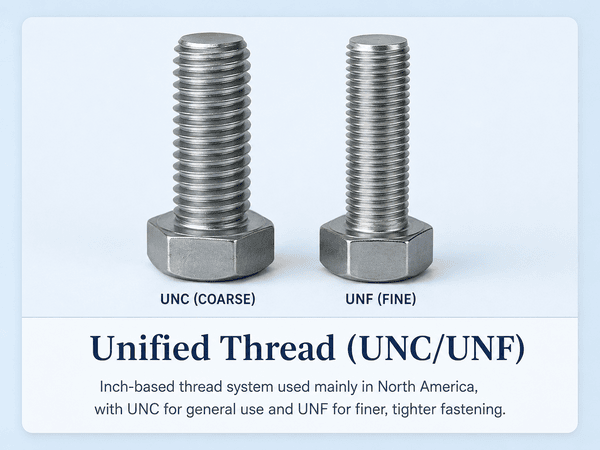
UNC stands for Unified National Coarse. It has fewer threads per inch than a fine thread of the same diameter.
UNC threads are commonly used for:
- General fasteners
- Structural bolts
- Machine screws
- Construction hardware
- Automotive and industrial parts
- Parts that require quick assembly
Coarse threads are easier to install and less likely to cross-thread. They also perform better in softer materials because deeper thread engagement provides better grip.
UNF Thread
UNF stands for Unified National Fine. It has more threads per inch than UNC.
UNF threads are used when:
- Better vibration resistance is needed
- Higher tensile strength is required
- More precise adjustment is important
- The part has limited thread engagement length
- Aerospace or high-performance fasteners are involved
Fine threads have a smaller helix angle, which helps resist loosening under vibration. They are also useful where precise clamping force is required.
Example of Unified Thread Designation
A thread marked:
1/4″-20 UNC
means:
| Part | Meaning |
|---|---|
| 1/4″ | Nominal diameter |
| 20 | 20 threads per inch |
| UNC | Unified National Coarse |
A thread marked:
1/4″-28 UNF
means:
| Part | Meaning |
|---|---|
| 1/4″ | Nominal diameter |
| 28 | 28 threads per inch |
| UNF | Unified National Fine |
2. ISO Metric Threads
ISO metric threads are the most widely used thread system in global manufacturing. They are identified by the letter M, followed by the nominal diameter in millimeters.
For example:
M10 × 1.5
means:
| Part | Meaning |
|---|---|
| M | Metric thread |
| 10 | 10 mm nominal diameter |
| 1.5 | 1.5 mm pitch |
Metric threads are used in:
- Automotive parts
- Electronics
- Machinery
- Consumer products
- Medical devices
- Industrial equipment
- CNC-machined components
- Global manufacturing assemblies
Metric Coarse Threads
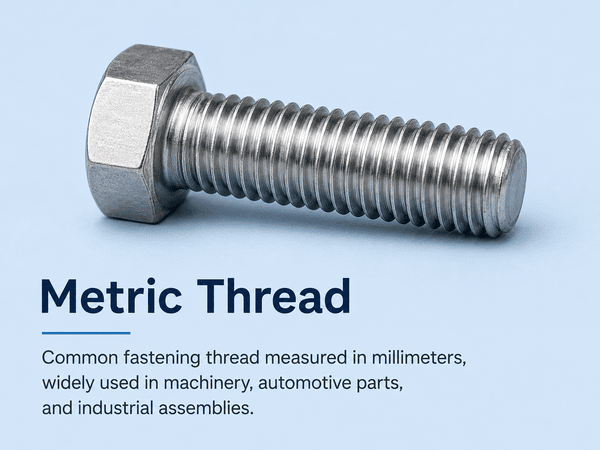
Metric coarse threads are the standard choice for general assembly. If no pitch is specified, the thread is usually assumed to be coarse for that diameter.
Coarse metric threads are preferred for:
- Standard bolts and nuts
- General machine assembly
- Softer materials
- Fast installation
- Parts exposed to dirt or damage
Metric Fine Threads
Metric fine threads have a smaller pitch. They are used when greater adjustment precision, improved vibration resistance, or higher clamping control is needed.
Metric fine threads are common in:
- Engine components
- Precision instruments
- Aerospace assemblies
- Hydraulic fittings
- Thin-walled components
- High-load fasteners
Metric vs. Unified Threads
Metric and Unified threads are not interchangeable. Even when diameters look similar, pitch and thread form may not match. For example, an M12 bolt and a 1/2-inch bolt are close in size but belong to different thread systems.
Trying to force one system into the other can damage the threads, reduce strength, or create an unsafe assembly.
3. V-Shaped Threads
V-shaped threads are the most common thread profile used for fastening. The thread cross-section forms a “V” shape, creating strong contact between the mating parts.
V-threads are used in:
- Bolts
- Screws
- Nuts
- Machine fasteners
- Automotive parts
- Furniture hardware
- General mechanical assemblies
Most ISO metric and Unified threads are based on a 60-degree V profile. Whitworth-family threads use a 55-degree angle.
Advantages of V-Shaped Threads
- Good clamping strength
- Easy to manufacture
- Works well for general fastening
- Good resistance to loosening
- Compatible with taps, dies, and thread rolling
- Available in many sizes and standards
Limitations of V-Shaped Threads
V-shaped threads are excellent for fastening, but they are less efficient for power transmission. Their angled flanks create radial forces and friction, which makes them less suitable for lead screws, jacks, and motion-control applications.
For moving loads, Acme, square, or ball screw systems are usually better.
4. British Standard Whitworth Threads
British Standard Whitworth, often abbreviated as BSW, is an older British thread standard. It was one of the first widely standardized screw thread systems.
The main feature of Whitworth threads is the 55-degree thread angle. This makes them different from ISO metric and Unified threads, which normally use a 60-degree angle.
Whitworth threads may still be found in:
- Older British machinery
- Classic vehicles
- Restoration projects
- Legacy equipment
- Some pipe-thread-related applications
- Vintage tools and mechanical parts
BSW vs. BSF vs. BSP
Whitworth-family threads include several related standards:
| Standard | Meaning | Common Use |
|---|---|---|
| BSW | British Standard Whitworth | General legacy fastening |
| BSF | British Standard Fine | Fine-thread legacy fasteners |
| BSP | British Standard Pipe | Pipe fittings and fluid connections |
| BSPT | British Standard Pipe Taper | Tapered sealing pipe threads |
Whitworth threads are not the same as metric or Unified threads. A similar-looking part may start to engage but fail to seat correctly.
5. Acme Threads
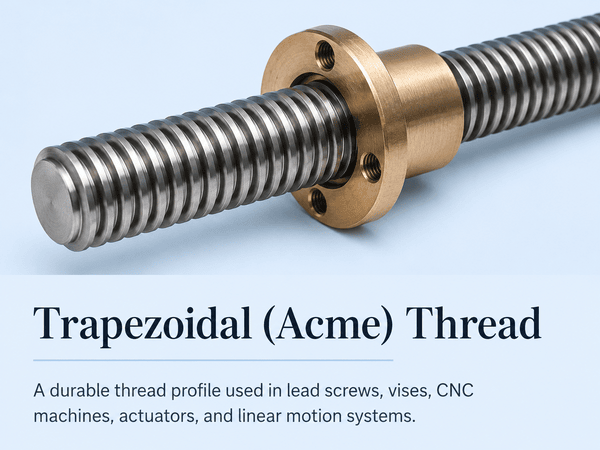
Acme threads have a trapezoidal profile with flat crests and roots. They are designed mainly for power transmission rather than ordinary fastening.
Acme threads are commonly used in:
- Lead screws
- CNC machine tools
- Lathe carriages
- Bench vises
- Screw jacks
- Clamps
- Linear actuators
- Adjustment mechanisms
The Acme profile provides a good balance between strength, efficiency, and manufacturability. It is easier to produce than a square thread but more efficient than a V-thread for moving loads.
Why Acme Threads Are Useful
Acme threads have wide, flat flanks that can carry heavy loads. They also allow the use of split nuts, which can engage and disengage from lead screws in machines such as lathes.
Advantages of Acme Threads
- Strong profile
- Good wear resistance
- Suitable for heavy loads
- Easier to manufacture than square threads
- Better power transmission than V-threads
- Works with split-nut mechanisms
Limitations of Acme Threads
- More friction than ball screws
- Not as efficient as square threads
- May require lubrication
- Can develop backlash over time
6. Square Threads
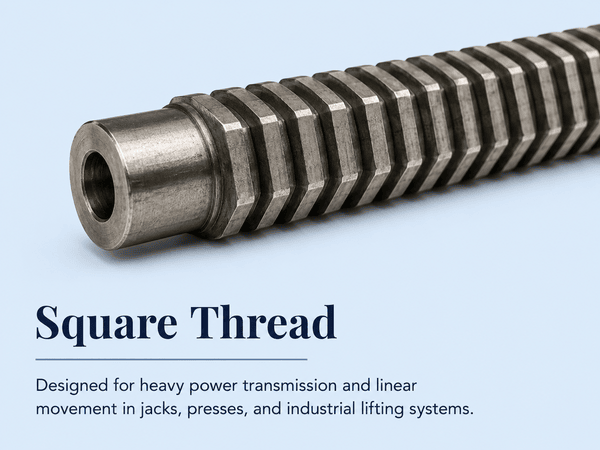
Square threads have a square-shaped profile with flanks that are nearly perpendicular to the thread axis. This design is highly efficient for transmitting power because it directs force along the axis with minimal radial load.
Square threads are used in:
- Heavy screw jacks
- Presses
- Large valve stems
- Industrial lifting mechanisms
- High-load power screws
- Specialized machinery
Advantages of Square Threads
- Very high mechanical efficiency
- Excellent for axial load transmission
- Low friction compared with V-threads
- Good for lifting and pressing applications
Limitations of Square Threads
Despite their efficiency, square threads are not as common as Acme threads because they are harder and more expensive to manufacture. They are also more difficult to inspect, machine accurately, and maintain.
Square threads are usually selected only when high efficiency is more important than manufacturing cost.
7. Buttress Threads
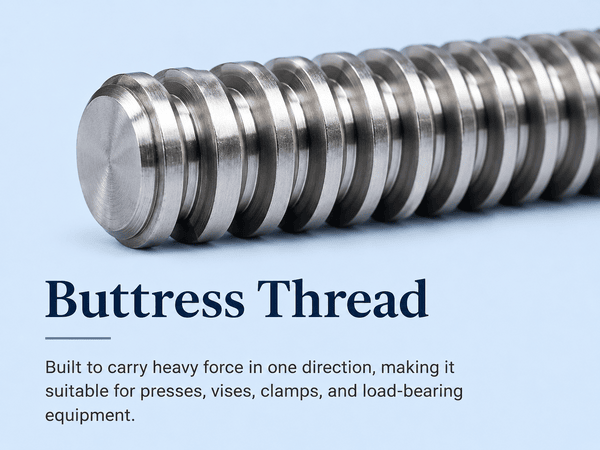
Buttress threads are asymmetrical. One side of the thread is nearly vertical to handle heavy axial loads, while the other side is angled to make manufacturing easier and reduce friction during return movement.
Buttress threads are ideal when force acts mainly in one direction.
Common applications include:
- Heavy-duty vises
- Artillery mechanisms
- Aircraft propeller hubs
- Hydraulic presses
- Jack screws
- Injection molding machinery
- Large clamps
- Load-bearing mechanical assemblies
Why Buttress Threads Are Different
A buttress thread acts like a one-direction load wall. The strong load flank resists high thrust, while the sloped back flank allows easier movement when the load is released or reversed.
Advantages of Buttress Threads
- Excellent for high one-way axial loads
- Stronger in one direction than many other profiles
- More manufacturable than square threads
- Useful for heavy-duty industrial parts
Limitations of Buttress Threads
- Not ideal for reversing loads
- Direction of force must be known
- Less common than V or Acme threads
- Requires careful design and orientation
8. Knuckle Threads
Knuckle threads have rounded crests and roots. Instead of sharp or flat profiles, they use a smooth, rounded shape that resists damage and contamination.
Knuckle threads are often used in:
- Bottle caps
- Jar lids
- Hose couplings
- Railway couplings
- Fire hydrant fittings
- Plastic closures
- Rough-service connectors
- Cast or rolled components
Why Knuckle Threads Are Used
Knuckle threads are not designed for high precision. They are designed for durability, easy engagement, and tolerance of dirt, wear, or minor damage.
The rounded profile helps prevent thread chipping and makes the thread easier to form by casting, molding, rolling, or stamping.
Advantages of Knuckle Threads
- Resistant to damage
- Easy to clean
- Works well in dirty environments
- Good for repeated manual use
- Suitable for low-cost mass production
- Less likely to cross-thread in casual use
Limitations of Knuckle Threads
- Lower precision
- Lower load capacity
- Not suitable for high-strength bolted joints
- Not ideal for fine adjustment
9. Tapered Pipe Threads: NPT and BSPT
Tapered pipe threads are designed for sealing, not just fastening. Unlike straight threads, a tapered thread gradually changes diameter along its length.
As the male and female threads are tightened, the taper wedges them together. This helps create a pressure-resistant joint for liquids, gases, hydraulic systems, and pneumatic systems.
NPT Threads
NPT stands for National Pipe Thread. It is widely used in North America for pipe and fluid connections.
NPT threads are used in:
- Plumbing systems
- Gas lines
- Hydraulic fittings
- Pneumatic equipment
- Industrial piping
- Pumps and valves
BSPT Threads
BSPT stands for British Standard Pipe Taper. It is used in many regions outside North America, including Europe and parts of Asia.
BSPT threads are used in:
- Pipe fittings
- Hydraulic equipment
- Industrial fluid systems
- Gas connections
- HVAC systems
- Water systems
NPT vs. BSPT
NPT and BSPT may look similar, but they are not the same. They differ in thread angle and geometry. Mixing them can create leakage paths, especially in pressurized systems.
| Feature | NPT | BSPT |
|---|---|---|
| Common region | North America | Europe, UK, Asia, Australia |
| Thread angle | 60 degrees | 55 degrees |
| Thread shape | Tapered | Tapered |
| Main use | Pipe sealing | Pipe sealing |
| Interchangeable? | No | No |
For pipe systems, always verify the thread standard before assembly. A connection that feels tight is not always sealed correctly.
10. Worm Threads
A worm thread is used in a worm gear system. It looks like a screw that meshes with a gear wheel at an angle, usually 90 degrees.
Worm threads are used for:
- Gear reducers
- Lifting mechanisms
- Steering systems
- Conveyor drives
- Gate openers
- Tuning mechanisms
- Packaging machines
- Positioning equipment
How Worm Threads Work
When the worm rotates, it turns the worm wheel. This creates a high reduction ratio in a compact space. In many designs, the gear cannot easily drive the worm backward, which gives the mechanism a self-locking effect.
Advantages of Worm Threads
- High speed reduction
- Compact design
- Smooth motion
- Good for holding position
- Can prevent back-driving in many applications
Limitations of Worm Threads
- Lower efficiency than some gear systems
- Generates friction and heat
- Requires lubrication
- Wear can be an issue under heavy loads
11. Right-Hand and Left-Hand Threads
Threads can also be classified by direction.
Right-Hand Threads
Right-hand threads are the standard thread direction. They tighten when turned clockwise and loosen when turned counterclockwise.
Most screws, bolts, and nuts use right-hand threads.
Right-hand threads are used in:
- General fasteners
- Machine screws
- Structural bolts
- Consumer products
- Automotive assemblies
- Industrial equipment
Left-Hand Threads
Left-hand threads tighten counterclockwise and loosen clockwise. They are used when normal rotation would loosen a right-hand thread.
Left-hand threads are found in:
- Bicycle pedals
- Turnbuckles
- Some gas cylinder fittings
- Rotating shafts
- Grinding wheels
- Special mechanical assemblies
- Certain automotive and industrial components
How to Identify Left-Hand Threads
Left-hand threaded parts may be marked with:
- “LH”
- A notch on the nut or bolt head
- A groove around the fastener
- Special documentation or part markings
Never assume a stuck fastener is right-hand. If the part is used on rotating equipment, verify thread direction before applying force.
12. Single-Start and Multi-Start Threads
Threads can have one or more helical starts.
Single-Start Threads
A single-start thread has one continuous spiral ridge. Most standard bolts and screws are single-start.
Single-start threads are used when:
- Strong clamping is required
- Self-locking is important
- Assembly speed is not the main concern
- High holding force is needed
Multi-Start Threads
A multi-start thread has two or more separate thread spirals. These threads allow faster axial movement per revolution.
Types include:
| Type | Description | Advance Per Turn |
|---|---|---|
| Single-start | One thread path | 1 × pitch |
| Double-start | Two thread paths | 2 × pitch |
| Triple-start | Three thread paths | 3 × pitch |
| Quad-start | Four thread paths | 4 × pitch |
Multi-start threads are used in:
- Bottle caps
- Pen caps
- Medical connectors
- Quick-release fasteners
- Adjustment knobs
- Lead screws requiring fast travel
- Plastic closures
Advantages of Multi-Start Threads
- Faster assembly
- More travel per rotation
- Smooth engagement
- Useful for quick-opening closures
Limitations of Multi-Start Threads
- Less self-locking
- More complex to manufacture
- Requires careful matching between male and female parts
Thread Profiles Compared
The shape of a screw thread affects strength, efficiency, load direction, and manufacturability.
| Thread Profile | Shape | Best For | Main Advantage |
|---|---|---|---|
| V-thread | Triangular | General fastening | Strong clamping and easy manufacturing |
| Acme thread | Trapezoidal | Lead screws and motion | Good strength and efficiency |
| Square thread | Square | Power transmission | Very high efficiency |
| Buttress thread | Asymmetric | One-direction heavy loads | Excellent axial load capacity |
| Knuckle thread | Rounded | Rough handling and closures | Damage resistance |
| Worm thread | Screw-like gear thread | Gear reduction | Compact motion transmission |
| Tapered pipe thread | Tapered V-form | Sealing | Leak-resistant pipe joints |
Common Screw Thread Standards
Thread standards make sure fasteners and threaded parts fit correctly. Without standards, a bolt from one manufacturer might not fit a nut from another.
| Standard | Units | Thread Angle | Common Region | Typical Use |
|---|---|---|---|---|
| ISO Metric | mm | 60° | Global | General fastening |
| UNC | inch/TPI | 60° | North America | General fastening |
| UNF | inch/TPI | 60° | North America | Fine fasteners, vibration resistance |
| BSW | inch/TPI | 55° | UK legacy | Older machinery |
| BSP | inch/TPI | 55° | UK, Europe, Asia | Pipe fittings |
| NPT | inch/TPI | 60° | North America | Pipe sealing |
| Acme | inch or metric | 29° common | Industrial | Lead screws, jacks, vises |
| API | inch/TPI | Varies by type | Oil and gas | Casing, tubing, drill pipe |
| UNJ / MJ | inch or metric | 60° modified | Aerospace | Fatigue-critical fasteners |
How to Identify a Screw Thread
Identifying a screw thread requires more than guessing by appearance. The safest method is to measure the thread and compare it to a standard chart.
Tools Needed
- Digital caliper
- Thread pitch gauge
- Thread angle gauge
- Thread identification chart
- Good lighting
- Magnifier, if needed
Step 1: Check External or Internal Thread
First, determine whether the thread is external or internal.
External threads are measured across the outside crests. Internal threads are measured across the inside opening or with dedicated thread gauges.
Step 2: Measure the Major Diameter
Use calipers to measure the outside diameter of an external thread. For example, a metric bolt measuring around 10 mm may be an M10 thread.
For inch threads, convert the measurement if needed. A thread around 0.250 inch may be a 1/4-inch thread.
Step 3: Measure the Pitch or TPI
For metric threads, measure pitch in millimeters. For example, M8 × 1.25 has a 1.25 mm pitch.
For imperial threads, count threads per inch. For example, 1/4″-20 UNC has 20 threads per inch.
A thread pitch gauge is the fastest tool. Match the gauge leaf to the thread until it seats cleanly with no visible gaps.
Step 4: Check the Thread Angle
Most metric and Unified threads use a 60-degree profile. Whitworth and BSP threads use a 55-degree profile.
If a thread looks close but does not seat properly with the gauge, the angle may be different.
Step 5: Check Whether the Thread Is Tapered
Pipe threads may be tapered. Measure the diameter at multiple points along the threaded section. If the diameter changes, the thread may be tapered.
Tapered threads are common in pipe, gas, hydraulic, and pneumatic fittings.
Step 6: Match the Measurements to a Standard
Once you know diameter, pitch or TPI, angle, and taper, compare the values to a thread chart.
Examples:
| Measurement | Likely Thread |
|---|---|
| 10 mm diameter, 1.5 mm pitch | M10 × 1.5 |
| 1/4 inch diameter, 20 TPI | 1/4″-20 UNC |
| 1/4 inch diameter, 28 TPI | 1/4″-28 UNF |
| Tapered pipe fitting, 60° angle | NPT |
| Tapered pipe fitting, 55° angle | BSPT |
How to Choose the Right Screw Thread Type
Choosing the correct screw thread depends on what the thread must do. A fastening thread, motion thread, and sealing thread are not the same.
For General Fastening
Use:
- ISO metric coarse for global applications
- UNC for North American inch-based assemblies
- UNF or metric fine when vibration resistance is needed
Best applications:
- Bolts
- Nuts
- Screws
- Machine assemblies
- Frames
- Brackets
- Automotive components
For High Vibration
Use:
- UNF threads
- Metric fine threads
- Proper locking features such as locknuts, threadlocker, washers, or safety wire where required
Best applications:
- Engines
- Aerospace parts
- Pumps
- Motors
- Vehicles
- Precision machinery
For Power Transmission
Use:
- Acme threads
- Square threads
- Ball screws
- Buttress threads for one-way loads
Best applications:
- Lead screws
- Jacks
- Clamps
- Linear actuators
- CNC machines
- Presses
For Pipe and Fluid Sealing
Use:
- NPT for North American pipe systems
- BSP or BSPT where that standard is required
- Sealants, tapes, O-rings, or gaskets depending on the thread design
Best applications:
- Plumbing
- Hydraulics
- Pneumatics
- Gas connections
- HVAC
- Industrial fluid lines
For Quick Assembly
Use:
- Multi-start threads
- Knuckle threads
- Coarse threads
- Plastic molded threads
Best applications:
- Bottle caps
- Medical connectors
- Consumer products
- Access covers
- Quick-release parts
For Heavy One-Way Loads
Use:
- Buttress threads
Best applications:
- Presses
- Heavy vises
- Lifting equipment
- Load-bearing spindles
- Industrial clamping systems
Applications of Screw Threads by Industry
Screw threads are used across almost every manufacturing sector.
| Industry | Common Thread Types | Typical Applications |
|---|---|---|
| Automotive | ISO metric, metric fine, pipe threads | Engine bolts, chassis, sensors, fittings |
| Aerospace | UNF, UNJ, MJ, fine threads | Structural fasteners, fatigue-critical joints |
| CNC machining | Acme, ball screw, metric | Lead screws, fixtures, machine components |
| Oil and gas | API, NPT, BSPT | Pipe, casing, valves, pressure fittings |
| Medical | Metric fine, custom threads | Instruments, implants, adjustment devices |
| Consumer products | Knuckle, multi-start, plastic threads | Caps, closures, housings |
| Construction | UNC, metric, coarse threads | Anchors, bolts, threaded rods |
| Marine | Metric, UNC, pipe threads | Hardware, fittings, pumps, valves |
| Electronics | Metric small screws | Enclosures, connectors, mounting hardware |
| Industrial machinery | Acme, square, buttress, metric | Jacks, vises, presses, actuators |
Common Thread Selection Mistakes
Thread mistakes can be expensive and dangerous. The most common problems include:
Mixing Metric and Inch Threads
Metric and inch threads can sometimes look close enough to start by hand. However, the pitch and diameter usually do not match correctly. Tightening them can strip the thread.
Mixing NPT and BSP Threads
NPT and BSP fittings may appear similar, but the thread angle and geometry differ. Using the wrong fitting can cause leaks.
Choosing Fine Threads for Dirty Environments
Fine threads are more precise but less tolerant of dirt, corrosion, and damage. Coarse threads are often better for outdoor, construction, or rough-service applications.
Using Fastening Threads for Motion
Standard V-threads are not efficient for repeated movement under load. For lead screws or jacks, Acme, square, or ball screw systems are more suitable.
Ignoring Material Strength
Thread performance depends on material as well as geometry. Aluminum, plastic, brass, bronze, steel, stainless steel, and titanium all behave differently when threaded.
Forgetting Thread Engagement Length
A strong bolt can still fail if it does not engage enough thread in the nut or tapped hole.
How to Remove a Stuck or Damaged Threaded Screw
Threaded screws can become stuck due to rust, corrosion, over-tightening, thread galling, damaged drive heads, or broken shanks.
Start with the least destructive method and move step by step.
Method 1: Use Penetrating Oil
Penetrating oil helps loosen corrosion and debris inside the thread interface.
Steps:
- Apply penetrating oil around the screw head and thread area.
- Allow time for the oil to wick into the thread.
- Tap the screw lightly to help break corrosion.
- Use the correct screwdriver or bit.
- Apply steady pressure and turn slowly.
This method is best for rusty, seized, or lightly corroded fasteners.
Method 2: Use a Rubber Band for a Stripped Head
If the driver slips inside the screw head, a rubber band can improve grip.
Steps:
- Place a wide rubber band over the screw head.
- Push the driver firmly into the recess.
- Apply downward pressure.
- Turn slowly.
This works best for partially stripped Phillips, Pozidriv, or similar screw heads.
Method 3: Use a Screw Extractor
A screw extractor is designed to remove broken or stripped screws. It has a reverse spiral that grips the drilled hole and turns the screw out.
Steps:
- Center punch the broken screw.
- Drill a pilot hole.
- Insert the extractor.
- Turn counterclockwise slowly.
- Avoid excessive force.
Extractors are hard but brittle. If one breaks inside the screw, removal becomes much more difficult.
Method 4: Cut a New Slot
If the head is damaged, you can cut a new slot across it.
Steps:
- Protect the surrounding surface.
- Use a rotary tool with a thin cutting wheel.
- Cut a straight slot across the screw head.
- Use a flat screwdriver to remove the screw.
This method is useful when the head is visible and accessible.
Method 5: Weld a Nut to the Screw
For severely damaged or broken fasteners, welding a nut onto the remaining screw can restore grip.
Steps:
- Choose a nut that fits over the broken stub.
- Weld the nut to the screw.
- Allow the part to cool slightly.
- Use a wrench to turn the nut and remove the screw.
The heat from welding can also help break corrosion, but this method should only be used when the surrounding material can tolerate heat.
Screw Thread Manufacturing Methods
Screw threads can be made in several ways depending on material, quantity, tolerance, and application.
Thread Cutting
Thread cutting removes material to form the thread. It can be done using taps, dies, lathes, thread mills, or CNC machining.
Best for:
- Low-volume production
- Custom threads
- Large parts
- Hard materials
- Repair work
Thread Rolling
Thread rolling forms threads by pressing the material between dies. It does not remove material. Instead, the metal flows into the thread shape.
Best for:
- High-volume fasteners
- Strong external threads
- Bolts and screws
- Improved fatigue resistance
- Smooth surface finish
Thread Milling
Thread milling uses a rotating cutter to create internal or external threads. It is common in CNC machining.
Best for:
- Large threads
- Blind holes
- Difficult materials
- Precise control
- Custom thread profiles
Tapping
Tapping creates internal threads in drilled holes. It is one of the most common ways to make threaded holes.
Best for:
- Nuts
- Machine parts
- Housings
- Brackets
- CNC-machined components
Form Tapping
Form tapping, also called roll tapping, forms internal threads without cutting chips. It works by displacing material.
Best for:
- Ductile metals
- Aluminum
- Brass
- Copper alloys
- High-strength internal threads
- Chip-free holes
Internal vs. External Threads
Internal and external threads must match correctly.
| Feature | External Thread | Internal Thread |
|---|---|---|
| Location | Outside of a shaft | Inside a hole |
| Example | Bolt, screw, stud | Nut, tapped hole |
| Measured by | Major diameter | Minor or tap drill size |
| Made by | Die, lathe, thread rolling, thread milling | Tap, thread mill, boring tool |
| Common issue | Damaged crests | Stripped internal thread |
A properly designed threaded joint considers both parts, not just the bolt.
Parallel vs. Tapered Threads
Threads may be parallel or tapered.
Parallel Threads
Parallel threads maintain the same diameter along their length. They are typically used for fastening.
Examples:
- Metric threads
- UNC threads
- UNF threads
- BSW threads
- Straight pipe threads
Parallel threads usually require a separate sealing method if used in fluid systems.
Tapered Threads
Tapered threads change diameter along the thread length. They are commonly used for sealing.
Examples:
- NPT
- BSPT
- Some API pipe threads
Tapered threads wedge together as they tighten, helping create a pressure-resistant seal.
Coarse vs. Fine Threads
Coarse and fine threads are two of the most common choices in fastener design.
| Feature | Coarse Thread | Fine Thread |
|---|---|---|
| Thread spacing | Wider | Narrower |
| Installation speed | Faster | Slower |
| Cross-thread risk | Lower | Higher |
| Vibration resistance | Moderate | Better |
| Strength in soft material | Better | Lower risk only with enough engagement |
| Adjustment precision | Lower | Higher |
| Dirt tolerance | Better | Lower |
| Common use | General assembly | Precision and high-vibration applications |
When to Use Coarse Threads
Use coarse threads for:
- General fastening
- Soft materials
- Outdoor equipment
- Quick assembly
- Rough conditions
- Parts frequently removed and reinstalled
When to Use Fine Threads
Use fine threads for:
- High vibration
- Thin-walled parts
- Precision adjustment
- Higher clamping control
- Aerospace and automotive applications
- Limited engagement length
Screw Thread Design Tips
When designing or selecting threaded components, consider these practical guidelines.
1. Match the Standard to the Market
For global products, metric threads are often the safest default. For North American industrial equipment, UNC and UNF may be common. For pipe systems, the regional standard is critical.
2. Avoid Mixing Standards
Do not mix metric and inch fasteners. Do not mix NPT and BSP pipe fittings. Similar appearance does not mean compatibility.
3. Choose Coarse Threads for Durability
Coarse threads are better for dirt, corrosion, and repeated assembly.
4. Choose Fine Threads for Precision
Fine threads are better for controlled preload, vibration resistance, and precise adjustment.
5. Use the Right Thread for Motion
Use Acme, square, buttress, or ball screw systems for movement. Do not rely on ordinary bolt threads for power transmission unless loads are light and movement is limited.
6. Consider Material Pairing
Stainless steel, aluminum, brass, bronze, plastics, and coated steel all behave differently. Some combinations may gall, seize, corrode, or strip if not designed properly.
7. Specify Tolerance and Fit
A thread callout should include the standard, size, pitch or TPI, tolerance class, and direction if it is left-hand.
8. Consider Surface Treatment
Coatings such as zinc plating, black oxide, anodizing, passivation, or dry film lubricant can change fit, corrosion resistance, and torque behavior.
Examples of Screw Thread Callouts
Correct thread callouts help manufacturers, suppliers, and inspectors understand exactly what is required.
| Example | Meaning |
|---|---|
| M8 × 1.25 | Metric thread, 8 mm diameter, 1.25 mm pitch |
| M10 × 1.25 | Metric fine thread, 10 mm diameter, 1.25 mm pitch |
| 1/4″-20 UNC | 1/4 inch diameter, 20 TPI, Unified coarse |
| 1/4″-28 UNF | 1/4 inch diameter, 28 TPI, Unified fine |
| 3/8″-16 UNC-2A | External 3/8 inch coarse thread, Class 2 fit |
| 1/2″-13 UNC-2B | Internal 1/2 inch coarse thread, Class 2 fit |
| 1/8 NPT | National Pipe Thread, tapered pipe thread |
| M12 × 1.75 LH | Metric thread with left-hand direction |
Types of Screw Threads: Quick Selection Table
| Need | Recommended Thread Type |
|---|---|
| General global fastening | ISO metric coarse |
| North American general fastening | UNC |
| Better vibration resistance | UNF or metric fine |
| Fast assembly in consumer products | Multi-start thread |
| Heavy linear movement | Acme thread |
| Maximum power screw efficiency | Square thread |
| Heavy one-direction load | Buttress thread |
| Pipe sealing in North America | NPT |
| Pipe sealing in Europe/Asia | BSPT |
| Damage-resistant closure | Knuckle thread |
| Compact speed reduction | Worm thread |
| Reverse rotation resistance | Left-hand thread |
Frequently Asked Questions
What are the main types of screw threads?
The main types of screw threads include ISO metric, UNC, UNF, V-shaped, Whitworth, Acme, square, buttress, knuckle, pipe, worm, left-hand, right-hand, single-start, and multi-start threads.
What is the most common screw thread type?
The most common screw thread type worldwide is the ISO metric thread. In North America, UNC and UNF inch-based threads are also very common.
What is the difference between UNC and UNF threads?
UNC threads are coarse and used for general fastening. UNF threads are fine and used when better vibration resistance, stronger clamping control, or more precise adjustment is needed.
What is the difference between metric and imperial threads?
Metric threads are measured in millimeters and pitch. Imperial threads are measured in inches and threads per inch. They are not interchangeable.
What is an Acme thread used for?
Acme threads are used for power transmission and linear motion. Common applications include lead screws, vises, jacks, machine tools, and clamps.
What is a square thread used for?
Square threads are used where high power transmission efficiency is required. They are found in heavy jacks, presses, valve stems, and specialized industrial machinery.
What is a buttress thread used for?
Buttress threads are used when a screw must handle heavy axial force in one direction. They are common in presses, vises, lifting mechanisms, and heavy industrial equipment.
What is a knuckle thread?
A knuckle thread has rounded crests and roots. It is used in bottle caps, hose fittings, couplings, and rough-service applications where durability is more important than precision.
What is the difference between NPT and BSPT?
NPT is a North American tapered pipe thread with a 60-degree angle. BSPT is a British tapered pipe thread with a 55-degree angle. They are not interchangeable.
Are pipe threads the same as bolt threads?
No. Pipe threads are often designed to seal fluids or gases, while bolt threads are usually designed for fastening. Pipe threads may be tapered, while most bolt threads are parallel.
What does thread pitch mean?
Thread pitch is the distance from one thread crest to the next. In metric threads, pitch is measured in millimeters. In imperial threads, spacing is usually expressed as threads per inch.
What does TPI mean?
TPI means threads per inch. It tells how many thread peaks are present in one inch of thread length.
What is a left-hand thread?
A left-hand thread tightens counterclockwise and loosens clockwise. It is used where normal rotation would loosen a standard right-hand thread.
What is a multi-start thread?
A multi-start thread has more than one helical thread path. It advances faster per turn than a single-start thread and is often used for quick-opening closures and fast-adjustment mechanisms.
How do you identify an unknown thread?
Use a caliper to measure the diameter, a thread pitch gauge to measure pitch or TPI, and a thread angle gauge to check the profile. Then compare the measurements with a thread standard chart.
Can metric and UNC threads fit together?
No. They may seem close in some sizes, but metric and UNC threads have different pitch and diameter relationships. Forcing them together can damage both parts.
Conclusion
Screw threads are not one-size-fits-all. Each thread type is designed for a specific purpose, whether that purpose is fastening, sealing, lifting, adjusting, transmitting motion, or resisting vibration.
For general fastening, ISO metric, UNC, and UNF threads are the most common choices. For power transmission, Acme and square threads are more suitable. For one-direction heavy loads, buttress threads offer excellent strength. For pipe sealing, NPT and BSPT threads are used depending on region and system standard. For closures and rough handling, knuckle and multi-start threads provide fast, durable engagement.
The best way to avoid thread problems is to identify the thread correctly before assembly. Measure the diameter, pitch, angle, direction, and taper. Then match those measurements to the correct thread standard.
Choosing the right screw thread improves fit, safety, service life, manufacturing quality, and long-term performance.