Introduction
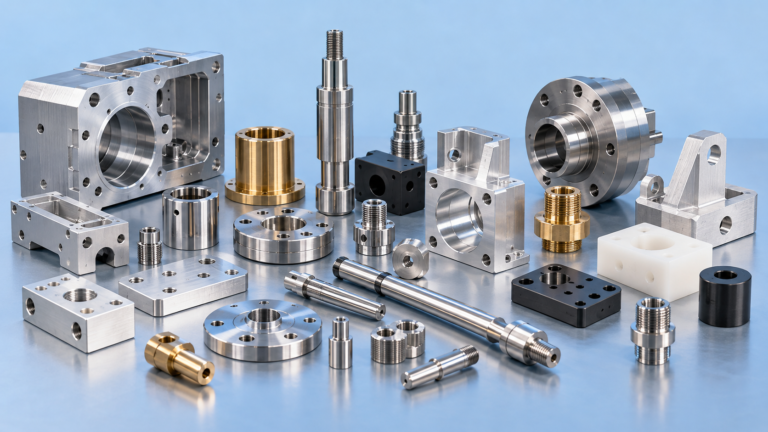
Milling is a fundamental subtractive manufacturing process used to produce components with tight tolerances, complex geometries, and controlled surface finishes. It is widely applied across aerospace, automotive, medical, and general engineering sectors.
With the adoption of CNC systems, milling has become a highly repeatable and programmable process, enabling consistent production in both prototype and serial manufacturing environments. For engineering teams and procurement specialists in Europe, milling remains a key process for precision part production and supply chain reliability.
Definition of Milling
Milling is a machining process in which a rotating multi-edge cutting tool removes material from a stationary workpiece. The tool motion is typically controlled along multiple axes (X, Y, Z, and rotational axes), allowing for complex feature generation.
Key characteristics:
- Intermittent cutting (multi-point tool engagement)
- Capability to machine flat, contoured, and freeform surfaces
- High dimensional accuracy depending on machine and setup
Unlike turning, where the workpiece rotates, milling relies on tool rotation and coordinated axis motion.
Milling Process Mechanics
The milling process involves controlled material removal through relative motion between the tool and the workpiece. The main parameters influencing the process include:
- Cutting speed (Vc)
- Feed rate (f)
- Depth of cut (ap, ae)
- Tool geometry and coating
- Workpiece material properties
Process Stages
- Setup and Fixturing
The workpiece is constrained using fixtures or vises to minimize vibration and ensure positional accuracy. - Toolpath Generation (CNC)
CAM software generates toolpaths based on CAD geometry. Strategies include contouring, pocketing, and adaptive clearing. - Material Removal Phases
- Roughing: High material removal rate (MRR), lower precision
- Semi-finishing: Geometry refinement
- Finishing: Low feed, small step-over, high surface quality
- Inspection and Post-Processing
Dimensional verification using CMM or manual measurement. Secondary processes may include deburring, anodizing, or heat treatment.
Types of Milling Operations
Different operations are used depending on feature requirements:
- Face Milling – Produces flat surfaces; tool axis perpendicular to surface
- Peripheral (Slab) Milling – Tool axis parallel to surface
- End Milling – General-purpose operation for slots, pockets, and profiles
- Slotting – Narrow feature generation with defined width
- Contour Milling – 3D surface machining
- Drilling/Interpolation (via milling tools) – Hole creation using circular toolpaths
Operation selection depends on geometry, tolerance, and surface finish requirements.
CNC Milling Systems
CNC milling machines use numerical control to execute programmed toolpaths with high precision. They are classified by axis configuration:
- 3-axis systems – Linear motion along X, Y, Z
- 4-axis systems – Additional rotational axis (typically A-axis)
- 5-axis systems – Simultaneous multi-axis machining for complex geometries
Engineering Advantages
- High repeatability (± tolerances depending on setup)
- Reduced setup variation between batches
- Capability to machine complex parts in a single setup
- Integration with CAD/CAM workflows
5-axis machining, in particular, reduces the need for multiple fixtures and improves geometric accuracy.
Milling Machine Configurations
Vertical Milling Machines
- Spindle axis oriented vertically
- Suitable for precision work and general-purpose machining
Horizontal Milling Machines
- Spindle axis horizontal
- Better chip evacuation and higher MRR for heavy cutting
Machining Centers
- CNC-controlled systems with tool changers and automation
- Capable of multi-operation machining
Gantry/Portal Mills
- Designed for large workpieces
- Common in heavy industry and structural component manufacturing
Materials and Machinability
Milling is compatible with a wide range of engineering materials. Machinability depends on hardness, thermal conductivity, and chip formation characteristics.
Common Materials
Metals:
- Aluminum alloys (high machinability, low cutting forces)
- Carbon steels (moderate machinability)
- Stainless steels (work hardening, lower machinability)
- Titanium alloys (low thermal conductivity, tool wear challenges)
Polymers:
- ABS, Nylon, POM, PEEK
- Lower cutting forces but sensitive to heat and deformation
Composites:
- Require specialized tooling due to abrasive fibers
Material selection directly impacts tool wear, cutting parameters, and cycle time.
Applications in Engineering and Manufacturing
Milling is used for producing both functional and structural components:
Aerospace
- Structural brackets, housings, and turbine components
- Tight tolerances and high material requirements
Automotive
- Engine blocks, transmission components, tooling
Medical
- Implants, surgical instruments, and precision devices
General Engineering (EU Context)
- OEM components
- Custom machine parts
- Tooling and fixtures
- Low-volume, high-mix production
Advantages of Milling
- High geometric flexibility (3D surfaces, complex features)
- Precision and repeatability
- Wide material compatibility
- Scalability from prototype to production
Limitations of Milling
- Material waste due to subtractive process
- Tool wear, especially in hard or abrasive materials
- Setup complexity for multi-axis operations
- Cost sensitivity for low-volume production
Comparison With Other Machining Processes
| Process | Mechanism | Typical Use Case |
|---|---|---|
| Milling | Rotating tool, multi-axis motion | Complex geometries |
| Turning | Rotating workpiece | Cylindrical parts |
| Drilling | Axial cutting | Hole generation |
| Grinding | Abrasive finishing | Surface finish and precision |
Milling is generally preferred when multi-surface machining and geometric complexity are required.
Role of Milling in European Manufacturing
In European manufacturing environments, including Lithuania, milling supports:
- Localized production and nearshoring strategies
- Compliance with ISO and industry-specific standards
- Rapid prototyping and iterative design
- Flexible production for small and medium batch sizes
It is a critical process for maintaining engineering quality and production independence within regional supply chains.
Conclusion
Milling remains a core machining process for producing precision components across industries. With CNC integration, it offers high accuracy, repeatability, and flexibility, making it suitable for both prototype and production applications.
For engineering teams, understanding milling parameters, machine capabilities, and material behavior is essential for optimizing design, manufacturability, and cost.