Key takeways:
- Casting is a manufacturing process where molten metal is poured into a mold and allowed to solidify to create a specific metal component.
- Different types of casting processes are used in industries such as aerospace, automotive, machinery, and construction.
- The most common casting methods include sand casting, die casting, investment casting, centrifugal casting, lost-foam casting, and permanent mold casting.
- Sand casting services are cost-effective and suitable for large metal parts but offers lower dimensional accuracy.
- Die casting provides high precision, smooth surface finish, and is ideal for mass production of non-ferrous metal parts.
- Investment casting (lost wax casting) is best for complex designs and precision components with excellent surface finish.
- Centrifugal casting is mainly used to produce cylindrical parts such as pipes, barrels, and sleeves.
- Lost-foam casting allows flexible designs and clean production but may involve higher pattern costs.
- Permanent mold casting uses reusable molds and produces strong, high-quality components for large production runs.
- Choosing the right casting process depends on material type, production volume, part complexity, cost, and surface finish requirements.
- Working with an experienced casting manufacturer helps businesses select the most suitable casting method and ensure consistent product quality.
The casting process is an industrial procedure where the molten metal is poured into a cavity, designed mold and allowed to harden. The manufacturers remove workpiece from the mold after solidification and each component undergoes to finishing treatments and then give the final casting part.
The different types of casting processes are used in a wide range of applications, including aerospace, automotive, and more. Casting processes such as investment casting sand casting, die casting and centrifugal casting each offer unique benefits depending on the complexity, volume and material requirements.
On the basis of complexity, volume and material requirements. You must understand different types of casting process, with its pros and cons and select the right process that fits your manufacturing facility. Working with an experienced Casting Manufacturer can also help businesses identify the most suitable casting method based on their specific manufacturing requirements.
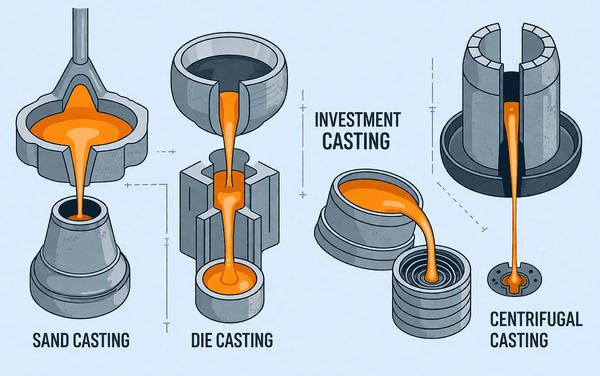
Different Types of Casting Processes
1. Sand Casting
Here are the different types of casting process, with its advantages and disadvantage
Sand Casting is a versatile casting process that is used to cast metal alloys. It is used for mass industrial production, such as automotive metal casting parts like cylinder heads, engine blocks, crankshafts, etc. Let us talk about its benefits and drawbacks.
| Advantages | Disadvantages |
| Cost-effective for low-volume production | Lower degree of accuracy than other methods |
| Large components fabrication | Hard to use this method for products with pre-determined weight and size specifications |
| Casting ferrous and non-ferrous alloys | It yields products with a rough surface finish |
2. Die Casting
Die Casting is another type of Casting Processes involving molding materials under extreme pressure. Die casting is a manufacturing process where molten metal is injected into a steel mold under high pressure. It is commonly used with non-ferrous metals such as aluminum, zinc, magnesium and copper alloys.
Then the mold will be applied with lubricant, regulate the temperature and remove the workpiece easily.
| Advantages | Disadvantages |
| High production efficiency and suitable for mass production | High initial tooling and mold costs |
| Excellent dimensional accuracy | Limited to metals with lower melting points |
| Smooth and high-quality surface finish | Hard for large or complex shapes |
| Produce thin-walled parts | Less suitable for high-melting-point metals like titanium or steel |
| Reusable molds reduce long-term costs | Shrinkage or Porosity defects may occur if not controlled properly |
3. Centrifugal Casting
Centrifugal Casting is used to produce cylindrical parts using centrifugal forces. This type of metal casting uses a preheated spinning die into which molten metal is poured. The centrifugal forces distribute the molten metal within the die under high pressure. Here are its advantages and disadvantages, given below.
| Advantages | Disadvantages |
| Increase process yields and reduce wastage | Centrifugal casting requires high investments |
| High-density casting and almost no defects | Require skilled labor |
| Convenient process and manufacture barrel and sleeve composite metal casting process | Specific shapes production |
4. Lost-Foam Casting
The Lost-Foam Casting method is similar to investment casting but uses foam for the pattern instead of wax. After forming the pattern, it is coated with a refractory ceramic through dipping, coating, spraying, or brushing. Then, molten metal is poured into the mold to create the desired product.
| Advantages | Disadvantages |
| High precision casting | Low volume production, High pattern costs |
| Facilitates flexible design | Low strength may damage the pattern and cause distortion |
| Clean production | Many production processes and long delivery times |
5. Permanent Mold Casting
Permanent Mold Casting is a method similar to centrifugal casting and die casting, mainly using reusable molds. It made the mold with steel, graphite, or cast iron, and used for materials like lead, zinc, aluminum, magnesium alloys, certain bronzes and cast iron. Let us look at its cons and pros below.
| Advantages | Disadvantages |
| High-quality surface finish | High initial mold cost |
| Good dimensional accuracy | Limited to metals with lower melting points |
| Reusable molds reduce cost for large production runs | Hard to cast complex shapes |
| Produces dense and strong parts | Not suitable for very small production volumes |
| Faster production than sand casting | Limited flexibility for design changes once the mold is made |
| Produce thin-walled components | Less suitable for metals like titanium or steel |
Conclusion
Casting is a crucial process performed to create complex and durable components across various industries. By understanding the different types of casting processes and their applications, manufacturers can make informed choices that improve production efficiency, cut costs and ensure quality.
Whether you’re working with intricate designs or high-volume production, partnering with a reliable casting manufacturer helps you navigate the complexities of the process and achieve successful results.