CNC Machining Tolerances Explained: Precision, ISO Standards & Cost Optimization
CNC machining tolerances define the acceptable limits of variation in a part’s dimensions during manufacturing. Because no machining process can achieve perfect accuracy, tolerances establish the boundaries within which a component is still considered functional and compliant.
In modern manufacturing, tolerances play a critical role in ensuring that parts fit together correctly, perform reliably, and meet industry standards. This is especially important in high-precision sectors such as aerospace, automotive, medical devices, and industrial machinery, where even minimal deviations can lead to performance issues or system failure.
For companies operating in Europe, including Lithuania, Germany, and Nordic countries, tolerance standards such as ISO 2768 are widely used to streamline production, improve supplier communication, and maintain consistent quality across international supply chains.
What Are CNC Machining Tolerances?
A CNC machining tolerance is the permissible deviation from a specified nominal dimension. It defines the range between the maximum and minimum acceptable values for a given measurement.
For example:
A dimension of 50 mm ±0.1 mm allows the part to fall within 49.9 mm and 50.1 mm while still meeting design requirements.
This range is essential because manufacturing processes are influenced by factors such as tool wear, machine precision, thermal expansion, and material properties. Without tolerances, it would be impossible to produce interchangeable parts or maintain consistent product quality.
In practice, tolerances ensure:
- Interchangeability of components
- Reliable assembly processes
- Predictable product performance
Why CNC Machining Tolerances Are Critical ?
Functional Performance and Assembly
Tolerances directly affect how parts interact. Components that are too tight may not assemble, while those that are too loose may cause vibration, leakage, or premature wear.
Quality and Repeatability
Consistent tolerances allow manufacturers to produce identical parts across large production runs. This is essential for maintaining product reliability and reducing defects.
Cost Efficiency in Manufacturing
Tolerances have a direct impact on production cost. As tolerances become tighter, machining becomes more complex and time-consuming. This requires:
- Slower cutting speeds
- More precise tooling
- Additional quality control
As a result, unnecessarily tight tolerances can significantly increase manufacturing costs without improving functionality.
Standard CNC Machining Tolerances
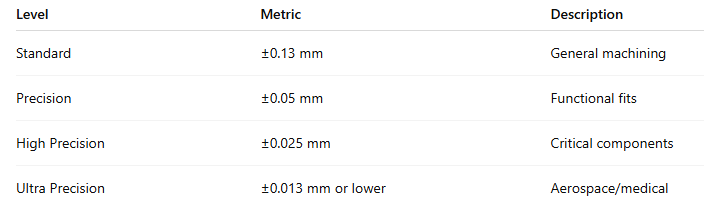
Most CNC machining projects use ±0.127 mm (±0.005″) as a cost-effective standard.
ISO 2768: The Standard for General Tolerances in Europe
ISO 2768 is an internationally recognized standard that simplifies technical drawings by defining general tolerances without specifying each dimension individually.
This standard is widely used in European manufacturing environments because it improves clarity and reduces the risk of misinterpretation between engineers and suppliers.
Structure of ISO 2768
ISO 2768 is divided into two parts:
- ISO 2768-1: Covers linear and angular dimensions
- ISO 2768-2: Covers geometric tolerances such as flatness and perpendicularity
Tolerance Classes
The standard defines four tolerance classes:
- f (fine): High precision applications
- m (medium): Most commonly used
- c (coarse): Less critical components
- v (very coarse): Non-functional features
By applying these classes, engineers can avoid over-specifying tolerances while maintaining adequate precision.
Types of CNC Machining Tolerances
Linear Tolerances
These control basic dimensions such as length, diameter, and thickness. They are the most commonly used tolerances in CNC machining.
Angular Tolerances
Angular tolerances define the allowable variation in angles between surfaces. These are critical in components requiring alignment or directional accuracy.
Geometric Dimensioning and Tolerancing (GD&T)
GD&T provides a more advanced system for controlling form, orientation, and position. It ensures functional performance beyond simple dimensional limits.
Common GD&T controls include:
- Flatness
- Parallelism
- Perpendicularity
- Concentricity
Surface Finish Tolerances
Surface finish defines the texture and roughness of a part. It is important for:
- Friction reduction
- Wear resistance
- Sealing surfaces
Bilateral vs Unilateral Tolerances
Bilateral Tolerances
Allow variation in both directions from the nominal dimension.
Example: ±0.05 mm
Unilateral Tolerances
Allow variation in only one direction.
Example: +0.00 / -0.05 mm
Unilateral tolerances are often used when a part must not exceed a specific limit, such as in shaft and hole systems.
Engineering Fits and Their Role
Tolerances define how parts fit together. This relationship is known as an engineering fit.
Clearance Fit
Provides space between parts for movement or rotation.
Transition Fit
Allows either slight clearance or interference depending on variation.
Interference Fit
Creates a tight press-fit for permanent assembly.
These fits are typically standardized using ISO 286.
Factors That Affect CNC Machining Tolerances
Achieving tight tolerances depends on several variables:
- Material properties: Softer materials deform more easily
- Machine precision: Higher-end machines achieve tighter tolerances
- Tool condition: Worn tools reduce accuracy
- Temperature: Heat causes expansion and dimensional changes
- Part geometry: Complex shapes are harder to machine accurately
Understanding these factors helps engineers design realistic and cost-effective tolerances.
Cost vs Precision: Finding the Optimal Balance
One of the most important principles in CNC machining is avoiding over-tolerancing.
Tighter tolerances increase:
- Machining time
- Setup complexity
- Inspection requirements
This leads to higher costs and longer lead times.
Practical Approach
- Apply tight tolerances only to critical features
- Use standard tolerances for non-critical areas
- Optimize design for manufacturability
This approach ensures both performance and cost efficiency.
Best Practices for CNC Tolerance Design
To achieve optimal results:
- Define functional requirements clearly
- Use ISO 2768 for general tolerances
- Apply GD&T for critical features
- Collaborate with manufacturers early
- Avoid unnecessary precision
These practices reduce production issues and improve overall efficiency.
CNC Machining Tolerances in Europe
In European manufacturing, adherence to ISO standards ensures:
- Consistent quality across suppliers
- Simplified communication
- Faster production cycles
- Reduced manufacturing costs
For companies in Lithuania and across the EU, this standardization is essential for competing in global markets.
Conclusion
CNC machining tolerances are fundamental to precision engineering. They define how accurately parts must be produced and directly influence product quality, performance, and cost.
The key is not to aim for the tightest tolerance, but to select the most appropriate tolerance for each feature.
By applying structured standards such as ISO 2768 and following best practices, manufacturers can achieve:
- Reliable product performance
- Efficient production processes
- Cost-effective manufacturing