CNC machining is a core manufacturing process used across industries like aerospace, automotive, and medical. The most common machine types are 3-axis and 5-axis CNC machines, each offering different capabilities depending on part complexity, cost, and production needs.
Understanding the difference between these two machining methods helps businesses choose the most efficient and cost-effective solution.
What is 3-Axis CNC Machining?
3-axis CNC machining operates along three linear directions: X (left-right), Y (forward-backward), and Z (up-down).
This is the most traditional and widely used CNC method.
Key Features
- Suitable for 2D and simple 3D geometries
- Requires multiple setups for complex parts
- Common in milling, drilling, and cutting operations
Advantages of 3-Axis CNC
- Lower cost compared to 5-axis machines
- Easier to operate and program
- Lower maintenance requirements
- Reliable accuracy for standard parts
Limitations
- Limited access to complex angles
- Requires repositioning for multi-sided parts
- Less efficient for intricate designs
👉 Best for: simple parts, flat surfaces, brackets, housings
What is 5-Axis CNC Machining?
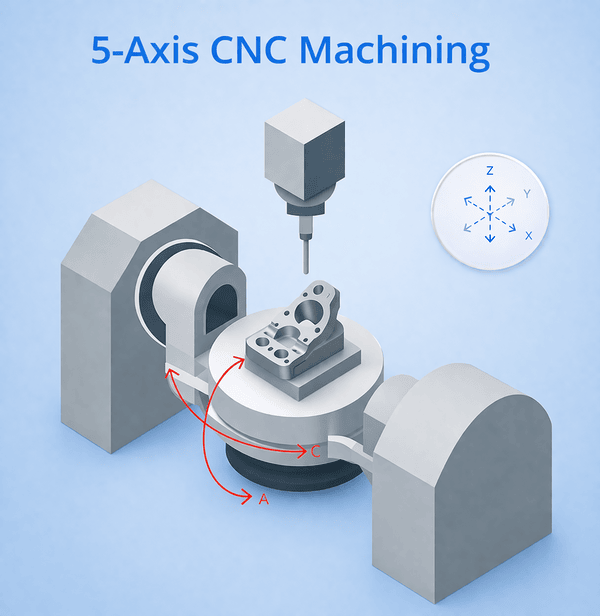
5-axis CNC machining adds two rotational axes (A and B) to the standard three linear axes, allowing the tool to approach the part from almost any angle.
This enables advanced manufacturing of highly complex components.
Key Features
- Simultaneous movement across five axes
- Ability to machine complex geometries in one setup
- Continuous cutting for smoother finishes
Advantages of 5-Axis CNC
- Higher precision and surface quality
- Faster production with fewer setups
- Ability to machine complex shapes and contours
- Reduced need for manual repositioning
Limitations
- Higher machine and operating costs
- Requires skilled operators and advanced programming
- More complex maintenance
👉 Best for: aerospace parts, turbine blades, impellers, medical components
3-Axis vs 5-Axis CNC: Main Differences
1. Movement & Capability
- 3-axis: linear movement only
- 5-axis: linear + rotational movement for multi-angle machining
2. Complexity of Parts
- 3-axis: simple geometries
- 5-axis: complex, organic, and detailed shapes
3. Efficiency
- 3-axis: multiple setups required
- 5-axis: single setup for most parts → faster production
4. Accuracy
- 3-axis: good accuracy
- 5-axis: higher precision and smoother finishes
When to Choose 3-Axis CNC
Choose 3-axis machining when:
- Your part has simple geometry
- You need cost-effective production
- High-volume production is required
- Tight tolerances are not extreme
👉 Ideal for: panels, brackets, enclosures, flat components
When to Choose 5-Axis CNC
Choose 5-axis machining when:
- Your part has complex curves or multiple angles
- You want fewer setups and faster production
- High precision and surface finish are critical
- The part requires machining from multiple sides
👉 Ideal for: aerospace components, medical implants, molds
Cost vs Performance: Which is Better?
There is no “one-size-fits-all” answer.
- 3-axis CNC = lower cost, simpler jobs
- 5-axis CNC = higher cost, but better for complex parts
In many cases, 5-axis machining can actually reduce total production time and cost per part for complex designs by eliminating multiple setups.
Final Thoughts
Both 3-axis and 5-axis CNC machining play essential roles in modern manufacturing.
- Use 3-axis for affordability and simplicity
- Use 5-axis for precision, speed, and complex geometries
The best choice depends on your part design, budget, and production goals.