Precision CNC machined steel housings are critical components in industrial machinery, automation systems, gearboxes, hydraulic equipment, and mechanical assemblies. Although many housings appear relatively simple, manufacturing them accurately can involve demanding requirements for bearing alignment, bore geometry, mounting surfaces, material stability, and dimensional inspection.
For purchasing managers and engineers, sourcing these components is not simply a matter of finding a supplier with a CNC milling machine. The manufacturer must understand how the housing functions within the finished assembly and how its critical dimensions will be maintained throughout production.
MegaMETA is a Lithuanian ISO 9001-certified contract manufacturing company supplying precision CNC components to European OEMs. Through its qualified manufacturing partner network, the company coordinates CNC milling, turning, precision grinding, material procurement, finishing, and dimensional inspection.
This guide explains how precision steel housings are manufactured, which factors influence cost and quality, and what buyers should consider when sourcing custom CNC machined housings in Europe.
What Are Precision CNC Machined Steel Housings?
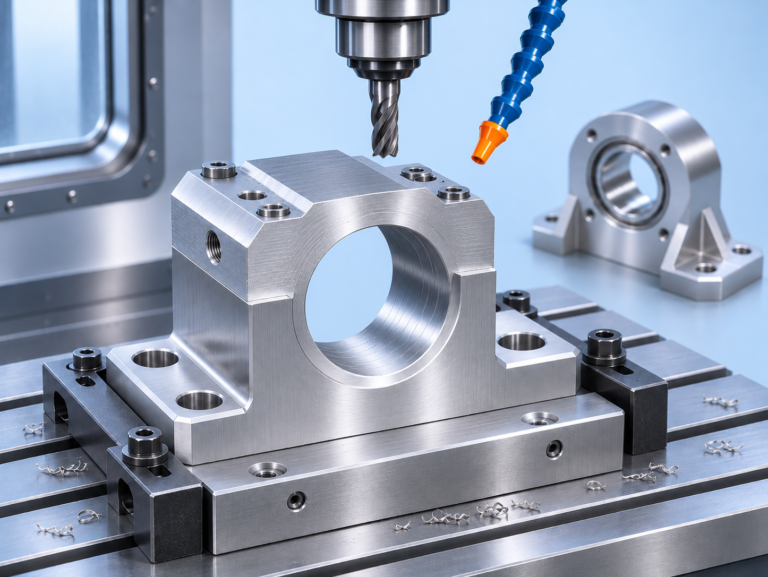
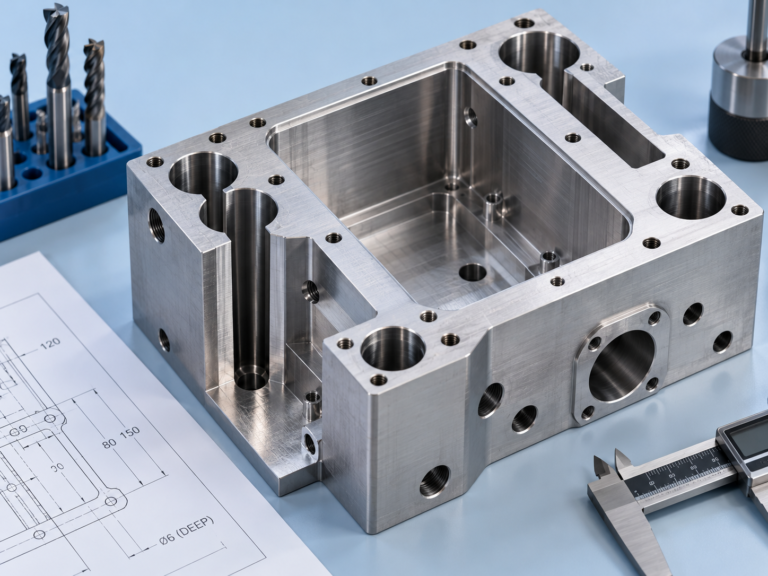
A precision CNC machined steel housing is a custom mechanical component manufactured from steel to support, locate, protect, or connect other parts within an industrial assembly.
Unlike standard sheet metal enclosures, machined steel housings often contain closely controlled internal bores, bearing seats, threaded features, and accurately positioned mounting surfaces.
Common applications include:
- Bearing housings for rotating shafts.
- Gearbox and transmission housings.
- Hydraulic equipment bodies and mounting structures.
- Industrial actuator housings.
- Machinery and automation equipment housings.
- Pump and mechanical drive components.
- Precision mounting blocks and structural assemblies.
Depending on the application, these components may be manufactured from solid steel billets, steel plates, castings, forgings, or welded fabrications that undergo final precision machining.
The appropriate manufacturing method depends on component geometry, material requirements, production volume, and the tolerances specified on the engineering drawing.
Which Steel Grades Are Used for CNC Machined Housings?
Material selection influences the housing’s strength, machinability, dimensional stability, corrosion resistance, and total manufacturing cost.
The most suitable material is not necessarily the strongest steel available. It is the material that provides the necessary performance without introducing unnecessary manufacturing complexity.
| Steel grade | Properties | Typical housing applications |
|---|---|---|
| S235 / S355 | Structural steels with good weldability | Structural housings, mounting structures, welded assemblies |
| C45 / 1.0503 | Medium-carbon steel with useful strength and machinability | Machinery housings, bearing supports, mechanical components |
| 42CrMo4 / 1.7225 | Alloy steel offering high strength after appropriate heat treatment | Heavily loaded housings, mechanical drive components |
| 34CrNiMo6 / 1.6582 | High-strength nickel-chromium-molybdenum alloy steel | Highly stressed mechanical components |
| 304 / 1.4301 | Austenitic stainless steel with good general corrosion resistance | Equipment housings exposed to moisture or mild corrosive environments |
| 316L / 1.4404 | Austenitic stainless steel with improved resistance in many chloride-containing environments | Food-processing, chemical and marine-related equipment |
MegaMETA’s CNC machining capabilities include these carbon, alloy, and stainless steel families.
For example, S355 can be an economical choice for a welded machinery housing, whereas 42CrMo4 may be appropriate where greater mechanical strength is necessary.
However, higher-strength material does not automatically improve dimensional accuracy. Machining sequence, residual stresses, wall thickness, and heat treatment may have a greater effect on the finished component’s geometry.
Procurement recommendation: Specify the required steel grade, delivery condition, and applicable material standard rather than relying solely on a commercial material name.
How Are Precision Steel Housings CNC Machined?
Most precision steel housings require several manufacturing operations, particularly when internal bores and mounting surfaces must maintain accurate positions relative to one another.
1. Technical drawing and manufacturability review
Manufacturing begins with an examination of the 3D model and engineering drawing.
The review identifies:
- Critical dimensions and geometrical tolerances.
- Reference datums and mounting interfaces.
- Bearing seats, bores, and threaded connections.
- Areas requiring fine surface finishes.
- Suitable workholding and machining sequences.
- Any necessary heat treatment or surface protection.
This stage helps identify unnecessary machining complexity before production begins.
For instance, specifying extremely tight tolerances across every surface of a housing can substantially increase manufacturing costs without improving its function.
2. Raw material preparation
The housing may begin as a solid billet, saw-cut block, plate assembly, casting, or forging.
Machining from solid steel offers flexibility for prototypes and smaller quantities because no dedicated casting or forging tooling is required.
For larger or more complex components, a near-net-shape casting or welded fabrication may reduce material waste and machining time.
3. CNC rough machining
During rough machining, large volumes of material may be removed to establish the housing’s overall geometry.
This can include:
- External profile milling.
- Pocket and cavity machining.
- Preliminary bore machining.
- Drilling and material removal.
- Establishing reference surfaces for subsequent setups.
Material removal can release internal stresses and cause dimensional movement, particularly in asymmetrical housings with thin walls or deep cavities.
For demanding parts, the manufacturing process may include intermediate inspections or a stabilization stage before final machining.
4. Precision finish machining
Finish machining establishes the final dimensions and functional surfaces.
Particular attention is given to bearing bores, shaft alignment, mounting faces, perpendicularity, and critical feature positions.
Where geometry permits, machining related features within the same setup can reduce errors associated with repeated clamping and repositioning.
For complex components, multi-axis machining may also reduce the number of required setups.
5. Grinding, finishing, and inspection
Additional operations may include precision grinding, deburring, threading, heat treatment, coating, and final dimensional inspection.
The production sequence should account for any dimensional changes introduced by heat treatment or surface finishing.
The objective is not merely to produce the correct geometry at the machining stage, but to deliver a component that meets its drawing requirements in its final condition.
What Tolerances Can CNC Machined Steel Housings Achieve?
CNC machined housing tolerances depend on component size, material, geometry, feature accessibility, and the available machining and inspection processes.
MegaMETA’s manufacturing network includes precision CNC machining capability down to ±0.005 mm for suitable features and applications. This represents an available capability, not a universal tolerance for every dimension of every housing.
For a steel housing, different features may require very different accuracy levels.
| Housing feature | Typical engineering consideration |
|---|---|
| Bearing bore | Diameter tolerance, roundness, cylindricity |
| Two aligned bores | Coaxiality or position relative to defined datums |
| Mounting surface | Flatness and surface finish |
| Shaft interface | Position and perpendicularity |
| Threaded holes | Thread specification, location and depth |
| General outer profile | Dimensional accuracy appropriate to assembly clearance |
Bearing bores may require precision boring or other finishing operations, while non-functional exterior surfaces can often be produced with more economical general tolerances.
The most important factor is the relationship between features, not simply the smallest numerical tolerance on the drawing.
For example, two individually accurate bearing bores may still produce an unsuitable housing if their axes are incorrectly aligned.
This is why functional tolerances and a clearly defined datum system are essential.
How Does MegaMETA Support Precision Steel Housing Manufacturing?
MegaMETA coordinates precision component manufacturing through an established network of production partners, with project management and quality oversight from Lithuania.
Founded in Kaunas in 2015, the company supplies mechanical components and manufacturing services to European industrial customers.
Its wider manufacturing scope is relevant to housing projects that require more than conventional CNC milling.
Documented manufacturing capabilities
| Capability | MegaMETA manufacturing scope |
|---|---|
| CNC milling | 3-, 4-, and 5-axis machining |
| Maximum listed milling work envelope | Up to 4000 × 2000 × 1000 mm |
| CNC turning | Horizontal and vertical CNC turning capabilities |
| Precision tolerance capability | Down to ±0.005 mm on suitable features |
| Precision finishing | Surface, cylindrical, and centerless grinding |
| Surface finish capability | Ra down to 0.2 µm for applicable processes |
| Production quantities | Single prototypes through batches of 10,000+ parts |
| Materials | Carbon steel, alloy steel, stainless steel, and other engineering materials |
| Quality management | ISO 9001-certified management system |
These capabilities describe the available manufacturing network. Actual housing feasibility, tolerances, lead time, and process selection are established after evaluating the drawings.
Quality control and verification
For steel housings, inspection is particularly important when the component contains precision bearing seats, mating interfaces, or critical geometrical relationships.
MegaMETA’s documented quality-control system includes:
- Incoming material verification and traceability.
- First-article and in-process inspection.
- Coordinate Measuring Machine (CMM) inspection.
- Surface roughness verification.
- Hardness testing where applicable.
- Verification of critical dimensions against engineering drawings.
- Material certification, including EN 10204 3.1 documentation according to project requirements.
MegaMETA maintains ISO 9001:2015 certification through Bureau Veritas.
For buyers, this offers a defined quality-management framework and the ability to request project-specific inspection documentation.
A supplier’s general machining capability should always be assessed alongside its ability to verify the exact tolerances required by the housing drawing.
Why Can CNC Machined Steel Housings Be Expensive?
The price of a precision steel housing is rarely determined by material weight alone.
Several manufacturing factors can substantially affect the quotation.
Deep cavities and high material removal
A solid steel block containing a large internal cavity may require extensive machining.
The cost increases when the cavity has deep walls, narrow access, or internal corners requiring small cutting tools.
Longer tools may require reduced cutting parameters to maintain accuracy and prevent vibration.
Multiple machining setups
Housings containing features on several sides often require multiple clamping orientations.
Every additional setup introduces handling time, fixturing requirements, and potential dimensional variation.
When possible, a suitable multi-axis machining strategy can reduce these operations.
Tight geometric tolerances
Precision bearing bores, closely positioned holes, and flat mating surfaces may require additional finishing and inspection.
The cost is driven not only by machining accuracy, but also by the need to maintain relationships between separate features.
Material grade and heat treatment
Alloy steels and pre-hardened materials may require different tools and machining strategies from conventional structural steel.
Heat treatment can introduce additional operations and dimensional risks, particularly where the housing has uneven wall thicknesses.
Production quantity
A single prototype must absorb programming, workholding, and setup costs across one component.
When producing 50, 100, or 500 housings, those costs can be distributed across a larger production quantity.
Repeat production may also justify dedicated fixtures that improve consistency and reduce machining time.
For procurement teams, the most effective way to reduce housing costs is often to review the manufacturing method and functional tolerances before changing suppliers.
CNC Machining from Solid Steel vs Casting or Welded Fabrication
For some housings, CNC machining from a solid steel block is not the most economical method.
The manufacturing method should be selected based on the entire component lifecycle, including tooling, raw material, machining, inspection, and expected repeat orders.
| Manufacturing method | Often suitable for | Main consideration |
|---|---|---|
| CNC machining from solid | Prototypes, low-volume production, evolving designs | Higher material removal for hollow geometries |
| Casting followed by CNC machining | Complex geometries and recurring production | Tooling, casting quality and machining allowances |
| Welded fabrication followed by CNC machining | Large steel structures and fabricated housings | Welding distortion, stress control and finishing |
| Forging followed by CNC machining | High-strength parts with suitable geometry and production demand | Tooling costs and forging design constraints |
A welded steel housing can be especially attractive when the component consists of plate structures with a limited number of precision-machined interfaces.
Conversely, machining from solid can be preferable for smaller precision housings where tooling investment would outweigh material savings.
MegaMETA coordinates CNC machining, casting, welding, and finishing services through its manufacturing network, allowing buyers to discuss alternative production approaches within one supply chain.
What Should Buyers Include in an RFQ for CNC Machined Steel Housings?
A complete RFQ allows the supplier to assess the manufacturing process, production quantity, inspection requirements, and realistic delivery schedule.
For the most accurate quotation, provide:
- 3D CAD model: Preferably STEP format, showing the complete housing geometry.
- 2D technical drawing: Including dimensions, datums, geometrical tolerances, surface finish, and relevant standards.
- Steel grade: Including the required material condition and certification.
- Quantity: Prototype requirement, initial batch size, and estimated annual demand.
- Critical features: Bearing seats, aligned bores, mounting surfaces, and other functional interfaces.
- Post-processing: Heat treatment, grinding, protective coating, or additional operations.
- Quality documentation: Inspection reports, material certificates, and any customer-specific requirements.
- Delivery requirements: Destination, target dates, and any required batch delivery schedule.
Where possible, distinguish between mandatory specifications and features that may be adjusted following a manufacturability review.
This can help suppliers propose cost-saving changes without compromising the component’s intended function.
Frequently Asked Questions About CNC Machined Steel Housings
Can MegaMETA supply custom CNC machined steel housings from drawings?
Yes. MegaMETA coordinates custom CNC turning and milling projects from engineering drawings and 3D CAD models through its manufacturing partner network. Housing feasibility, material selection, production cost, and inspection requirements are evaluated for each individual project.
Can steel housings be manufactured in small batches?
Yes. CNC machining can be suitable for prototypes, small batches, and recurring production because dedicated casting or forging tooling is not necessarily required. The best process depends on geometry, quantity, and material removal.
Which steel is best for precision bearing housings?
There is no single best steel. C45 may suit conventional mechanical housings, S355 can suit fabricated structures, and 42CrMo4 may be selected for higher-strength requirements. The correct grade depends on operating loads, material condition, corrosion exposure, and design requirements.
Can bearing bores and mounting surfaces be precision machined?
Yes. Precision boring, milling, and grinding can be used to achieve specified dimensions and surface requirements. The achievable accuracy must be confirmed against the housing geometry and inspection requirements.
Can MegaMETA provide inspection reports and material certificates?
Yes. MegaMETA’s quality system supports dimensional inspection, material traceability, and certification documentation according to project requirements, including EN 10204 3.1 certificates and CMM inspection reports where specified.
Can a welded or cast housing be finish-machined?
Yes. Welded fabrications and castings can undergo CNC machining to establish precision bores, mounting surfaces, and other functional features. The manufacturing plan must account for machining allowances and dimensional stability.
Where is MegaMETA located, and which markets does it serve?
MegaMETA is based in Kaunas, Lithuania, and coordinates precision component supply for industrial customers across Europe, including Scandinavia, Germany, the Netherlands, and the United Kingdom.
Sourcing Precision CNC Machined Steel Housings in Europe
Precision steel housings require more than accurate cutting tools. Successful manufacturing depends on material selection, machining sequence, fixturing, geometrical tolerances, finishing, and reliable dimensional verification.
For purchasing managers, the ideal supplier is one that can assess the complete manufacturing requirement and provide a clear route from technical drawings to finished, inspected components.
MegaMETA combines CNC machining capabilities with coordinated material procurement, finishing processes, inspection, and European supply-chain management.
Whether the requirement involves a prototype bearing housing, a machined steel mounting block, or a recurring production order for industrial machinery components, each project begins with an evaluation of its technical and commercial requirements.
Need a quotation for custom CNC machined steel housings?
Send your engineering drawings, material requirements, and expected quantities to MegaMETA for a manufacturing feasibility review and quotation.
Learn more about MegaMETA’s CNC machining services and quality assurance capabilities.