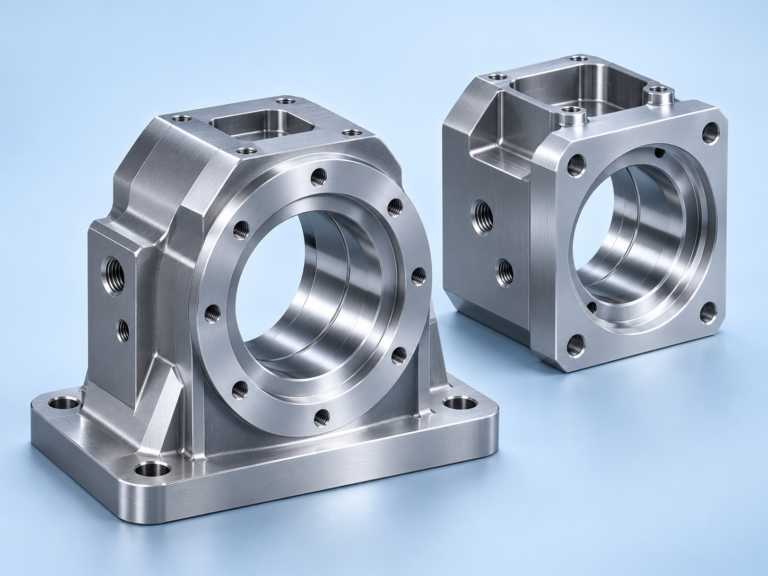
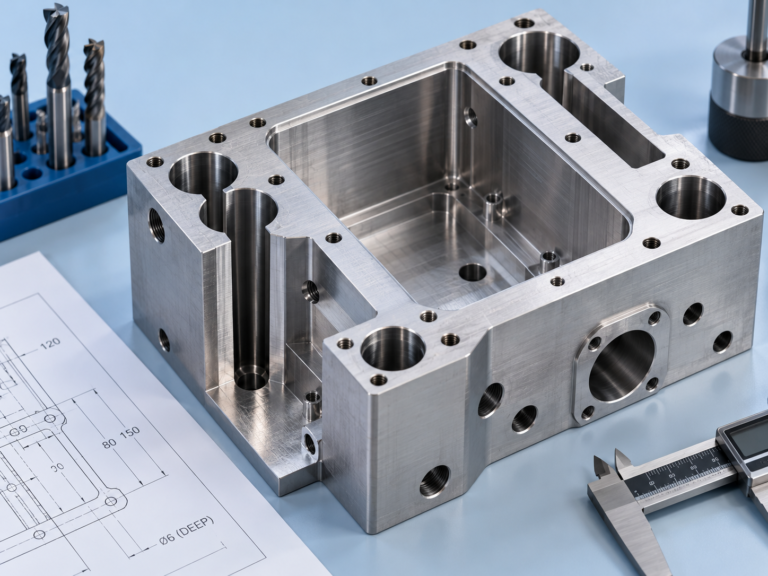
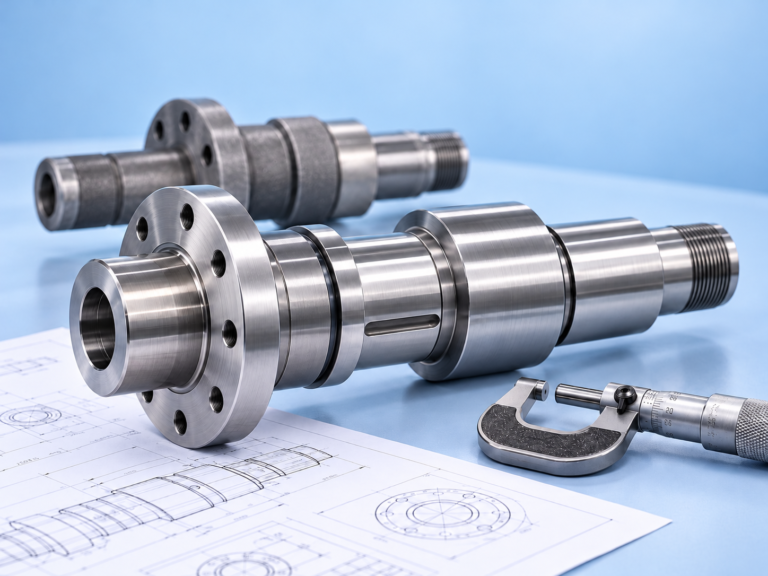
Custom CNC machined bearing blocks and supports are essential components in industrial machinery, automation equipment, conveyor systems, mechanical drives, and precision motion assemblies. Although these parts may appear relatively simple, their manufacturing accuracy can directly influence bearing performance, shaft alignment, vibration, and the reliability of the entire mechanical system.
For OEM manufacturers and purchasing managers, sourcing custom bearing blocks involves more than finding a CNC machining supplier capable of producing the required external geometry.
The manufacturer must understand bearing fits, mounting accuracy, material selection, geometrical tolerances, and the relationship between the bearing support and the surrounding assembly.
MegaMETA is a Lithuania-based precision manufacturing company coordinating custom CNC milling, turning, grinding, and dimensional inspection for European industrial customers. Through its qualified manufacturing partner network, MegaMETA supports the production of custom bearing blocks, bearing supports, and other mechanical components according to customer drawings.
This article explains how custom CNC machined bearing blocks are manufactured, which technical specifications matter most, what influences manufacturing costs, and how to select a reliable European supplier.
What Are Custom CNC Machined Bearing Blocks?
A CNC machined bearing block is a mechanical component designed to support and position a bearing, shaft, or rotating assembly within a machine.
Unlike standardized bearing units available from industrial component distributors, custom bearing blocks are manufactured according to application-specific technical drawings.
They may require unique mounting dimensions, non-standard bearing arrangements, special materials, additional fixing features, or particularly tight geometrical tolerances.
Common examples include:
- Custom bearing support blocks: Precision-milled components designed to support bearings within industrial machinery.
- Shaft bearing mounts: Components that maintain the required position of rotating shafts.
- Flanged bearing supports: Bearing mounting structures with integrated fixing flanges.
- Precision linear shaft supports: Custom support components for linear motion systems.
- Split bearing blocks: Two-piece components designed to simplify assembly and maintenance.
- Heavy-duty bearing supports: Steel components used in machinery with significant mechanical loading.
- Special bearing mounting plates: Machined components incorporating bearing bores, mounting holes, and precision reference surfaces.
These components are frequently manufactured from steel, stainless steel, aluminium, or other engineering materials.
The appropriate design depends on bearing type, applied loads, shaft arrangement, environmental conditions, and assembly requirements.
Why Does Precision Matter in Bearing Block Manufacturing?
Bearing blocks perform an important mechanical function: maintaining the correct position and support conditions for a bearing.
Even relatively small manufacturing deviations can influence the performance of a complete assembly.
For example, a bearing support may have the correct external dimensions while the bearing bore is positioned incorrectly relative to its mounting surface.
This can result in assembly difficulties, unwanted bearing loading, increased vibration, or premature component wear.
Bearing bore accuracy
The bearing bore is often one of the most critical features.
Its diameter must provide the intended fit between the bearing outer ring and the housing.
The correct fit depends on the bearing type, loading conditions, temperature, mounting arrangement, and bearing manufacturer’s recommendations.
An incorrect bore diameter may lead to insufficient bearing retention, excessive interference, or difficulties during installation.
Shaft alignment
When two bearing supports hold the same shaft, their bore axes must be positioned correctly relative to one another.
Misalignment can increase bearing loads and contribute to vibration, overheating, and reduced service life.
Maintaining the required positional relationship between supports is therefore just as important as achieving the correct bore diameter.
Mounting surface accuracy
A bearing block normally interfaces with a machine frame, mounting plate, or another structural component.
If the mounting surface lacks the required flatness or orientation, tightening the mounting bolts may distort the support or create unwanted stress.
Repeatability in batch production
For OEM manufacturers purchasing 50, 100, or 500 bearing blocks, consistency between components is essential.
Repeatable machining and controlled inspection help ensure that parts from different batches can be assembled without unnecessary adjustments.
The objective of precision machining is not simply to achieve a small dimensional tolerance. It is to manufacture bearing supports that function correctly within the complete mechanical assembly.
Which Materials Are Used for CNC Machined Bearing Blocks?
Material selection influences strength, rigidity, corrosion resistance, machining cost, and bearing support performance.
For custom bearing blocks, steel and aluminium are commonly considered, although cast iron and other engineering materials may be suitable depending on the application.
| Material | Main characteristics | Typical applications |
|---|---|---|
| S355 structural steel | Good weldability and practical strength | Machinery supports and fabricated assemblies |
| C45 / 1.0503 | Medium-carbon steel with good mechanical properties | General industrial bearing blocks |
| 42CrMo4 / 1.7225 | High-strength alloy steel after suitable heat treatment | Heavily loaded mechanical supports |
| 34CrNiMo6 / 1.6582 | High-strength alloy steel for demanding applications | Highly stressed machine components |
| Stainless steel 304 / 1.4301 | Good general corrosion resistance | Equipment exposed to moisture |
| Stainless steel 316L / 1.4404 | Improved resistance in many aggressive environments | Food processing and chemical equipment |
| Aluminium 6082 / 6061 | Lightweight and generally easy to machine | Automation and lightweight machinery |
For example, C45 may provide a practical combination of strength, machinability, and cost for conventional bearing support applications.
42CrMo4 may be selected when higher strength or demanding mechanical performance is required.
However, the use of high-strength steel does not automatically guarantee improved bearing alignment or dimensional stability.
The manufacturing sequence, residual stresses, component geometry, and final machining operations also influence accuracy.
For applications involving significant vibration or demanding damping requirements, cast iron may be worth considering as an alternative.
Procurement recommendation: Always specify the material grade and delivery condition on the engineering drawing. If alternative materials are acceptable, identify them separately for technical review.
How Are Custom Bearing Blocks CNC Machined?
The manufacturing process depends on the bearing block’s geometry, material, dimensions, tolerances, and production quantity.
A typical precision bearing support manufacturing process involves several stages.
1. Technical drawing and manufacturability assessment
The manufacturer first reviews the 2D drawing and 3D CAD model.
Important requirements include:
- Bearing bore diameter and tolerance.
- Bore position relative to mounting surfaces.
- Flatness and perpendicularity.
- Mounting-hole dimensions and locations.
- Material specification.
- Surface roughness requirements.
- Critical dimensions and geometrical tolerances.
- Production quantity and inspection requirements.
This review helps determine whether the component can be manufactured efficiently using conventional CNC milling or requires additional processes.
2. Raw material preparation
The bearing block may be manufactured from a solid steel or aluminium block, a near-net-shape casting, or another suitable blank.
Machining from solid material is particularly flexible for prototypes and small batches.
No dedicated casting tooling is required, and design changes can often be implemented through updates to machining programs.
However, components with large internal cavities or substantial material removal may benefit from alternative manufacturing methods.
3. CNC milling and rough machining
During rough machining, the basic geometry is created.
Operations may include:
- Milling external surfaces.
- Machining bearing support profiles.
- Drilling mounting holes.
- Milling pockets and recesses.
- Preparing the bearing bore.
- Establishing reference surfaces.
For complex components, 3-, 4-, or 5-axis CNC machining may help reduce the number of setups.
Fewer setups can improve consistency when the component contains features that must maintain accurate positions relative to one another.
4. Precision boring and finish machining
The bearing bore is typically finished using an appropriate precision machining process.
Depending on the application, this may include precision boring, reaming, or an additional finishing operation.
Finish machining also establishes the required mounting geometry.
A key objective is maintaining the relationship between the bearing bore and the component’s reference surfaces.
Where technically practical, machining critical features within the same setup can reduce accumulated positioning errors.
5. Deburring, surface treatment, and inspection
After machining, the bearing block may require:
- Deburring and edge finishing.
- Protective coating or surface treatment.
- Precision grinding.
- Cleaning.
- Dimensional inspection.
- Material and inspection documentation.
Special care should be taken when applying surface treatments to bearing bores.
A coating that changes the effective bore diameter may influence bearing fit. For this reason, critical surfaces may require masking or allowances defined in the manufacturing plan.
Bearing Block Tolerances: H7 Fits, Bore Position, and Surface Finish
Bearing block tolerances must be selected according to the bearing arrangement and functional requirements.
A common engineering mistake is to concentrate on the bearing bore diameter while overlooking geometrical tolerances.
Bearing bore tolerances
For certain bearing arrangements, an H7 bore tolerance may be specified.
However, H7 is not a universal requirement for every bearing housing.
The correct tolerance class must be determined from the bearing manufacturer’s guidance, loading conditions, and intended fit.
For example, a nominal Ø40 H7 hole has an ISO 286 tolerance interval of:
40.000 mm to 40.025 mm
This gives a total tolerance width of 0.025 mm.
This example illustrates the dimensional precision required for a particular fit designation. It does not establish that Ø40 H7 is suitable for every bearing application.
Geometrical tolerances
In addition to the bore diameter, bearing supports may require control of:
| Feature | Relevant requirement |
|---|---|
| Bearing bore | Diameter, roundness, cylindricity |
| Bore relative to mounting surface | Position and perpendicularity or parallelism, as appropriate |
| Mounting face | Flatness |
| Two bearing bores | Relative position and axis alignment |
| Threaded mounting holes | Thread size, position, and depth |
| Bearing contact surfaces | Surface roughness and geometry |
The exact tolerance values depend on the assembly design.
For applications with multiple bearing supports, engineers should consider how the tolerances of the separate components combine during installation.
Surface roughness
Bearing support surfaces may require different surface finishes depending on their function.
A mounting surface may have different requirements from a precision bearing seat.
It is important to distinguish between features requiring a specified roughness and general surfaces where a standard machined finish is sufficient.
Unnecessarily restrictive surface requirements can increase manufacturing time and inspection costs.
MegaMETA’s CNC Manufacturing Capabilities for Custom Bearing Supports
MegaMETA coordinates custom precision components through a network of qualified manufacturing partners.
For bearing block projects, relevant capabilities include CNC milling, turning, grinding, material procurement, and dimensional inspection.
Published manufacturing capabilities
| Manufacturing capability | MegaMETA’s available scope |
|---|---|
| CNC milling | 3-, 4-, and 5-axis machining |
| Milling work envelope | Up to 4000 × 2000 × 1000 mm |
| CNC turning | Horizontal and vertical turning |
| Precision capability | Tolerances down to ±0.005 mm on suitable features |
| Precision finishing | Surface, cylindrical, and centerless grinding |
| Surface finish capability | Ra down to 0.2 µm where applicable |
| Materials | Carbon steel, alloy steel, stainless steel, aluminium, and engineering plastics |
| Production quantities | From individual prototypes to series exceeding 10,000 parts |
| Quality management | ISO 9001:2015-certified quality management system |
These figures describe MegaMETA’s available manufacturing network, not guaranteed specifications for every bearing block.
The actual manufacturing process, achievable tolerances, and inspection requirements are established after reviewing the customer’s engineering drawings.
What Does MegaMETA’s Manufacturing Evidence Include?
For industrial procurement, manufacturing capability should be supported by technical verification rather than general claims about precision.
MegaMETA’s published quality-management framework includes:
Material traceability: Incoming materials can be verified against purchase specifications and accompanied by appropriate material certificates.
Dimensional inspection: Critical dimensions can be checked using calibrated measurement equipment and coordinate measuring machines.
Surface roughness verification: Specified surface requirements can be measured and documented.
First-article inspection: Initial production components can be inspected against technical requirements before proceeding with larger batches.
Quality documentation: Depending on the project, documentation can include dimensional reports, CMM measurements, and EN 10204 3.1 material certificates.
MegaMETA maintains an ISO 9001:2015-certified quality management system through Bureau Veritas.
This provides a framework for managing manufacturing processes, inspection, and traceability across its production network.
For buyers, the important distinction is that these capabilities can support a bearing block manufacturing project, while the acceptance criteria for the actual component must still be defined by its drawing.
Manufacturing Coordination for Complete Components
Some bearing blocks require more than one manufacturing process.
For example, a steel support may need CNC milling followed by heat treatment, grinding, protective coating, and final inspection.
MegaMETA can coordinate multiple operations through its manufacturing network rather than requiring customers to source each process separately.
This is particularly relevant for OEM manufacturers purchasing complete, ready-to-assemble mechanical components.
What Determines the Price of a Custom CNC Machined Bearing Block?
The manufacturing cost depends on several factors beyond the size or weight of the component.
Material selection
Different steel and aluminium grades have different procurement costs and machining characteristics.
High-strength or heat-treated materials may require different tooling and machining conditions.
Bearing bore precision
A general clearance hole is typically easier to manufacture than a bearing seat requiring controlled diameter, roundness, and position.
Additional finishing and inspection may increase the manufacturing cost.
Geometrical complexity
Features such as deep pockets, inaccessible mounting holes, internal recesses, and complex profiles can increase machining time.
A simple bearing support block with accessible features may be substantially more economical than a complex component requiring multiple orientations.
Quantity
Setup and programming costs influence the price per part.
For example, producing 10 bearing blocks may involve nearly the same initial programming effort as producing 100 identical blocks.
As production quantities increase, these fixed costs can be distributed across more components.
Inspection requirements
Extensive dimensional reporting, additional surface measurements, and customer-specific quality documentation can increase total project cost.
These requirements should be communicated at the quotation stage.
Opportunities to reduce costs
A manufacturability review may identify opportunities such as:
- Simplifying non-functional features.
- Reducing unnecessary machining setups.
- Using standard hole sizes and thread specifications.
- Applying tight tolerances only where functionally required.
- Improving accessibility for cutting tools.
- Optimizing the order quantity.
- Selecting an alternative approved material.
Any proposed drawing changes should be reviewed and approved by the customer’s engineering team before implementation.
Custom Bearing Blocks vs Standard Bearing Housings
Standard bearing housings and mounted bearing units are widely available from industrial suppliers.
For many applications, standard components are the most economical solution.
Custom CNC machined bearing blocks become relevant when standard products cannot satisfy the mechanical design.
| Requirement | Standard bearing housing | Custom CNC machined bearing block |
|---|---|---|
| Standard dimensions | Generally suitable | Can match specific dimensions |
| Custom mounting-hole pattern | Limited | Defined by customer drawing |
| Special material requirements | Depends on available product range | Material can be specified |
| Integrated additional features | Limited | Can incorporate multiple functions |
| Prototype design changes | Limited by existing product design | Often possible through CAD and program updates |
| Dedicated production tooling | Usually not a customer concern | Often unnecessary for CNC machining |
| Unit price | Often lower for standard applications | Depends on geometry, quantity, and requirements |
The decision should be based on technical necessity rather than assuming that a custom solution is always preferable.
For OEM designs with non-standard geometry or integrated mounting features, CNC machining provides greater flexibility.
What Should an RFQ for Custom Bearing Blocks Include?
A complete technical enquiry helps the manufacturer prepare a reliable quotation and identify potential production difficulties before manufacturing begins.
The following information is particularly useful:
- 2D technical drawing: Include all relevant dimensions, tolerances, surface requirements, and drawing revision.
- 3D CAD model: Preferably STEP format for programming and manufacturability review.
- Bearing designation: Provide the exact bearing type or part number where applicable.
- Material specification: Include material grade and condition.
- Critical tolerances: Clearly identify bearing bores, positions, datum references, and mounting interfaces.
- Quantity: Specify the initial batch and expected annual demand.
- Finishing requirements: Include coating, heat treatment, grinding, and other operations.
- Quality documentation: Specify dimensional reports, material certificates, or first-article requirements.
- Delivery requirements: Include delivery destination and required dates.
For bearing supports used in a larger assembly, providing an assembly drawing can also be valuable.
It allows the manufacturer to understand which surfaces and features are functionally related.
Frequently Asked Questions About CNC Machined Bearing Blocks
Can MegaMETA manufacture custom bearing blocks from engineering drawings?
Yes. MegaMETA coordinates custom CNC milling, turning, and finishing through its manufacturing partner network. Custom bearing block requirements can be reviewed from 2D drawings and 3D CAD models, with feasibility and achievable tolerances assessed for each project.
What materials are suitable for CNC machined bearing supports?
Common choices include C45, S355, 42CrMo4, stainless steel, and aluminium alloys. The correct material depends on mechanical loads, rigidity, corrosion exposure, weight, and assembly requirements.
Can bearing blocks be manufactured with H7 holes?
Yes, H7 bores can be produced using suitable precision machining methods, subject to the component’s geometry and inspection requirements. However, the H7 designation should only be specified when appropriate for the actual bearing arrangement.
Can CNC machined bearing blocks be produced in small quantities?
Yes. CNC machining is suitable for one-off prototypes, small batches, and repeat production. The unit cost depends on setup time, complexity, material, and quantity.
How is bearing bore alignment verified?
Depending on the drawing requirements, alignment and position can be evaluated using coordinate measurement, precision gauges, and other suitable inspection methods. The inspection plan should reference the specified datum system and geometrical tolerances.
Can bearing blocks be supplied with material certificates?
Yes. MegaMETA supports material traceability and project-specific certification, including EN 10204 3.1 certificates where required.
Does MegaMETA provide CNC machining services to European OEMs?
Yes. MegaMETA is based in Kaunas, Lithuania, and coordinates CNC component manufacturing for European industrial customers, including companies in Scandinavia, Germany, the Netherlands, and other European markets.
Sourcing Custom CNC Machined Bearing Blocks in Europe
Custom bearing blocks may appear to be straightforward machined components, but their function depends on the precise relationship between bearing bores, mounting surfaces, material properties, and the surrounding assembly.
Successful manufacturing requires appropriate CNC machining processes, clearly defined tolerances, consistent quality control, and reliable technical communication.
For OEM purchasing managers, selecting a supplier with relevant machining capabilities and inspection procedures can help reduce manufacturing risks and improve repeatability across production batches.
MegaMETA combines CNC machining capacity with coordinated material sourcing, precision finishing, dimensional inspection, and European supply-chain management.
Whether the requirement involves a prototype bearing support, a custom steel bearing block, or recurring serial production of precision mechanical components, MegaMETA can evaluate the drawings and coordinate a suitable manufacturing solution.
Looking for a supplier of custom CNC machined bearing blocks and supports?
Send your technical drawings, material specifications, and expected quantities to MegaMETA for a manufacturing feasibility assessment and quotation.
Learn more about MegaMETA’s CNC machining capabilities, custom machined shafts and bushings, and quality assurance procedures.