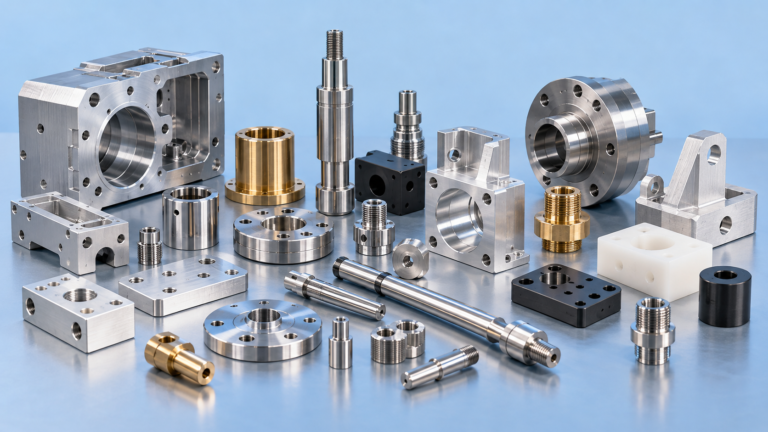
Looking for a reliable manufacturer of custom CNC machined shafts and bushings in Europe? Whether you need 10 precision shafts, 200 steel bushings, or recurring production of several thousand components, finding the right supplier can make a significant difference in cost, quality, and delivery.
Custom shafts and bushings are used in industrial machinery, hydraulic equipment, automation systems, agricultural machinery, and many other mechanical assemblies.
Although these components may appear simple, their manufacturing requirements can be demanding.
A shaft may require precise diameters, bearing seats, keyways, threads, heat treatment, and cylindrical grinding. A bushing may require accurate internal dimensions, specific surface finishes, and a carefully controlled fit with another component.
Finding a manufacturer capable of meeting these requirements at a competitive price is therefore an important purchasing decision.
European purchasing managers often face the same challenges:
- Finding suppliers willing to manufacture custom components from technical drawings.
- Obtaining competitive prices for small and medium production batches.
- Identifying manufacturers capable of meeting tight tolerances.
- Coordinating CNC turning, milling, grinding, and heat treatment.
- Reducing long or unreliable delivery times.
- Finding an alternative to an existing supplier.
This guide explains where to order custom CNC machined shafts and bushings in Europe, what to check before choosing a supplier, and how to prepare an RFQ that helps you receive an accurate manufacturing quotation.
Need Custom CNC Machined Shafts or Bushings?
MegaMETA provides CNC turning, CNC milling, and precision machining services through its manufacturing partner network in Lithuania.
We help European OEM companies and purchasing departments source custom shafts, bushings, sleeves, pins, and other precision-machined components according to their technical drawings.
Whether you need prototypes, small batches, or recurring production, our team can review your manufacturing requirements and prepare a quotation.
Already have technical drawings?
Request a CNC Machining Quote from MegaMETA
1. What Types of Custom Shafts Can CNC Manufacturers Produce?
Custom shafts are commonly manufactured using CNC turning, sometimes combined with milling, heat treatment, or precision grinding.
The required manufacturing process depends on the shaft’s geometry, material, dimensions, and functional requirements.
Stepped shafts
Stepped shafts have different diameters along their length.
They are frequently used in mechanical transmissions, industrial equipment, and rotating assemblies.
Their manufacturing requirements may include:
- Multiple turning diameters.
- Precision bearing seats.
- Threaded sections.
- Grooves.
- Chamfers.
- Tight dimensional tolerances.
For purchasing departments, it is important to find a supplier with suitable CNC turning capacity and experience in maintaining dimensional accuracy across several shaft features.
Threaded shafts
Threaded shafts may have external threads at one or both ends.
They can require standard metric threads, fine threads, or specialized thread profiles.
When requesting a quotation, specify the thread type, diameter, pitch, tolerance class, and any relevant inspection requirements.
Precision ground shafts
Some shafts require tighter dimensional tolerances or finer surface finishes than conventional turning can economically achieve.
These components may require cylindrical grinding after CNC turning or heat treatment.
Typical applications include bearing assemblies, rotating equipment, and precision machinery.
Long CNC machined shafts
Long shafts can introduce additional manufacturing challenges.
These may include:
- Maintaining straightness.
- Controlling runout.
- Supporting the workpiece during machining.
- Preventing vibration.
- Achieving consistent dimensions over the full length.
Not every CNC turning supplier has the equipment required for long components.
When requesting a quote, always specify the total length, maximum diameter, material, and critical geometrical tolerances.
Shafts with keyways and milled features
Some shafts need more than turning.
Additional features may include:
- Keyways.
- Flats.
- Cross-holes.
- Slots.
- Threaded holes.
- Milled surfaces.
These features can require CNC milling, driven tooling on a CNC lathe, or a secondary machining operation.
A supplier that can coordinate both turning and milling may simplify the purchasing process.
Custom shafts from your drawings
MegaMETA can evaluate shaft manufacturing requests involving CNC turning, milling, and finishing operations through its precision CNC machining services.
Send your drawings, material requirements, quantities, and required delivery date to receive a quotation.
Get a Quote for Custom CNC Shafts
2. What Types of Custom Bushings Can Be Manufactured?
Bushings are used in mechanical assemblies to support shafts, guide movement, reduce wear, maintain positioning, or provide a controlled fit between components.
Their function depends on the design, material, surface finish, lubrication arrangement, and operating conditions.
Custom bushings are commonly manufactured using CNC turning and precision boring.
Steel bushings
Steel bushings are frequently used in industrial machinery and mechanical assemblies.
Depending on the application, they may require:
- Carbon steel or alloy steel.
- Heat treatment.
- Accurate internal and external diameters.
- Ground surfaces.
- Lubrication grooves.
- Specific hardness requirements.
Stainless steel bushings
Stainless steel bushings may be suitable for applications requiring corrosion resistance.
Common material grades include stainless steels such as 304 and 316L, although the correct grade depends on the operating environment.
Bronze and brass bushings
Bronze and brass alloys are frequently considered for bearing and sliding applications.
However, the specific alloy must be selected according to the load, wear conditions, lubrication, operating speed, and mating material.
The alloy specified in the technical drawing should be confirmed before production.
Flanged bushings
Flanged bushings contain a cylindrical section and an additional flange.
The flange may provide axial positioning or help control movement within an assembly.
These components often require accurate relationships between the internal diameter, external diameter, flange thickness, and flange face.
Plastic bushings
Engineering plastics such as POM, PA6, PEEK, and PTFE may be used for particular applications.
Material selection depends on dimensional stability, operating temperature, friction, chemical resistance, and mechanical loading.
CNC machining can be suitable for custom plastic bushings when standard components do not meet the dimensional or material requirements.
Special bushings
Manufacturers may also receive requests for:
- Threaded bushings.
- Spacer bushings.
- Sleeves.
- Guide bushings.
- Reducing bushings.
- Bushings with lubrication grooves.
- Bushings with nonstandard dimensions.
If your required bushing is not available as a standard catalogue product, manufacturing it from a technical drawing may be the most suitable solution.
MegaMETA can evaluate custom bushing projects through its CNC turning and precision machining capabilities.
3. Where Can You Order CNC Machined Shafts and Bushings in Europe?
Europe has a wide range of CNC machining companies, including small specialist turning shops, medium-sized subcontract manufacturers, and larger industrial production facilities.
However, choosing a supplier should not be based on location alone.
A technically capable manufacturer with suitable machinery may offer a better overall solution than the nearest available workshop.
Local CNC turning companies
Local machine shops can be convenient for urgent projects, prototype development, and frequent technical communication.
However, some smaller workshops may have limitations in production capacity, shaft dimensions, or additional processes.
Specialized shaft manufacturers
Manufacturers focusing on shafts and rotating components can be particularly suitable for projects involving complex geometries, long shafts, bearing surfaces, and demanding geometric tolerances.
Some also offer grinding or other finishing operations.
General CNC subcontract manufacturers
CNC subcontract manufacturers may produce shafts, bushings, housings, brackets, and other machined components.
They can be useful when your project includes multiple part types rather than only shafts.
Manufacturing partners with a wider supplier network
For companies buying different custom components, working with a manufacturing partner can reduce the time spent contacting and managing separate workshops.
For example, a project might require:
- CNC-turned shafts.
- CNC-machined bushings.
- Milled steel mounting brackets.
- Ground bearing surfaces.
- Heat treatment.
- Surface coating.
Instead of managing each process separately, a manufacturing partner can coordinate the required production steps.
MegaMETA provides this type of coordinated manufacturing service through its Lithuanian partner network.
Our CNC machining services support both simple turned components and more complex machined parts requiring additional operations.
Why consider manufacturing in Lithuania?
For European industrial buyers, Lithuania is one possible sourcing location for CNC-machined components.
Its position within the European Union can simplify cross-border purchasing compared with sourcing from outside the EU, depending on the buyer’s requirements and the transaction structure.
Lithuanian manufacturing partners can serve companies in Sweden, Finland, Denmark, Norway, Germany, the Netherlands, and other European markets.
However, the important question remains the same:
Can the selected supplier manufacture your shafts or bushings according to your drawings, at the required quantity, price, quality, and delivery date?
That is what should determine the purchasing decision.
4. What Materials Are Used for Custom CNC Shafts and Bushings?
Material selection affects manufacturing cost, durability, machining time, and component performance.
The exact material must be selected according to the engineering requirements.
| Material | Common component applications |
|---|---|
| C45 steel | General-purpose shafts and mechanical components |
| 42CrMo4 steel | Higher-strength shafts and machine components |
| S355 steel | Structural and general machined parts |
| 304 stainless steel | Corrosion-resistant components |
| 316L stainless steel | Components requiring enhanced corrosion resistance in suitable environments |
| Aluminium alloys | Lightweight shafts, sleeves, and mechanical components |
| Brass | Bushings, sleeves, and fittings |
| Bronze alloys | Selected bearing and sliding applications |
| POM | Plastic bushings and precision mechanical components |
| PEEK | Specialized engineering plastic components |
Why does material specification matter?
Two apparently identical shafts can have significantly different prices if their materials are different.
For example, a shaft manufactured from C45 steel may have different costs and properties from one manufactured from 42CrMo4 alloy steel.
Heat treatment can also influence the manufacturing process.
When requesting quotations, indicate:
- Exact material grade.
- Applicable material standard.
- Required material condition.
- Heat treatment specification, where applicable.
- Material certification requirements.
Avoid accepting substitute materials without approval from your engineering department.
Can suppliers suggest alternative materials?
Yes.
A machining supplier may identify an alternative that is easier to obtain or machine.
However, the alternative must be evaluated for mechanical properties, operating conditions, corrosion resistance, and other relevant requirements.
It should be accepted only after technical approval.
For accurate pricing, ask the supplier to quote the original material first.
5. How Important Are Tolerances for Shafts and Bushings?
Tolerances are among the most important requirements for custom CNC-turned components.
A shaft that fits inside a bearing or bushing must meet the specified dimensions and geometrical requirements.
Even relatively small dimensional differences can affect how components fit and function.
Shaft diameter tolerances
Industrial drawings frequently use ISO tolerance designations such as:
- h6.
- h7.
- g6.
- f7.
The correct designation depends on the fit required by the assembly.
Bushing bore tolerances
Bushing holes may use tolerance classes such as:
- H7.
- H8.
- H9.
The fit depends on both the shaft and hole dimensions.
An H7 hole cannot be fully evaluated without considering the mating shaft and the intended clearance, transition, or interference.
Other important geometric requirements
Shafts and bushings may also require control of:
- Concentricity or coaxiality.
- Circular runout.
- Total runout.
- Straightness.
- Cylindricity.
- Perpendicularity.
- Surface roughness.
These requirements can influence machine selection, process planning, inspection, and cost.
Surface roughness
Some shaft and bushing surfaces require controlled roughness for bearings, seals, or sliding contact.
Commonly specified values might include Ra 3.2, Ra 1.6, or Ra 0.8 µm, depending on the application.
More demanding finishes may require an additional operation such as grinding.
MegaMETA provides a useful surface roughness calculator for checking roughness values and grades.
For shaft and hole fit calculations, you can also use the ISO 286 tolerance calculator.
Can MegaMETA handle precision shaft tolerances?
MegaMETA’s CNC machining network includes precision turning and grinding capabilities.
The achievable tolerance for a particular shaft or bushing depends on its material, geometry, dimensions, manufacturing process, and inspection requirements.
Our team can evaluate your technical drawing and confirm the proposed manufacturing approach.
Request a Quote for Precision Shafts and Bushings
6. CNC Turning, Milling, and Grinding: Which Processes Are Needed?
Not every shaft or bushing can be completed using only one operation.
Understanding the main manufacturing steps can help purchasing managers compare quotations more accurately.
CNC turning
CNC turning is usually the primary method for manufacturing rotational components.
It is suitable for:
- External diameters.
- Internal bores.
- Grooves.
- Threads.
- Steps.
- Chamfers.
- Many flange features.
A relatively simple shaft or bushing may be manufactured entirely by turning.
CNC milling
Milling may be needed when the component includes:
- Keyways.
- Flats.
- Slots.
- Cross-holes.
- Non-rotational features.
Some turning centres have driven tooling that can perform certain milling operations during the same setup.
In other cases, secondary milling is more suitable.
Precision grinding
Grinding may be required for shafts or bushings with demanding diameter tolerances, roundness, or surface finish requirements.
Depending on the component, manufacturing may involve cylindrical, internal, or centreless grinding.
Heat treatment
Heat treatment may be required for mechanical strength, hardness, or wear-related performance.
If heat treatment changes the component dimensions, final grinding or machining may also be necessary.
Surface treatment
Corrosion protection and other surface requirements may involve zinc plating, anodizing for suitable aluminium parts, or additional treatments.
The process must be compatible with the component’s material, tolerances, and intended use.
MegaMETA can coordinate CNC machining and complementary finishing operations through its manufacturing network.
This can simplify procurement for components requiring several production steps.
7. How Much Does Custom CNC Shaft and Bushing Manufacturing Cost?
The price of a custom shaft or bushing depends on the technical drawing and production conditions.
Unlike standard catalogue parts, custom components usually do not have a fixed price.
Main factors affecting the price
Material: Alloy steel, stainless steel, bronze, and engineering plastics have different raw material and machining costs.
Component dimensions: Larger diameters and longer shafts generally require more material and may need different equipment.
Geometrical complexity: Grooves, internal profiles, threads, keyways, and multiple precision surfaces increase manufacturing complexity.
Tolerances: Tighter requirements can increase machining, inspection, and finishing costs.
Order quantity: Programming and setup costs are distributed across the production batch.
Heat treatment: Additional processes may increase the total cost and lead time.
Grinding: Precision-ground surfaces may require further manufacturing steps.
Inspection: Material certificates, dimensional reports, and specialized measurements can influence the quotation.
Why is a single custom shaft often more expensive?
Consider two orders:
- Order A: 5 custom shafts.
- Order B: 500 identical custom shafts.
Both orders may require the same initial programming, manufacturing preparation, and first-piece inspection.
However, these preparation costs are distributed across a much smaller quantity in Order A.
As a result, the price per shaft is typically higher for the smaller batch, although the actual difference depends on the manufacturing process.
Ask for prices at several quantities
If your demand may increase, request prices for different batch sizes.
For example:
| Quotation option | Quantity |
|---|---|
| Prototype batch | 5 pieces |
| Small production run | 25 pieces |
| Medium production run | 100 pieces |
| Recurring production | 500 pieces |
These quantities are examples, not minimum order requirements.
Receiving several volume prices helps buyers understand whether ordering larger batches could reduce the cost per part.
Can a new supplier offer a better price?
Possibly.
Different manufacturers have different machine capacities, cost structures, and production schedules.
A workshop equipped for the particular shaft or bushing geometry may be more competitive than one using a less suitable production method.
If you already have a quotation from another supplier, MegaMETA can review the same drawings and quantities and prepare an alternative offer where the project matches our manufacturing capabilities.
Compare Your Existing CNC Quote with MegaMETA
8. Small Batch vs Series Production: Which Supplier Is Best?
Not all CNC manufacturers are equally suitable for every order quantity.
A supplier optimized for large production batches may be less competitive when producing ten custom parts.
A smaller CNC workshop may handle prototype quantities efficiently but have limited capacity for recurring orders of thousands of components.
Prototype manufacturing
Prototypes can help verify:
- Component dimensions.
- Assembly fit.
- Material suitability.
- Functional performance.
- Design changes.
For new parts, prototype production may be appropriate before committing to a larger order.
Small batch production
Small batches are common for:
- Industrial spare parts.
- Special machinery.
- Maintenance projects.
- Equipment modifications.
- Pilot production.
- Low-volume OEM assemblies.
For these projects, finding a manufacturer willing to accept smaller orders is often as important as the unit price.
Medium and recurring production
Regular manufacturing may benefit from:
- Optimized CNC programs.
- Established manufacturing processes.
- Repeatable inspection procedures.
- More efficient material procurement.
- Scheduled deliveries.
When requesting a quotation for recurring parts, state both the initial batch and estimated annual volume.
Can MegaMETA support different batch sizes?
MegaMETA’s CNC machining services cover prototypes, small production batches, and recurring series orders through suitable manufacturing partners.
The production approach is selected according to the component requirements and project volume.
9. How to Choose a Reliable Shaft and Bushing Manufacturer
Before placing a purchase order, verify that the supplier has the appropriate capabilities.
Check experience with similar components
Ask whether the manufacturer has experience producing parts with similar:
- Diameters.
- Lengths.
- Materials.
- Tolerances.
- Surface requirements.
- Geometrical features.
A supplier specializing in simple turning may not be the best choice for a long shaft requiring tight runout and precision grinding.
Confirm the manufacturing process
Ask which operations will be used.
For example, will the shaft require turning followed by grinding?
Will the keyway be milled in the same machine or in a separate operation?
Will heat treatment be completed before final machining?
A manufacturer should understand and be able to explain the proposed manufacturing sequence.
Evaluate quality control
Depending on the criticality of the parts, request information about:
- Incoming material verification.
- Dimensional inspection.
- Surface roughness measurement.
- Material traceability.
- Inspection reports.
- Quality management procedures.
Confirm delivery commitments
Ask for a realistic delivery date that includes all required production operations.
If you need recurring orders, discuss production planning and expected lead times for repeat purchases.
Evaluate communication
Reliable communication is important when buying custom components.
The supplier should respond clearly to questions about tolerances, materials, pricing, technical changes, and delivery.
Consider long-term capacity
If the component will be used in production for several years, evaluate whether the supplier can support changing order quantities.
The most suitable supplier should meet the present requirement while remaining capable of supporting future demand.
10. How to Prepare an RFQ for Custom Shafts and Bushings
A complete RFQ helps manufacturers prepare accurate prices and avoid unnecessary clarification.
For custom shafts and bushings, the most important starting point is a clear technical drawing.
Recommended RFQ checklist
| Information | What to provide |
|---|---|
| Part identification | Component name or part number |
| Technical drawing | PDF drawing with dimensions and tolerances |
| CAD model | STEP file if available |
| Material | Exact grade and condition |
| Quantity | Required order quantity |
| Annual demand | Expected yearly requirement |
| Critical dimensions | Bearing seats, bore sizes, and other important features |
| Surface finish | Specified roughness or finishing requirements |
| Heat treatment | Required hardness or treatment specification |
| Inspection | Required reports, certificates, and checks |
| Delivery | Destination and requested date |
| Packaging | Any special handling or protection requirements |
Example RFQ for a custom CNC shaft
Part: Drive shaft DS-104
Material: 42CrMo4
Quantity: 100 pieces
Annual demand: Approximately 600 pieces
Dimensions: According to attached technical drawing
Special requirements: Bearing seats, keyway, threads, and specified geometric tolerances
Finishing: According to drawing
Documentation: Material certificate and agreed dimensional inspection report
Delivery: Sweden
Requested delivery date: To be confirmed
This information gives the manufacturer a much better starting point than a short request asking only for the price of a steel shaft.
Example RFQ for a custom bushing
Part: Guide bushing GB-208
Material: Bronze alloy according to technical drawing
Quantity: 250 pieces
Annual demand: Approximately 1,000 pieces
Dimensions: According to attached technical drawing
Special requirements: Precision bore, external diameter, and flange dimensions
Surface requirements: According to drawing
Documentation: Material identification and dimensional inspection
Delivery: Finland
Requested delivery date: To be confirmed
What if you have no STEP model?
A complete technical PDF drawing may be sufficient for some machining projects.
However, a 3D model can help manufacturers review geometry and prepare their process planning.
If only a physical sample exists, additional reverse-engineering work may be needed before an accurate quotation can be prepared.
For the fastest and clearest RFQ process, provide both the technical drawing and 3D model whenever possible.
11. Common Mistakes When Ordering Custom Shafts and Bushings
Even experienced buyers can encounter problems when ordering custom precision components.
Many of these issues can be prevented before production begins.
Mistake 1: Providing incomplete drawings
If tolerances, materials, or surface requirements are missing, different manufacturers may make different assumptions.
Solution: Use complete, approved technical drawings.
Mistake 2: Choosing a supplier only by price
The cheapest quote may exclude grinding, heat treatment, or required inspection.
Solution: Compare the full manufacturing scope and total delivered cost.
Mistake 3: Not specifying the mating fit
A bushing’s internal diameter and the corresponding shaft diameter must be considered together.
Solution: Specify the required tolerances and fit requirements in the drawings.
Mistake 4: Ignoring heat-treatment effects
Heat treatment may influence dimensions and straightness.
Solution: Confirm the complete manufacturing sequence, including any required finishing operations.
Mistake 5: Choosing an unsuitable supplier for long shafts
Long and slender components can require specialized support and process control.
Solution: Confirm the supplier’s maximum turning length, workholding approach, and relevant experience.
Mistake 6: Ordering a large production batch before validation
For new or modified components, unforeseen fit or assembly issues may appear during testing.
Solution: Consider prototype or sample approval where appropriate.
Mistake 7: Not discussing future demand
A supplier may quote a small batch without knowing that the customer expects recurring production.
Solution: Share realistic forecasts to support better production planning and pricing.
12. Why Order CNC Machined Shafts and Bushings Through MegaMETA?
For European OEM companies, sourcing custom components can involve more than finding a workshop with a CNC lathe.
The purchasing process may also require material procurement, additional machining, finishing, quality control, documentation, and international delivery.
MegaMETA helps coordinate these requirements through its manufacturing network based in Lithuania.
CNC turning for custom components
Our CNC turning and milling services can be used to evaluate the manufacture of:
- Custom shafts.
- Stepped shafts.
- Precision bushings.
- Steel sleeves.
- Stainless steel components.
- Threaded cylindrical parts.
- Pins and spacers.
- Flanges and other turned components.
The appropriate manufacturing approach depends on each drawing.
Additional manufacturing processes
A shaft may require a milled keyway, heat treatment, and cylindrical grinding.
A bushing may require precision boring, finishing, or another specialized process.
MegaMETA can coordinate relevant manufacturing operations through its production partners rather than requiring customers to manage each supplier independently.
If a larger assembly contains other components, our services can also include sheet metal fabrication, metal casting, and other industrial manufacturing operations.
Prototypes and recurring orders
We can evaluate prototype requirements, small batches, medium-volume production, and recurring orders.
Tell us your current quantity and expected annual consumption so the project can be assessed using a suitable production strategy.
European manufacturing supply
MegaMETA operates from Kaunas, Lithuania, serving customers across European industrial markets.
Our role is to coordinate manufacturing requirements, supplier selection within our network, project communication, quality requirements, and delivery.
An alternative to your current CNC supplier
You do not need to be developing a new product to request a quote.
If your existing supplier is becoming expensive, cannot handle additional capacity, or has difficulty maintaining delivery dates, MegaMETA can evaluate the same technical requirements for an alternative manufacturing offer.
Already buying shafts or bushings from another manufacturer? Send us the drawings and quantities for comparison.
REQUEST A QUOTE FOR CNC SHAFTS AND BUSHINGS
Email: contact@megameta.lt
Location: Kaunas, Lithuania
13. Frequently Asked Questions About Custom CNC Shafts and Bushings
Where can I order custom CNC machined shafts in Europe?
Custom shafts can be ordered from CNC turning specialists, precision machining companies, and manufacturing partners offering CNC services.
Choose a supplier based on the required dimensions, material, tolerances, production quantity, and additional operations.
MegaMETA provides CNC machining solutions through its Lithuanian manufacturing partner network.
Can I order custom shafts without standard catalogue dimensions?
Yes. CNC turning is suitable for producing shafts with custom diameters, lengths, grooves, threads, shoulders, and other specified features.
Manufacturing feasibility depends on the drawing and available equipment.
Can CNC suppliers manufacture only 10 or 20 shafts?
Some suppliers accept small production batches, while others concentrate on larger quantities.
MegaMETA can evaluate small-batch CNC machining requirements through its production network.
Can you manufacture custom bushings from bronze?
Bronze bushings can be manufactured by CNC turning when the selected material and design are suitable.
Provide the exact bronze alloy, dimensions, tolerances, and surface requirements in the quotation request.
Can shafts be supplied with keyways and threads?
Yes. These features can be produced using suitable CNC turning and milling operations.
The manufacturing process depends on the geometry and required accuracy.
Can CNC shafts be heat-treated and ground?
Yes, where the selected material and component design support the specified operations.
Depending on the requirements, turning may be followed by heat treatment and precision grinding.
These steps should be included in the original quotation request.
How do I calculate the correct fit between a shaft and bushing?
The fit depends on the shaft and bore tolerance zones.
The drawing should specify the dimensions and relevant ISO tolerance classes.
MegaMETA’s ISO 286 tolerance calculator can help with standard shaft-and-hole tolerance calculations.
What is the typical lead time for custom shafts and bushings?
Lead time depends on the material, dimensions, quantity, required operations, supplier capacity, and finishing requirements.
Simple turned components may have a different lead time from hardened and precision-ground shafts.
Request a confirmed project-specific delivery estimate.
Can I request a quote using only a PDF drawing?
A sufficiently detailed technical PDF drawing may be enough for initial evaluation.
A STEP model is also useful, particularly for more complex parts.
Include the required quantity and material information to help the supplier prepare an accurate quote.
Can MegaMETA provide an alternative quote to my existing manufacturer?
Yes. MegaMETA can review existing technical drawings, material specifications, quantities, and delivery requirements to evaluate an alternative CNC machining quotation.
This can help when comparing prices or identifying a second manufacturing source.
Conclusion: Find the Right CNC Shaft and Bushing Supplier for Your Project
Finding a reliable manufacturer for custom CNC machined shafts and bushings in Europe requires more than checking the lowest quoted price.
The supplier must have suitable machining equipment, understand the drawing requirements, work with the specified materials, and provide consistent quality and delivery.
For precision shafts, particular attention should be given to diameters, bearing surfaces, runout, heat treatment, and grinding requirements.
For custom bushings, the key considerations often include internal and external diameters, material selection, mating fits, surface finish, and wear-related requirements.
Purchasing managers should also consider batch sizes, future demand, quality documentation, and the number of manufacturing processes required.
A complete RFQ containing accurate drawings, material specifications, quantities, and delivery requirements is the best starting point for receiving meaningful quotations.
Need Custom CNC Shafts or Bushings? Send Your Drawings to MegaMETA.
MegaMETA supports European companies with CNC turning, milling, precision machining, and coordinated manufacturing services through its partner network in Lithuania.
Whether you need a small batch of custom shafts, recurring production of precision bushings, or an alternative supplier for existing components, we can evaluate your project.
To request a quotation, send us:
- Your technical drawings in PDF format.
- STEP files, if available.
- Material specifications.
- Required quantities.
- Expected annual demand.
- Heat treatment, grinding, and finishing requirements.
- Required delivery date and destination.
Our team will review the information and assess a suitable manufacturing solution.
GET A COMPETITIVE QUOTE FOR CUSTOM CNC SHAFTS AND BUSHINGS
MegaMETA – Precision CNC Machining and Custom Metal Parts Manufacturing in Lithuania.