Are your CNC machining costs increasing, but switching to a cheaper supplier feels too risky?
For purchasing managers and OEM manufacturers, reducing the cost of CNC-machined components is rarely as simple as finding a machine shop with a lower hourly rate.
A cheaper quotation does not necessarily mean a lower total manufacturing cost. Poor dimensional accuracy, delivery delays, inconsistent materials, additional inspections, and rejected components can quickly eliminate the savings.
At the same time, accepting rising prices from an existing supplier without exploring alternatives can significantly affect manufacturing margins.
The challenge is finding the right balance.
How can you reduce CNC machining costs while maintaining the tolerances, materials, quality standards, and delivery reliability your production requires?
The answer often lies in improving the purchasing process, evaluating manufacturing methods, optimizing order quantities, and selecting suppliers whose capabilities match your components.
This guide explains practical ways European purchasing managers can reduce CNC machining costs without compromising product quality.
Whether you’re sourcing aluminum housings, stainless steel components, precision shafts, hydraulic parts, or custom machinery components, these strategies can help you identify potential savings.
Looking for a more competitive CNC machining supplier?
MegaMETA supports European OEM manufacturers with CNC milling, CNC turning, and precision machining services through its manufacturing partner network in Lithuania.
Send us your technical drawings, materials, quantities, and delivery requirements to receive a project-specific manufacturing quotation.
1. Understand What Actually Makes CNC Machining Expensive
Before trying to reduce CNC machining costs, purchasing managers should understand what determines the price of a machined component.
A supplier’s quotation typically includes several cost elements.
| Cost factor | What affects the price? |
|---|---|
| Raw material | Material grade, size, availability, and waste |
| CNC programming | Complexity, machining strategy, and setup preparation |
| Machine setup | Fixturing, tool changes, and workpiece positioning |
| Machining time | Number of operations, cutting conditions, and cycle time |
| Cutting tools | Tool wear, specialized tooling, and replacement costs |
| Tolerances | Required precision and inspection effort |
| Surface finish | Additional machining passes, grinding, or polishing |
| Batch size | Distribution of setup costs across the order |
| Quality control | Measurement, documentation, and testing |
| Logistics | Packaging, transportation, and delivery frequency |
Two CNC machining suppliers can receive exactly the same technical drawing and offer significantly different prices.
This does not automatically mean one supplier is better or worse.
One manufacturer might use a more efficient machining strategy. Another might have equipment better suited to the component’s dimensions.
A supplier specializing in large CNC-turned shafts may not be cost-effective for small aluminum components.
Similarly, a workshop optimized for high-volume serial production may charge more for prototypes or small batches because its production processes are designed for different quantities.
For purchasing managers, the first opportunity to reduce CNC machining costs is understanding why a component costs what it does.
When requesting quotations, consider asking suppliers whether the cost is primarily driven by material, setup, machining time, tolerances, or additional processing.
This information helps identify which changes could actually deliver savings.
2. Compare CNC Machining Suppliers, Not Just Prices
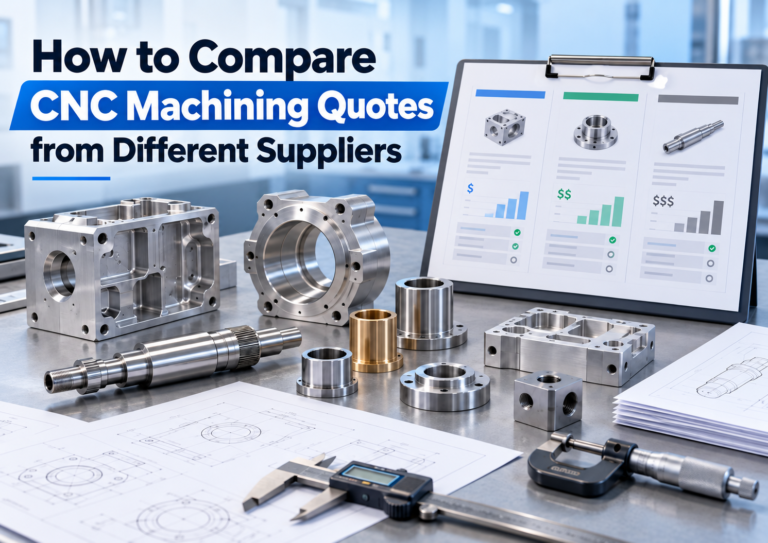
One of the most effective methods for reducing machining expenses is comparing quotations from multiple qualified manufacturers.
However, comparing suppliers involves more than reviewing the final price.
Why CNC machining quotations vary
Imagine that your company needs 500 precision-machined steel components.
You receive three quotations:
| Supplier | Price per part | Total for 500 parts |
|---|---|---|
| Supplier A | €42 | €21,000 |
| Supplier B | €36 | €18,000 |
| Supplier C | €33 | €16,500 |
At first glance, Supplier C appears to be the best choice.
But what if:
- Supplier C excludes material certificates.
- Supplier B includes dimensional inspection.
- Supplier A provides a shorter confirmed lead time.
- Supplier C requires an additional setup fee.
- One quotation excludes transportation.
- The suppliers interpret certain drawing requirements differently.
Without clarifying these differences, the lowest quotation may not represent the most economical purchasing decision.
What purchasing managers should compare
Before selecting a CNC machining supplier, evaluate the following:
Manufacturing price: Is the quotation based on the exact same drawing revision, material, and quantity?
Quality requirements: Are the specified tolerances, inspection procedures, and required certificates included?
Delivery conditions: Are delivery dates realistic, and are transportation costs included?
Production capability: Does the supplier have appropriate machines for the component’s geometry and dimensions?
Repeat-order pricing: Can the supplier maintain competitive pricing for future production batches?
Communication: Can technical questions and changes be resolved efficiently?
A supplier offering a slightly higher price may still be more competitive when overall procurement costs are considered.
When should you look for a new CNC supplier?
Consider comparing alternative manufacturers when:
- Your current supplier repeatedly increases prices.
- Quotations are significantly higher than expected.
- Lead times continue to increase.
- Your supplier is reluctant to accept smaller production batches.
- You regularly experience quality problems.
- You want to qualify an additional European production source.
You do not necessarily need to replace an existing supplier immediately.
A second qualified CNC machining supplier can help you benchmark pricing, access additional manufacturing capacity, and reduce purchasing risks.
MegaMETA helps European purchasing departments evaluate alternative CNC machining suppliers for existing and new components.
Send Your Drawings for a Competitive Quote
3. Review Unnecessarily Tight Tolerances
Tolerances can have a significant influence on CNC machining costs.
However, tighter tolerances do not automatically mean a better component.
They mean that the manufacturer must achieve a more restrictive dimensional requirement.
For example, consider two dimensions:
- 50.00 ±0.10 mm
- 50.00 ±0.01 mm
These specifications may require different machining strategies, measuring equipment, and process controls.
The tighter tolerance can increase machining time, inspection requirements, and the risk of rejected components.
Why unnecessarily tight tolerances increase costs
A manufacturer may need to use:
- Additional finishing passes.
- More precise machining equipment.
- Special workholding arrangements.
- Slower cutting parameters.
- More frequent dimensional inspections.
- Temperature-controlled measurement processes.
- Secondary grinding or finishing operations.
Not every component requires these processes.
For example, a mounting plate may have a few critical hole positions while its external dimensions can tolerate greater variation.
Applying extremely tight tolerances to every dimension can make the component unnecessarily expensive.
What purchasing managers should do
Work with your engineering department to identify:
- Which dimensions are functionally critical.
- Which tolerances affect assembly or product performance.
- Which dimensions can use standard manufacturing tolerances.
- Whether the current drawing includes unnecessarily restrictive requirements.
Important: Never relax tolerances solely to reduce costs without engineering approval. Changes must be validated against functional, safety, and assembly requirements.
The objective is not to reduce quality.
It is to specify the precision that the component actually requires.
When sending an RFQ, you can ask the supplier to identify costly tolerances and suggest technically feasible alternatives for engineering review.
This approach is commonly referred to as Design for Manufacturability (DFM).
4. Choose Materials Based on Actual Requirements
Material selection is another major factor affecting CNC machining costs.
Steel, aluminum, stainless steel, titanium, and engineering plastics have different material costs and machining characteristics.
Choosing a material that exceeds the component’s actual performance requirements can create unnecessary expenses.
Example: Stainless steel versus carbon steel
Suppose a component is currently manufactured from stainless steel.
If the component operates in a non-corrosive environment, your engineering team might investigate whether a suitable carbon steel grade with appropriate protection could meet the functional requirements.
Potential savings may come from:
- Lower raw material costs.
- Different machining characteristics.
- More readily available stock sizes.
However, the alternative material may require surface treatment, and the complete cost must be evaluated.
Material changes should always be approved by the responsible engineering team.
Common CNC machining materials
| Material | Typical applications | Purchasing considerations |
|---|---|---|
| S235 / S355 steel | Structural components and general machinery | Often accessible and suitable for non-critical structural machining |
| C45 steel | Shafts and mechanical components | Widely used for general mechanical parts |
| 42CrMo4 | High-strength shafts and mechanical components | Heat treatment and material condition can affect cost |
| 304 stainless steel | Corrosion-resistant components | Machining effort and material cost should be evaluated |
| 316L stainless steel | More demanding corrosion environments | Material premium should be justified by application |
| 6082 aluminum | Housings, plates, and structural components | Often suitable for efficient machining |
| 7075 aluminum | High-strength aluminum components | Typically costs more than common structural aluminum alloys |
| Titanium Grade 5 | High-performance components | Material and machining costs can be substantial |
| POM engineering plastic | Bushings, guides, and mechanical parts | Dimensional stability and operating conditions must be considered |
Avoid specifying expensive materials without justification
A purchasing manager may notice that an existing component uses an expensive alloy.
Rather than immediately asking for a cheaper substitution, involve the design engineer.
Questions worth investigating include:
- Is the specified material necessary for the operating environment?
- Can another approved material offer equivalent performance?
- Does the part require its current heat-treatment condition?
- Are alternative stock dimensions available?
- Could a different material form reduce machining waste?
Material optimization can be especially valuable for recurring orders.
Even a modest saving per part can become meaningful when multiplied across annual production volumes.
5. Optimize Batch Sizes to Reduce CNC Setup Costs
Batch size is one of the most important factors affecting the price per CNC-machined component.
Every machining order involves preparation work.
The manufacturer may need to:
- Review technical drawings.
- Create or verify CNC programs.
- Prepare fixtures.
- Install cutting tools.
- Set machine offsets.
- Machine and inspect the first component.
- Perform final inspection and packaging.
Many of these activities are required whether the order contains 10 parts or 500 parts.
For this reason, smaller production batches often have higher unit prices.
Example: The effect of batch size
Consider the following hypothetical machining project:
- Setup and programming: €300 per batch.
- Machining and variable production cost: €18 per component.
| Order quantity | Setup cost per part | Estimated total unit cost |
|---|---|---|
| 10 parts | €30.00 | €48.00 |
| 25 parts | €12.00 | €30.00 |
| 50 parts | €6.00 | €24.00 |
| 100 parts | €3.00 | €21.00 |
| 250 parts | €1.20 | €19.20 |
Illustrative calculation only. Actual quotations depend on production conditions, material, inspection, and supplier pricing.
The example shows how setup costs can affect pricing.
However, ordering larger quantities is not always the best decision.
Extra inventory creates additional costs and risks.
How to find the right order quantity
Purchasing managers should balance unit-price savings with:
- Annual consumption.
- Warehouse space.
- Cash flow.
- Inventory holding costs.
- Demand uncertainty.
- Engineering changes.
- Risk of obsolete components.
Instead of simply asking for the lowest price, request quotations for several batch sizes.
For example:
RFQ quantities: 25, 50, 100, 250, and 500 units.
This allows you to identify price breaks and compare them with your actual purchasing requirements.
Consider scheduled deliveries
If your company needs 1,200 components per year, you may not want all 1,200 delivered at once.
A supplier might be able to evaluate a production arrangement with agreed quantities and monthly or quarterly deliveries.
Such an arrangement must clearly define inventory ownership, delivery obligations, minimum quantities, and pricing.
For recurring CNC machining requirements, a well-structured supply agreement may reduce unnecessary setup and purchasing administration costs.
6. Simplify Component Design Where Possible
Some CNC-machined components cost more than necessary because their design requires difficult manufacturing operations.
This does not mean the component is poorly designed.
It may simply have been optimized for function without considering the most economical manufacturing method.
Design simplification can reduce machining time while preserving performance.
Deep pockets and narrow internal features
Deep pockets often require long cutting tools.
Long tools may need more conservative cutting conditions to control vibration and maintain dimensional accuracy.
Narrow internal corners can require small-diameter tools, additional passes, or specialized machining methods.
If the feature is not functionally critical, an engineering-approved geometry change may simplify the process.
Unnecessary machining operations
Consider a component that requires machining on six sides.
Depending on the geometry, the manufacturer may need multiple setups to access all surfaces.
Each additional setup adds handling time and potentially more inspection requirements.
In some cases, revising non-critical features can reduce the number of required setups.
Standard hole and thread sizes
Unusual hole diameters and uncommon thread specifications may require additional tools or special procedures.
Using standard dimensions where functionally acceptable can simplify tooling and reduce production complexity.
Internal corners and radii
CNC milling tools are round.
Therefore, perfectly sharp internal corners cannot normally be created by standard end milling alone.
Specifying a small internal corner radius may require a smaller tool and longer machining time.
Allowing a larger radius, where assembly permits, can improve machining efficiency.
Ask for DFM feedback before production
Purchasing managers do not need to redesign components themselves.
Instead, send drawings to a supplier capable of identifying manufacturing challenges.
Ask the supplier:
“Are there any design features that could be modified to reduce machining costs without affecting component function?”
The supplier may propose improvements for the engineering department to evaluate.
For high-volume or recurring components, even small improvements to cycle time can have a substantial commercial effect.
MegaMETA can review technical drawings and discuss suitable machining strategies through its CNC manufacturing network.
Request a Drawing Review and CNC Quote
7. Match the Manufacturing Process to the Component
Not every metal component needs to be fully machined from solid stock.
Some parts may be produced more economically using another manufacturing process followed by CNC finishing.
The best method depends on geometry, quantity, material, tolerances, and mechanical requirements.
CNC machining from solid material
Machining from solid bar, plate, or billet is commonly suitable for:
- Prototypes.
- Small production batches.
- Components with relatively simple geometry.
- Parts that require tight dimensional tolerances.
- Projects where dedicated tooling would not be economical.
It can also be suitable for larger series when the geometry and process allow competitive cycle times.
Casting followed by CNC machining
For certain complex components, casting can produce a near-net-shape blank.
Critical surfaces are then CNC-machined to their final dimensions.
This method may reduce material removal compared with machining the entire component from solid stock.
Possible applications include:
- Pump housings.
- Valve bodies.
- Gearbox housings.
- Complex mechanical enclosures.
- Machinery components.
However, casting may introduce tooling, inspection, porosity, and material-property considerations.
The economic benefit should be evaluated against the required order quantities.
MegaMETA coordinates metal casting services and related machining operations through its manufacturing partner network.
Forging followed by machining
Forged blanks can also be suitable for certain highly loaded mechanical components.
Depending on the design and production volumes, a forged preform may reduce the material that must be removed through machining.
Typical components can include shafts, flanges, and high-strength mechanical parts.
Forging dies and setup costs must still be considered when calculating total production costs.
Laser cutting and secondary machining
Some components can be produced more efficiently from laser-cut plate rather than fully CNC-milled from solid stock.
For example, a flat mounting plate with a complex outer profile may require:
- Laser cutting.
- Deburring.
- CNC machining of critical holes or surfaces.
- Surface treatment.
This combination can be more economical than machining the entire profile.
MegaMETA can coordinate sheet metal fabrication and related machining services for suitable projects.
For purchasing managers, the opportunity is to compare complete manufacturing routes rather than assuming the existing process is always the cheapest.
8. Reduce Costs by Consolidating Manufacturing Processes
Purchasing managers often work with several suppliers to produce one finished component.
A typical project might involve:
- A material supplier.
- A CNC machining company.
- A heat-treatment provider.
- A grinding specialist.
- A surface-treatment supplier.
- A final inspection provider.
Each additional supplier can introduce separate quotations, purchase orders, transport costs, communication requirements, and scheduling risks.
The hidden cost of multiple suppliers
Even when individual operations are competitively priced, total procurement costs may increase because of:
- Extra transportation between suppliers.
- Additional handling.
- Separate quality documentation.
- Communication delays.
- More purchase orders.
- Inventory waiting between operations.
- Difficulty coordinating delivery dates.
For example, a CNC-machined steel shaft may require turning, heat treatment, grinding, and final inspection.
Coordinating these operations separately can demand considerable purchasing and production-planning effort.
The advantage of a coordinated manufacturing partner
A manufacturing coordination partner can organize several production processes through a network of specialized suppliers.
This does not mean every operation must be performed in one factory.
Instead, the objective is to simplify procurement and improve coordination.
MegaMETA operates through a manufacturing partner network in Lithuania and Europe.
Depending on the project, its services can combine:
- CNC turning and milling.
- Precision grinding.
- Sheet metal fabrication.
- Welding.
- Metal casting.
- Surface treatments.
- Quality inspection and production coordination.
For OEM purchasing departments, fewer separate supplier relationships can reduce administrative workload and make complex manufacturing projects easier to manage.
The actual savings will depend on each project’s production processes, logistical requirements, and commercial arrangements.
9. Avoid Paying for Quality Requirements You Don’t Need
Quality control is essential in CNC machining.
However, inspection and documentation should match the actual requirements of the component.
A precision hydraulic component may require detailed dimensional reports, material traceability, and specific surface-finish verification.
A simple mounting bracket may require a less extensive inspection process.
Applying the same documentation requirements to both components can increase costs unnecessarily.
Common inspection costs
Quality-related manufacturing costs may include:
- Coordinate Measuring Machine (CMM) inspection.
- Surface roughness measurement.
- Material certification.
- Hardness testing.
- First Article Inspection (FAI).
- Special dimensional reporting.
- Third-party inspection.
- Additional traceability documentation.
These services can be essential for certain applications.
The goal is not to remove necessary inspections.
It is to ensure that each quality requirement has a clear technical, contractual, or regulatory purpose.
Define the scope before requesting quotations
In your RFQ, specify:
- Which dimensions require documented inspection.
- Whether material certificates are required.
- Which certificate type is needed.
- Whether first-article approval is necessary.
- Which surface-finish requirements must be verified.
- Whether special testing is required.
For example, if EN 10204 3.1 material certificates are required, state this explicitly.
If complete CMM inspection of every component is necessary, communicate this before the supplier prepares the quotation.
Unclear requirements can create pricing differences and disputes after the order has been placed.
Focus quality controls on actual risks
A risk-based inspection approach can help balance quality and cost.
Critical dimensions and safety-related characteristics should receive appropriate attention.
Less critical features may be inspected differently where approved by the customer’s engineering and quality teams.
The objective is to maintain the required quality with an efficient, clearly defined inspection process.
10. Consider Alternative European CNC Machining Suppliers
Many European OEM companies purchase CNC-machined components from established suppliers in their domestic markets.
This can provide benefits such as proximity, familiar communication, and existing supplier relationships.
However, relying only on domestic manufacturers may limit opportunities to compare pricing and production capacity.
Why purchasing managers explore alternative locations
Companies may consider suppliers in other European countries because they want to:
- Reduce manufacturing costs.
- Find additional CNC capacity.
- Improve delivery reliability.
- Diversify their supply chains.
- Source larger or more complex components.
- Find suppliers willing to handle different batch sizes.
Lithuania can be one potential sourcing location for these requirements.
CNC machining in Lithuania
Lithuania provides access to European manufacturing resources and operates within the EU market.
For buyers in Germany, Sweden, Denmark, Finland, the Netherlands, and other European countries, Lithuanian suppliers can be considered when comparing manufacturing alternatives.
Potential advantages depend on the project but may include competitive quotations, access to specialized machines, and opportunities to coordinate multiple manufacturing processes.
However, no country is automatically the cheapest or most reliable for every component.
Purchasing decisions should be based on verified manufacturing capabilities and actual quotations.
Why MegaMETA may be a suitable alternative
MegaMETA is based in Kaunas, Lithuania, and coordinates precision manufacturing through its partner network.
Its CNC machining capabilities include CNC turning, 3-axis to 5-axis CNC milling, and precision grinding.
The manufacturing network supports different materials, component sizes, and production quantities, subject to technical evaluation.
For purchasing managers, MegaMETA can serve as a contact point for evaluating new CNC manufacturing projects or alternative production sources.
Already have drawings and a current supplier price?
Send your requirements and request a comparable quotation.
Compare CNC Machining Prices with MegaMETA
11. Calculate the Total Cost of CNC-Machined Components
A common purchasing mistake is evaluating CNC machining suppliers based only on unit price.
The actual cost of a component includes more than the amount shown on the quotation.
Total cost of ownership
Purchasing managers should consider:
Purchase price: What does the supplier charge per component?
Transportation: What does it cost to move the components to your facility?
Quality costs: Are there inspection, rejection, rework, or replacement costs?
Inventory: How much working capital is tied up in stock?
Administrative effort: How many separate orders, follow-ups, and supplier interactions are required?
Delivery performance: What are the consequences if components arrive late?
Supplier qualification: What costs are involved in approving or transferring production to a new manufacturer?
Example: Comparing two CNC suppliers
Consider the following hypothetical annual purchasing requirements.
Your company buys 1,000 CNC-machined components per year.
| Cost element | Supplier A | Supplier B |
|---|---|---|
| Component price | €45 | €40 |
| Annual quantity | 1,000 | 1,000 |
| Annual component cost | €45,000 | €40,000 |
| Transportation | €800 | €1,800 |
| Quality-related costs | €500 | €700 |
| Purchasing and administration | €400 | €500 |
| Total annual cost | €46,700 | €43,000 |
In this hypothetical case, Supplier B provides an estimated annual saving of €3,700.
This comparison assumes equivalent product requirements and acceptable delivery performance. One-time supplier qualification and transition expenses are excluded.
The example illustrates why buyers should consider more than unit price.
If Supplier B regularly delivers late or supplies nonconforming components, the expected saving may disappear.
On the other hand, if quality and delivery performance remain acceptable, the alternative supplier may offer meaningful savings.
The most competitive CNC supplier is not necessarily the one with the lowest hourly machine rate. It is the supplier delivering conforming components at the lowest sustainable overall cost.
12. How to Prepare an RFQ That Helps Reduce CNC Machining Costs
A clear and complete Request for Quotation is one of the simplest ways to improve manufacturing pricing.
Suppliers cannot accurately optimize a quotation when important technical or commercial details are missing.
Incomplete RFQs may lead to conservative pricing, repeated clarification requests, or unexpected costs later.
CNC machining RFQ checklist
Before contacting a CNC manufacturer, prepare the following information.
| Information | What to provide |
|---|---|
| Technical drawing | PDF with all required dimensions and tolerances |
| 3D model | STEP or another suitable CAD format |
| Material | Exact grade and material condition |
| Quantity | Initial order and possible alternative batch sizes |
| Annual demand | Estimated yearly consumption |
| Surface finish | Required roughness and treatments |
| Heat treatment | Exact specification if applicable |
| Quality documents | Certificates and inspection requirements |
| Delivery date | Target date or delivery schedule |
| Delivery location | Country, city, and relevant delivery terms |
| Commercial details | Expected repeat orders and special requirements |
Ask for different pricing options
A strong CNC machining RFQ should not necessarily ask for only one price.
Consider requesting:
- Pricing for several production quantities.
- A quotation using the current drawing.
- A separate cost-optimization proposal.
- Alternative manufacturing methods, where technically appropriate.
- Pricing for annual or repeat orders.
- Options for scheduled deliveries.
For example, you can request:
“Please quote the attached component for 50, 100, 250, and 500 pieces. The estimated annual demand is 1,000 pieces. Please identify any design, material, or production improvements that could reduce cost without changing critical functional requirements.”
This gives the supplier more opportunities to propose an efficient manufacturing solution.
Keep engineering changes separate from the original quote
When asking for cost-saving recommendations, make it clear that the original specification remains valid unless changes are approved.
This allows the purchasing team to compare:
- The cost of manufacturing the current design.
- The cost of a proposed alternative.
- Any tooling or qualification expenses.
- The engineering work needed to implement the change.
No material, dimensional, or process changes should be introduced into production without the appropriate approval.
13. When Should You Change Your CNC Machining Supplier?
Sometimes the most effective cost-reduction opportunity is qualifying a new manufacturing partner.
However, switching suppliers should be a controlled purchasing decision rather than a reaction to one expensive quotation.
Signs that it may be time to compare alternatives
Your existing CNC machining supplier may no longer be the best fit if:
- Prices have increased repeatedly without a clear explanation.
- Production costs are consistently above comparable quotations.
- The supplier struggles with your order quantities.
- Delivery dates are frequently missed.
- Quality problems create additional internal costs.
- Communication is slow or inconsistent.
- The supplier cannot provide the manufacturing processes you need.
Reduce the risks of switching suppliers
A structured supplier transfer process can include:
Step 1: Obtain a comparable quotation.
Send the same technical drawings, material specifications, quantities, and quality requirements to the potential new supplier.
Step 2: Evaluate manufacturing capabilities.
Confirm that the supplier can handle the required dimensions, tolerances, materials, and processes.
Step 3: Order samples or a trial batch.
Use a small initial order to evaluate quality, communication, packaging, and delivery.
Step 4: Approve the components.
Complete any required engineering, quality, or supplier approval procedures.
Step 5: Introduce repeat orders.
Begin scheduled production only after the new supplier has demonstrated acceptable performance.
This reduces the risk of transferring critical production too quickly.
You can maintain two CNC suppliers
For many OEM companies, keeping an existing supplier and adding another qualified manufacturer is a practical strategy.
Dual sourcing can provide:
- Greater production flexibility.
- Additional manufacturing capacity.
- Better purchasing benchmarks.
- Reduced dependency on a single supplier.
- Alternative capacity when demand increases.
The actual benefits depend on maintaining qualified production processes and clear responsibilities.
14. How MegaMETA Helps European Buyers Optimize CNC Machining Costs
For purchasing managers, the objective is straightforward:
Purchase the correct components, at competitive prices, with consistent quality and reliable delivery.
MegaMETA supports this objective through coordinated CNC machining and industrial manufacturing services.
CNC milling and turning
MegaMETA offers access to CNC milling and turning through its manufacturing partner network.
Available processes include 3-axis, 4-axis, and 5-axis milling, CNC turning, and precision grinding, depending on the project’s technical requirements.
Explore CNC Machining Services
Different production quantities
Not every customer needs thousands of identical components.
MegaMETA can evaluate individual prototypes, small production batches, and recurring serial orders according to component complexity and manufacturing availability.
This allows buyers to request quotations matched to their purchasing requirements.
Multiple materials
Manufacturing capabilities include commonly used industrial materials such as:
- Carbon steel.
- Alloy steel.
- Stainless steel.
- Aluminum alloys.
- Brass and copper alloys.
- Titanium.
- Engineering plastics.
Specific material grades, conditions, and certificate requirements should be identified in the RFQ.
Quality and inspection coordination
MegaMETA works through an ISO 9001-certified manufacturing partner network and coordinates quality requirements for customer projects.
Depending on the application, relevant inspection and documentation can include dimensional measurements, CMM reports, surface-finish verification, and material certificates.
The exact requirements should be established before order confirmation.
Coordinated manufacturing services
For components that require more than CNC machining, MegaMETA can also coordinate related processes through its manufacturing partners.
These include:
- Sheet metal fabrication.
- Metal casting.
- Welding.
- Precision grinding.
- Surface treatment.
- Additional manufacturing operations.
This can simplify procurement for buyers managing complex metal-component projects.
Request a CNC machining cost comparison
If you’re purchasing CNC-machined components from an existing supplier, comparing another quotation can help you understand whether the current pricing is competitive.
MegaMETA can evaluate your technical requirements and propose a project-specific production quotation.
To get started, send:
- Technical drawings or CAD models.
- Material specifications.
- Required quantities.
- Expected annual volumes.
- Quality and inspection requirements.
- Desired delivery dates.
- Delivery destination.
Email: contact@megameta.lt
Location: Kaunas, Lithuania
15. Frequently Asked Questions About Reducing CNC Machining Costs
What is the most effective way to reduce CNC machining costs?
There is no single method that works for every component.
Common opportunities include comparing qualified manufacturers, optimizing batch sizes, reviewing tolerances, improving component manufacturability, and selecting efficient production methods.
For recurring orders, even relatively small improvements in unit costs may generate significant annual savings.
Is CNC machining cheaper in Lithuania?
Lithuanian manufacturers may offer competitive quotations for certain components.
However, actual savings depend on material, geometry, tolerances, order quantities, supplier capabilities, and logistics.
Purchasing managers should compare complete quotations rather than assuming that one country is always less expensive.
Why does CNC machining become cheaper with larger quantities?
Many CNC projects require programming, machine setup, tooling preparation, and first-piece inspection.
These costs are distributed across the production batch.
Larger quantities can reduce setup cost per component, although inventory and storage costs must also be considered.
Do tighter tolerances increase CNC machining costs?
They often can.
Tighter tolerances may require additional machining operations, more advanced equipment, slower machining parameters, and more extensive inspection.
However, tolerances required for functional or safety reasons should never be relaxed without engineering approval.
Can changing the material reduce CNC machining costs?
Potentially.
Different materials have different purchase prices and machining characteristics.
An approved alternative material may reduce costs, but it must satisfy the component’s mechanical, environmental, and functional requirements.
How many CNC machining suppliers should I compare?
For suitable non-sole-source projects, requesting quotations from two or three qualified manufacturers can provide a useful commercial comparison.
The appropriate number depends on component complexity, sourcing strategy, urgency, and the cost of qualifying additional suppliers.
Can I reduce CNC machining costs without changing the drawing?
Yes.
Possible approaches include comparing suppliers, optimizing batch sizes, improving scheduling, consolidating production steps, and negotiating repeat-order arrangements.
These strategies may reduce costs while keeping the approved component design unchanged.
Should I switch suppliers just because another manufacturer is cheaper?
Not necessarily.
The new supplier should be evaluated for quality, capabilities, documentation, communication, delivery reliability, and total purchasing cost.
For critical components, trial orders and formal approval procedures may be required.
Can MegaMETA quote existing CNC-machined components?
Yes. MegaMETA can evaluate existing component drawings and technical specifications through its manufacturing network.
This can be useful when buyers want to benchmark prices, find alternative manufacturing capacity, or qualify a second supplier.
You can submit a quotation request through the MegaMETA contact page.
Conclusion: Lower CNC Machining Costs Without Compromising Quality
Reducing CNC machining costs does not have to mean accepting lower-quality components, unreliable deliveries, or unnecessary manufacturing risks.
For European purchasing managers, the most effective approach is to examine the complete manufacturing and procurement process.
This includes understanding machining cost drivers, comparing qualified suppliers, evaluating batch sizes, reviewing tolerances, and identifying opportunities to simplify production.
Sometimes the biggest savings come from improving the design.
In other cases, savings can come from purchasing larger batches, coordinating additional processes, or sourcing components from a more suitable CNC manufacturer.
The objective should always be to reduce unnecessary costs while maintaining the technical specifications and quality standards your product requires.
If your current CNC supplier is becoming too expensive, your production volumes are changing, or you want to benchmark prices against an alternative European manufacturer, MegaMETA can help evaluate your requirements.
Through its manufacturing network in Lithuania, MegaMETA provides CNC machining and coordinated industrial production solutions for European OEM customers.
Are You Paying Too Much for CNC-Machined Parts?
You don’t need to change suppliers immediately to explore potential savings.
Start by requesting a comparable quotation.
Send MegaMETA your existing technical drawings, material requirements, quantities, and delivery expectations.
Our team can review the requirements and prepare a project-specific manufacturing quotation.
REQUEST A COMPETITIVE CNC MACHINING QUOTE
MegaMETA – Precision CNC Machining and Industrial Manufacturing Solutions in Lithuania.