Choosing a CNC machining supplier in Europe is rarely just a question of finding a company with the right machines.
For OEMs, engineering teams, procurement departments and industrial manufacturers, the real challenge is finding a supplier that can repeatedly manufacture parts to specification, document quality, respond quickly to engineering changes and deliver when promised.
A supplier can offer an attractive price and still become expensive if parts arrive late, tolerances drift between batches, documentation is incomplete or communication becomes difficult when something changes.
That is why the best CNC machining supplier is not necessarily the supplier with the lowest quoted unit price. It is the supplier that creates the lowest overall sourcing risk while maintaining competitive manufacturing costs.
This guide explains what European buyers should evaluate before selecting a CNC machining partner, from technical capability and quality assurance to lead times, communication, scalability and total cost.
What Should You Look for in a CNC Machining Supplier?
A reliable CNC machining supplier should be able to demonstrate five things:
- The technical capability to manufacture your parts
- A repeatable quality-control system
- Clear manufacturing and inspection documentation
- Reliable communication and delivery performance
- The ability to support your production volumes over time
Price matters, but it should be evaluated alongside these factors rather than independently.
For a purchasing team comparing several CNC machining companies in Europe, the supplier that is slightly more expensive per component may still provide the lower total cost if it reduces inspection failures, administrative work, emergency shipping and production delays.
1. Start With Technical Capability, Not the Supplier’s Machine List
Most CNC suppliers can provide a list of machine brands, spindle speeds and axis configurations.
That information has value, but it does not answer the most important question:
Can the supplier manufacture your specific component consistently and economically?
A better technical evaluation starts with the part itself.
Consider:
- Component dimensions
- Material
- Geometric complexity
- Tolerance requirements
- Surface finish
- Thread specifications
- Heat treatment
- Surface treatment
- Inspection requirements
- Annual volume
- Batch size
- Required delivery schedule
A simple aluminium bracket and a precision stainless-steel housing may both be described as “CNC machined parts,” yet they require very different processes, tooling strategies and quality controls.
For complex components, ask whether the supplier can support:
- CNC milling
- CNC turning
- 3-axis machining
- 4-axis machining
- 5-axis machining
- Mill-turn operations
- Large-component machining
- Small precision components
- Hard-material machining
- Secondary operations
The objective is not to find the supplier with the longest capability list. It is to find one whose equipment and manufacturing experience match the parts you actually purchase.
A useful question to ask
Instead of asking:
“What CNC machines do you have?”
ask:
“How would you manufacture this component, and what do you see as the main manufacturing risks?”
A strong manufacturing partner should be able to discuss workholding, tool access, tolerance interactions, inspection strategy and potential cost drivers before production begins.
That conversation can tell you far more than a machine list.
2. Evaluate Tolerances Realistically
One of the most common mistakes when sourcing CNC machined parts is comparing suppliers purely by the smallest tolerance they claim to achieve.
A supplier may advertise very tight machining tolerances, but this does not mean every dimension on every component should be manufactured to that tolerance.
What matters is whether the supplier can repeatedly hold the specific critical dimensions required by your drawing.
Tighter tolerances can require:
- Additional machining operations
- More expensive tooling
- Controlled environments
- Additional measurement
- Slower machining
- More frequent tool changes
- Increased scrap risk
All of these can increase part cost.
A capable CNC supplier should therefore be willing to identify unnecessarily restrictive tolerances and discuss whether they can be relaxed without affecting component function.
That is particularly valuable during new-product introduction or design-for-manufacturing reviews.
Procurement takeaway
Do not ask only:
“Can you hold ±0.01 mm?”
Ask:
“Can you repeatedly hold this tolerance at my required production quantity, and how will you verify it?”
Repeatability matters more than a capability demonstrated once.
3. Check the Supplier’s Quality Management System
For industrial OEM supply, quality assurance should not begin when a finished component reaches final inspection.
It should be built into the manufacturing process.
When evaluating a CNC machining supplier in Europe, examine how the company controls:
- Incoming material
- Manufacturing instructions
- Revision changes
- Inspection
- Non-conforming parts
- Corrective actions
- Measuring equipment
- Traceability
- Supplier management
- Documentation
ISO 9001 certification can provide useful evidence that a structured quality-management system exists, particularly for recurring industrial production.
However, certification alone should not end the evaluation.
Ask how quality is managed in practice.
Useful questions include:
- How are drawing revisions controlled?
- How are critical dimensions identified?
- What inspection equipment is available?
- Can measurement reports be supplied?
- How are non-conformities handled?
- Can material certificates be provided?
- How is batch traceability maintained?
- Can first-article inspection be performed?
For precision CNC parts, measurement capability may include CMM inspection, surface roughness measurement, hardness testing and conventional dimensional inspection.
The important point is that the inspection method should match the component requirement.
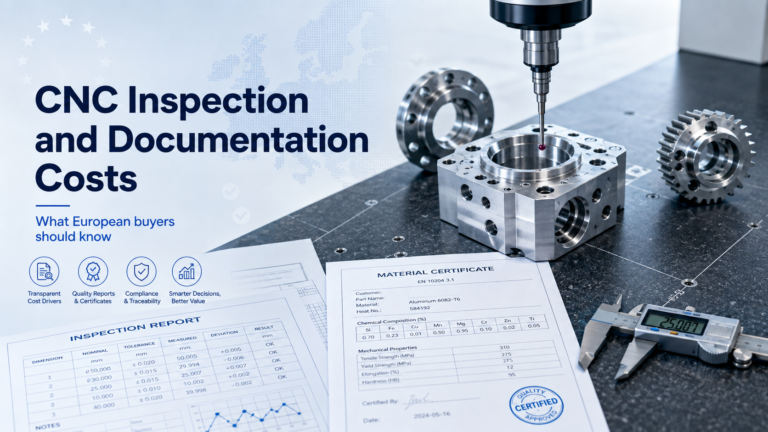
4. Ask What Documentation Can Be Supplied With the Parts
Documentation is often underestimated when suppliers are initially compared.
For many OEMs, however, receiving a correct component without the required documentation is still an incomplete delivery.
Depending on the application, buyers may require:
- Material certificates
- EN 10204 3.1 certificates
- Dimensional inspection reports
- CMM reports
- First Article Inspection reports
- Certificates of conformity
- Heat-treatment certificates
- Surface-treatment certificates
- Batch traceability
- Measurement records
Clarify these requirements before quotation.
Adding documentation after production has started can create unnecessary delays and cost.
This is particularly important for regulated sectors, critical components and companies operating formal supplier-quality systems.
5. Compare Total Cost, Not Only CNC Machining Price
Price will always be part of supplier selection.
But comparing only the price printed on two quotations can be misleading.
The real cost of a CNC component can include:
Unit price + transport + quality problems + administrative effort + inventory + delays + rework + production disruption
Consider two suppliers.
Supplier A quotes €18.50 per part.
Supplier B quotes €20.20.
At first glance, Supplier A appears cheaper.
But if Supplier A requires larger minimum orders, produces more quality issues, communicates slowly and requires expensive expedited freight, its actual sourcing cost may quickly exceed Supplier B.
For European OEMs, this is one reason regional manufacturing can be attractive even when the initial unit price is not always the lowest available globally.
Shorter supply chains can improve responsiveness when drawings change, forecasts move or replacement components are suddenly required.
When comparing quotations, check whether they include:
- Material
- Tooling
- Setup costs
- Inspection
- Documentation
- Surface treatment
- Heat treatment
- Packaging
- Shipping
- Minimum quantities
Without a common quotation scope, comparing unit prices can give the wrong answer.
6. Understand the Supplier’s Minimum and Maximum Production Volumes
Some CNC machining companies are optimized for prototypes.
Others are optimized for large recurring production batches.
The right supplier depends on your requirements.
An OEM may initially require:
- 2 prototype components
followed by:
- 25 validation parts
then:
- 250 pre-production components
and eventually:
- 2,000 parts per year.
Changing suppliers at every production stage creates additional qualification work and manufacturing risk.
For products expected to move from development into recurring production, it can therefore be valuable to find a CNC machining partner capable of supporting multiple production stages.
Ask suppliers about their typical:
- Prototype quantities
- Minimum order quantities
- Economic batch sizes
- Monthly capacity
- Annual production volumes
- Repeat-order capabilities
A supplier suitable for 10 parts is not automatically suitable for 10,000.
The opposite is also true.
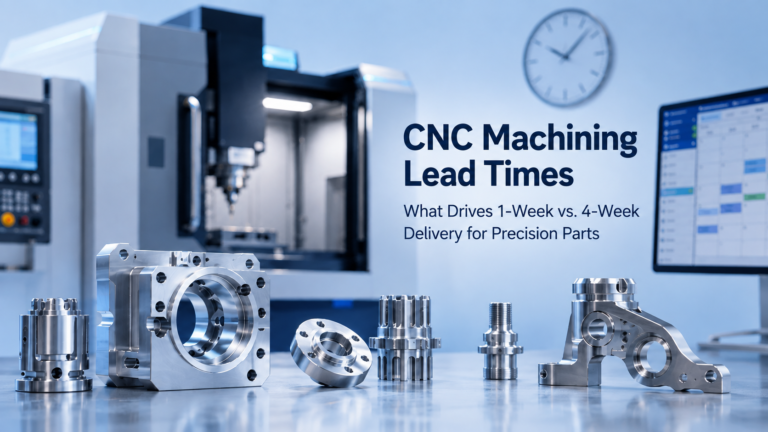
7. Evaluate Lead Time — But Ask What It Actually Means
“Lead time” can mean different things to different suppliers.
One quotation may define lead time as the period from purchase order to shipment.
Another may begin counting only after material arrives.
A third may exclude surface treatment.
Make sure you are comparing the same thing.
Ask:
What is the expected time from confirmed order and approved manufacturing documentation to shipment?
Then understand what drives it.
Typical lead-time factors include:
- Raw-material availability
- Machine capacity
- Tooling
- Component complexity
- Inspection requirements
- Heat treatment
- Surface treatment
- Batch quantity
- External operations
- Packaging
- Transport
For recurring production, also ask whether the supplier can maintain scheduled deliveries rather than manufacturing the entire annual requirement at once.
This can reduce inventory while keeping production supplied.
8. Communication Is a Manufacturing Capability
Communication sometimes receives less attention during supplier qualification because it cannot be measured like spindle capacity or dimensional tolerance.
Yet poor communication is one of the fastest ways for a manufacturing project to fail.
Imagine that an engineer discovers a drawing issue two days after sending an order.
Can the supplier react before material is cut?
Or imagine a machine operator identifies an ambiguous tolerance during setup.
Will the supplier ask for clarification, or simply make an assumption?
Good industrial suppliers communicate engineering questions early.
When evaluating a supplier, pay attention to:
- Response speed
- Technical understanding
- Quality of questions
- English proficiency
- Drawing comprehension
- Quotation clarity
- Change-management process
For international European supply chains, clear English-language technical communication can be particularly important.
The goal is not constant communication.
The goal is fast communication when something matters.
9. Look for Engineering Feedback Before Production
A machining supplier should not redesign your component without permission.
But experienced manufacturers often identify opportunities to make components easier or less expensive to manufacture.
Typical issues include:
- Unnecessarily tight tolerances
- Very deep pockets
- Difficult internal corners
- Excessive surface-finish requirements
- Thin walls
- Hard-to-reach features
- Non-standard threads
- Expensive material choices
- Tolerances that require multiple setups
- Features that complicate inspection
A supplier that identifies these issues before production can potentially save much more than a small difference in quoted unit price.
This is where a CNC supplier starts becoming a manufacturing partner.
10. Consider the Complete Manufacturing Chain
A CNC machined component often requires more than machining.
It may also require:
- Heat treatment
- Grinding
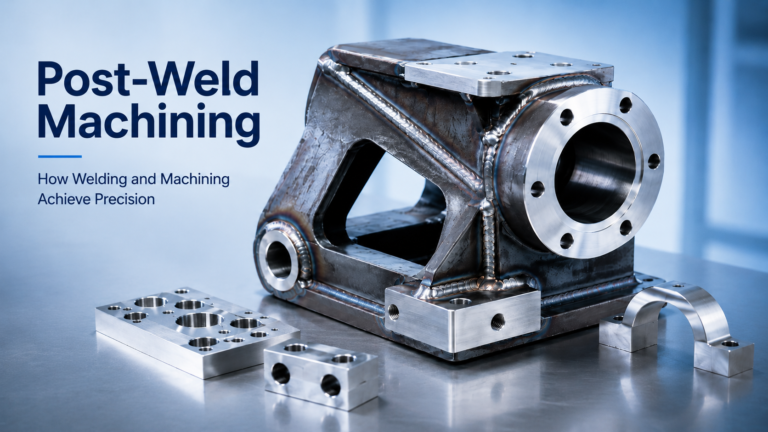
- Welding
- Gear cutting
- Laser marking
- Anodizing
- Zinc plating
- Nickel plating
- Powder coating
- Painting
- Passivation
- Assembly
- Special packaging
If the buyer must independently coordinate five different subcontractors, responsibility becomes fragmented.
When something goes wrong, determining where it happened can also become difficult.
For components requiring several operations, there can be significant value in working with a supplier capable of managing the complete manufacturing chain.
This does not necessarily mean every process must happen under one roof.
What matters is having one accountable supplier controlling the process, quality requirements and final delivery.
11. Verify Material Experience
A supplier experienced primarily in aluminium may not be the best choice for complex parts made from hardened tool steel.
Likewise, machining titanium, stainless steel, engineering plastics and high-strength steels creates different challenges.
Common CNC machining materials include:
Metals
- Carbon steel
- Stainless steel
- Tool steel
- Aluminium
- Brass
- Bronze
- Copper
- Titanium
Engineering plastics
- POM
- PA
- PEEK
- PTFE
- PE
- PMMA
Material experience affects tooling, cutting parameters, thermal control, workholding, surface finish and achievable production economics.
If a particular material is critical to your product, ask the supplier for examples of similar manufacturing experience.
12. European Location Can Matter More Than It Appears
For companies supplying customers across Europe, manufacturing location influences more than freight cost.
It can affect:
- Transport time
- Communication
- Time-zone differences
- Responsiveness
- Inventory requirements
- Emergency deliveries
- Supplier visits
- Engineering collaboration
Central and Eastern European manufacturing locations, including Lithuania and the Baltic region, can offer an interesting balance between manufacturing cost and proximity to major European industrial markets.
For OEMs in Germany, Sweden, Finland, Denmark, Norway, the Netherlands and other northern European markets, a supplier located within the European manufacturing ecosystem can also make short-notice engineering changes and repeat deliveries easier to coordinate than distant offshore sourcing.
That does not mean European sourcing is automatically the best option for every component.
High-volume, price-sensitive parts with stable designs may still justify longer global supply chains.
But for precision components, changing production requirements, low-to-medium volumes or engineering-intensive projects, responsiveness can carry substantial economic value.
13. Ask How the Supplier Handles Problems
No serious manufacturer should claim that manufacturing problems never occur.
The more useful question is:
What happens when something does go wrong?
A professional supplier should have a structured process for:
- Identifying the issue
- Containing affected components
- Determining root cause
- Implementing corrective action
- Preventing recurrence
- Communicating with the customer
For recurring OEM production, this is critical.
A supplier that responds transparently and systematically to a problem can be safer than one that promises perfection but cannot explain its corrective-action process.
14. Test the Supplier With a Real RFQ
Eventually, the best way to evaluate a CNC machining supplier is to send an actual component for quotation.
A useful RFQ should contain as much relevant information as possible.
Include:
- 2D technical drawing
- 3D CAD model where available
- Material specification
- Quantity
- Annual estimated demand
- Critical tolerances
- Surface-finish requirements
- Heat treatment
- Surface treatment
- Documentation requirements
- Required delivery date
- Delivery destination
STEP is commonly suitable for 3D manufacturing geometry, while PDF or DWG/DXF drawings can communicate tolerances, threads, surface finishes and other technical requirements.
The quality of the supplier’s response can itself become part of your qualification process.
Did they simply send a number?
Or did they identify missing information, manufacturing risks and potential improvements?
A good quotation should help you understand what you are buying, not just what it costs.
CNC Machining Supplier Evaluation Checklist
Before approving a new CNC supplier, confirm the following.
Technical
- Can they manufacture the required geometry?
- Can they machine the specified material?
- Can they hold the required tolerances repeatedly?
- Do they support the required component dimensions?
- Can they handle your batch sizes?
Quality
- Is a documented quality-management system in place?
- Is appropriate inspection equipment available?
- Can dimensional reports be supplied?
- Is material traceability available?
- Can non-conformities be managed systematically?
Commercial
- Is the quotation scope clear?
- Are tooling and setup costs transparent?
- Are minimum quantities acceptable?
- Are payment and delivery terms clear?
- Is the total landed cost competitive?
Supply chain
- Are secondary processes managed?
- Is material availability reliable?
- Can repeat production be supported?
- Can the supplier respond to urgent requirements?
Communication
- Are technical questions answered clearly?
- Are drawing changes controlled?
- Is communication fast enough for your organization?
- Do you know who is responsible for your project?
If a potential supplier performs well across these areas, price becomes much easier to evaluate in the correct context.
Frequently Asked Questions
What is the best CNC machining supplier in Europe?
There is no single supplier that is best for every CNC project. The right supplier depends on component size, material, tolerance, volume, documentation requirements, secondary processes and delivery expectations. Buyers should compare suppliers based on technical fit, quality capability, communication, total cost and production reliability rather than price alone.
How do I find a reliable CNC machining company in Europe?
Start by identifying suppliers that work with your required materials, component dimensions and production quantities. Then evaluate their quality-management system, inspection capability, technical communication, documentation, lead times and experience with similar components. A trial RFQ or initial production batch can help validate the supplier before larger recurring orders.
What information should I send for a CNC machining quote?
For an accurate quotation, provide a 2D drawing, 3D CAD model if available, material, quantity, tolerances, surface finish, heat treatment, surface treatment, inspection requirements, documentation requirements and required delivery date.
Is CNC machining cheaper in Eastern Europe?
Manufacturing costs can vary across Europe because of labour, energy, machine utilization, material sourcing and operating costs. For many buyers, countries such as Lithuania can offer competitive manufacturing economics while maintaining relatively short supply chains to Central and Northern European markets. The correct comparison should always use total landed cost rather than hourly machining rates alone.
Should I choose a local CNC supplier or an overseas supplier?
It depends on the component. Offshore manufacturing can work well for stable, predictable and sufficiently high-volume products. European sourcing can be particularly attractive where short lead times, engineering communication, lower inventory, frequent design changes or smaller production batches are important.
How important is ISO 9001 for a CNC machining supplier?
ISO 9001 can be valuable because it indicates that the supplier operates a formal quality-management system. However, buyers should also verify practical capabilities such as inspection equipment, traceability, drawing control, corrective-action processes and documentation.
Can one CNC supplier handle prototypes and series production?
Some can. This should be verified before supplier approval. A partner capable of supporting prototypes, validation batches and recurring production can reduce the need to transfer a component between suppliers as demand increases.
Choosing a CNC Machining Partner, Not Just a Machine Shop
Selecting a CNC machining supplier in Europe should ultimately come down to one question:
Can this company reliably protect your production?
The strongest supplier relationships are not built around the lowest possible machining rate.
They are built around predictable quality, transparent communication, technically sound manufacturing, competitive total cost and dependable delivery.
For procurement teams, this reduces supplier-management workload.
For engineers, it means fewer manufacturing surprises.
For production managers, it means parts arrive when they are needed.
And for OEMs, that reliability can ultimately matter far more than saving a small percentage on the initial machining quotation.
Looking for a CNC Machining Supplier in Europe?
MegaMETA supports European OEMs with precision CNC machining and broader manufacturing coordination from Lithuania, including CNC milling and turning, inspection, documentation and related production processes.
If you are currently evaluating suppliers, the simplest way to compare capabilities is with a real component.
Send your drawing, STEP file, material specification and required quantity to request an RFQ.
MegaMETA can review the manufacturing requirements and provide feedback on feasibility, production approach, pricing and expected lead time.