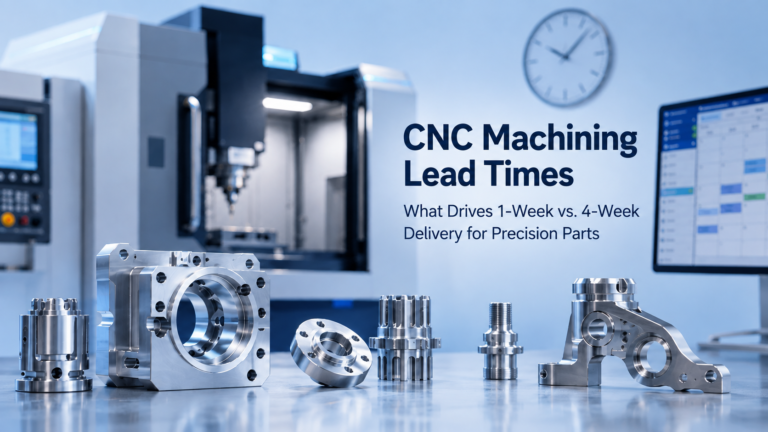
A CNC machine can remove metal extremely quickly. That does not necessarily mean your finished components will arrive quickly.
One of the biggest misunderstandings around CNC production lead time is treating machining time as if it were the entire manufacturing process. For many industrial components, the hours spent physically cutting material are only one part of the schedule.
A production order can lose days before the first tool touches the workpiece and additional days after machining has finished.
Drawing questions need clarification. Material has to arrive. Programs and fixtures have to be prepared. Parts need inspection. Anodizing, heat treatment or other secondary processes may involve another production queue. A dimensional problem can send a batch back for rework.
For engineering and procurement teams in Sweden, Finland, Denmark, Norway and the wider European manufacturing market, understanding these hidden lead-time drivers is important because the cheapest or fastest-looking CNC quote does not always create the fastest finished part.
The more useful question is:
What can delay the complete journey from approved drawing to inspected component delivered to your facility?
Here are the causes that matter most.
1. Incomplete or Ambiguous CNC Drawings
Some production delays begin before production officially begins.
A supplier receives a STEP model and drawing, but several questions remain unanswered. Which dimensions are actually critical? Does a general tolerance apply everywhere? Which revision is current? What surface finish is required? Is a particular thread specification mandatory? Does a cosmetic face have special requirements?
Production cannot safely proceed until those questions are answered.
A few emails may appear insignificant, but each clarification creates another hand-off between purchasing, engineering and manufacturing. If the engineer responsible for the component is unavailable, a one-hour technical question can become a two-day schedule delay.
This becomes particularly expensive with short production runs, prototypes and bridge production because engineering and setup represent a larger proportion of the total lead time.
How to prevent it
Send a complete RFQ package rather than only a 3D model.
The package should make the manufacturing intent obvious: current drawing revision, STEP file, quantity, material grade, critical tolerances, surface finish, threads, inserts, inspection requirements and any relevant material or traceability documentation.
If a dimension is genuinely critical to function, identify it. If it is not, avoid applying unnecessarily tight tolerances across the entire component.
A better drawing does not simply improve quality. It shortens decision time before production.
2. Over- Specified Tolerances
Tighter tolerances are not automatically better engineering.
A part specified at ±0.01 mm may require a very different manufacturing and inspection strategy from the same geometry at ±0.05 mm.
Tighter requirements can mean additional finishing passes, slower machining parameters, more controlled setups, temperature considerations, specialised measurement equipment and more inspection time.
The problem occurs when precision is specified where the assembly or function does not actually require it.
The manufacturer then has to produce—and the customer has to pay for—a more demanding process without receiving additional functional value.
This affects both CNC machining cost and CNC lead time.
A useful design review therefore asks two questions:
Where does precision create functional value?
And equally importantly:
Where does it not?
Applying demanding tolerances selectively can simplify manufacturing while preserving the performance of the part.
3. Difficult-to-Machine Geometry
A component that looks simple in CAD may be surprisingly difficult to manufacture.
Deep pockets, narrow internal corners, thin walls, long-reach features, complex undercuts and difficult tool access can increase programming and setup time considerably.
They can also make machining less stable.
Thin walls, for example, can deflect under cutting forces. Deep cavities may require long tools that are less rigid. Small internal radii may force the manufacturer to use smaller cutters and slower machining strategies.
In other cases, a feature that could almost be produced on a 3-axis machining centre requires an additional setup or a 5-axis process simply because of its orientation.
The important point is that geometry affects much more than cycle time.
It affects programming, tooling, workholding, inspection, machine selection and the probability of rework.
A practical DFM question
Before releasing a component, ask:
Could a small geometry change remove an entire machining operation?
Increasing an internal radius, standardising hole sizes, increasing wall thickness or changing feature orientation may reduce manufacturing complexity without changing the function of the product.
Good design for manufacturability is therefore not simply about making a component cheaper. It can make the production schedule substantially more predictable.
4. Material Availability
A machine can be available tomorrow and still be useless if the required material is not.
Common grades and dimensions may be readily available. Less common alloys, unusual bar sizes, thick plate, certified material or specialist engineering plastics can require additional sourcing time.
Material availability becomes particularly important when specifications include requirements such as specific melt certificates, mechanical properties, heat-treatment conditions or traceability.
There is also an important distinction between:
“We machine this material.”
and
“We regularly stock or can quickly source this exact grade and size.”
Procurement teams should establish material availability before assuming that machine availability equals production availability.
For recurring CNC components, forecasting demand or agreeing material strategies with the supplier can remove a recurring source of lead-time uncertainty.
5. CNC Programming, Tooling and Fixturing
The machine does not simply receive a CAD file and start producing finished parts.
Depending on the component, production may require CAM programming, toolpath simulation, tool selection, fixture design, workholding preparation, probing strategies and first-off validation.
For repeat parts, much of that work can already exist.
For a completely new component, it has to be created.
This explains why repeat CNC production can behave very differently from a first order even when the quantity is identical.
It also explains why switching suppliers repeatedly based purely on piece price can create hidden costs. Every new manufacturer may have to rebuild part of the process knowledge that already existed with the previous supplier.
For recurring low-volume CNC production, preserving validated programs, fixture concepts, inspection plans and revision history can improve both cost and delivery stability.
6. Production Capacity and Poor Scheduling
“Lead time” and “machining time” are two very different numbers.
A component may require only three hours of machine time but wait several days before the correct machining centre becomes available.
This is especially relevant for parts requiring specific capabilities such as large-envelope machining, mill-turn equipment, 5-axis machining or specialised inspection.
Rush orders can also disrupt an already-full production plan.
An aggressive delivery promise is therefore less valuable than a realistic one.
For buyers, the question should not simply be:
How quickly can you machine this?
A better question is:
When can the complete production route be scheduled, and what could move that date?
A reliable CNC supplier should be able to distinguish between machine cycle time, manufacturing lead time and final delivery date.
7. Quality Problems and Rework
Rework is one of the fastest ways to turn a small production problem into a major delivery problem.
Imagine that twenty components are completed on schedule but one critical dimension is outside tolerance.
The manufacturer now has to determine whether the components can be recovered, decide how to rework them, create capacity for that work, inspect them again and potentially repeat a secondary process.
If the components cannot be recovered, production may have to start again from raw material.
This is why quality control and delivery performance cannot be treated as separate supplier metrics.
Weak process control eventually becomes a lead-time problem.
Preventive measures such as first-off inspection, in-process measurement, controlled drawings, calibrated inspection equipment and clear non-conformance procedures may appear to add work to production.
In practice, they reduce the much larger disruption created by discovering problems at the end of a batch.
8. Secondary Processes Become the Hidden Bottleneck
Machining may finish on Tuesday.
That does not necessarily mean the parts ship on Wednesday.
Many CNC components require additional operations such as anodizing, hard anodizing, heat treatment, passivation, plating, grinding, painting, powder coating, laser marking, tumbling or assembly.
Every separate process introduces another queue.
It may also introduce another transport step, another supplier, another inspection point and another opportunity for scheduling problems.
A component can therefore spend considerably more calendar time waiting between operations than actually being machined.
This is particularly important when evaluating exceptionally short CNC lead times.
Ask whether the quoted delivery includes:
machining and finishing and inspection and transport.
Otherwise, two suppliers quoting “one-week machining” may actually be offering very different final delivery dates.
For Nordic OEMs sourcing across Europe, a coordinated manufacturing chain can be especially valuable because fewer uncontrolled hand-offs generally mean fewer opportunities for schedule drift.
9. Engineering Changes After Production Has Started
Design changes happen.
They are normal during prototyping, validation and new-product introduction.
The expensive part is not changing the design. The expensive part is changing it after material has been ordered, tooling prepared or machining started.
A seemingly minor revision may invalidate an existing CAM program, fixture or inspection routine.
Revision control therefore has a direct effect on CNC delivery reliability.
Engineering and procurement teams should define exactly what constitutes production release and make sure the supplier knows which drawing revision governs the order.
When a revision occurs, do not assume that the previous delivery date remains valid.
Ask what has to be repeated:
programming, material preparation, fixturing, first article inspection, finishing documentation or all of the above.
10. Communication Delays
Some of the longest CNC delays do not happen inside the factory.
They happen inside an inbox.
A supplier asks whether an unspecified radius can be changed.
The request waits with purchasing.
Purchasing forwards it to engineering.
Engineering asks the product owner.
The answer eventually returns three days later.
Nothing technically failed, yet the project lost three days.
This is one reason geographic proximity can still matter even in digital manufacturing.
Nordic manufacturers working with CNC suppliers in Europe benefit when engineering teams operate in compatible time zones, communicate directly and can resolve technical questions during the same working day.
The goal is not necessarily to choose the geographically closest machine shop.
It is to minimise communication distance.
A technically competent supplier that identifies manufacturability issues early and communicates them clearly can protect a production schedule more effectively than a supplier that simply accepts every drawing without questions.
11. Inspection and Documentation Requirements Are Added Too Late
Industrial components may require much more than dimensional verification.
Customers may need material certificates, dimensional reports, First Article Inspection, serialisation, measurement records, certificates of conformity or other traceability documents.
Those requirements affect production planning.
If they are specified only after machining is complete, the necessary measurements or traceability information may no longer be easy to reconstruct.
The same applies to inspection capacity.
A complex component may leave the machining centre but still need CMM measurement before it can be released.
If inspection requirements are known from the beginning, measurement can become part of the manufacturing plan instead of an unexpected final-stage bottleneck.
12. Logistics and Long Supply Chains
The final production delay may occur after the parts are already finished.
International freight, customs procedures, multiple consolidation points and long-distance shipping all add variability between manufacturing completion and actual delivery.
That does not make global sourcing inherently wrong.
For stable, high-volume components, a longer supply chain can make commercial sense.
But procurement teams should compare total replenishment time, not just factory lead time.
For Nordic companies in Sweden, Finland, Denmark and Norway, sourcing CNC machining within Europe can be particularly attractive for development builds, urgent replacements, low-volume production and frequently revised components because transport distances and communication loops can be shorter.
The correct sourcing strategy depends on the component.
Stable high-volume parts may justify long-distance sourcing.
Frequently changing or time-critical parts often reward proximity and flexibility.
The Real CNC Lead-Time Formula
A useful way to think about CNC production is:
Total CNC lead time = engineering clarification + material sourcing + programming + setup + production queue + machining + inspection + secondary processing + final quality release + logistics
Optimising only machining time attacks one part of the equation.
The larger opportunity is usually to remove waiting, uncertainty and unnecessary hand-offs from the complete manufacturing route.
That is why a supplier promising the fastest spindle time is not automatically the supplier capable of delivering the fastest finished component.
How to Reduce CNC Production Delays Before They Happen
The best time to solve a CNC production delay is before the order enters production.
A strong RFQ should give the manufacturer enough information to identify problems immediately. Your supplier should then challenge anything that creates unnecessary manufacturing risk rather than discovering those problems after the schedule has already started.
Before placing a time-critical CNC order, confirm the drawing revision, material availability, critical tolerances, production quantity, finishing requirements, inspection documentation, secondary operations and required delivery date.
Then ask one additional question:
“What is currently the biggest risk to this delivery date?”
That question often tells you more than asking for the shortest possible lead time.
What Nordic Manufacturers Should Look for in a CNC Supplier
For Nordic engineering and procurement teams, CNC sourcing increasingly involves balancing price against supply-chain resilience, engineering responsiveness and predictable delivery.
A strong CNC manufacturing partner should be able to explain where your lead time comes from.
You should know whether a delay risk sits in raw material, machining capacity, inspection, heat treatment, finishing or transport.
You should also know who will contact you when something changes.
This transparency matters particularly for:
prototype machining, product-development builds, low-volume production, bridge manufacturing, replacement parts, industrial machinery, automation equipment, energy applications and other B2B components where a delayed part can hold up an entire assembly.
The goal should not be to find a supplier that claims nothing ever goes wrong.
Manufacturing does not work that way.
The goal is to work with a supplier that identifies risks early, communicates them clearly and controls the complete production route well enough that small problems do not become missed customer deadlines.
Why Predictable CNC Lead Time Matters More Than the Fastest Quote
An extremely short quoted lead time is attractive.
A predictable lead time is more valuable.
Production planning, assembly, testing, customer commitments and product launches depend on parts arriving when expected.
If one supplier promises seven days but repeatedly delivers in twelve while another consistently delivers in ten, the second supplier may create far less operational cost.
That is the bigger lesson behind CNC production delays.
Delivery performance is not mainly about making the cutting tool move faster. It is about controlling everything that happens around the cutting process.
Clear technical specifications prevent questions.
DFM reduces unnecessary manufacturing complexity.
Material planning prevents shortages.
Good scheduling protects machine capacity.
Process control prevents rework.
Coordinated finishing reduces external queues.
Revision control prevents obsolete production.
Responsive communication keeps technical decisions moving.
And shorter, transparent supply chains make final delivery easier to predict.
When those elements work together, CNC machining becomes considerably more than a manufacturing operation.
It becomes a predictable part of your production system.
FAQ: CNC Production Delays
What is the most common cause of CNC production delays?
There is rarely one universal cause. In practice, delays frequently come from unclear technical specifications, material availability, production queues, difficult geometry, rework, secondary finishing or slow engineering communication rather than machining time alone.
Why does CNC machining take longer than the actual machine cycle?
CNC lead time includes much more than cutting. The complete process can involve engineering review, CAM programming, material sourcing, fixturing, scheduling, machining, inspection, finishing, documentation and transport.
How can I shorten CNC machining lead time?
Start with a production-ready drawing and STEP model, specify only functionally necessary tolerances, confirm material availability early, involve the manufacturer in DFM, define inspection requirements before production and minimise unnecessary secondary-process hand-offs.
Do tighter tolerances increase CNC lead time?
They can. Tight tolerances may require different machining strategies, additional finishing passes, more controlled setups and more extensive inspection. Critical tolerances should therefore be applied where function requires them rather than across every dimension.
Can surface finishing delay CNC production?
Yes. Anodizing, heat treatment, plating, passivation, painting and other secondary processes operate on their own production schedules. A machined part can therefore be complete while the overall order is still waiting for finishing.
Is European CNC machining faster for Nordic companies?
It can be advantageous for time-sensitive or frequently changing projects because transport routes and engineering communication can be shorter. However, the best sourcing location depends on volume, material, process requirements, cost and how stable the component design is.
How should I compare CNC supplier lead times?
Compare the complete delivery route rather than machining time alone. Confirm whether the quoted lead time includes material sourcing, programming, inspection, secondary finishing, documentation and delivery to your facility.
Need More Predictable CNC Production?
MegaMETA supports European engineering and procurement teams with CNC machining for prototypes, low-volume components and recurring production.
Our focus is not simply on quoting the shortest theoretical machining time. We look at the complete manufacturing route—from material and manufacturability through machining, inspection and secondary processing—to identify lead-time risks before they become production delays.