Industrial machinery depends on thousands of mechanical components working together under demanding conditions. From precision shafts and bearing housings to mounting plates, hydraulic components, and custom machine frames, the reliability of an industrial machine often depends on the quality of its individual parts.
For machinery manufacturers, sourcing these components is not simply a matter of finding a workshop capable of operating CNC machines. The challenge is identifying a manufacturing partner that understands technical drawings, material requirements, production volumes, inspection standards, and the importance of consistent deliveries.
This becomes particularly relevant when purchasing custom CNC machined parts for industrial machinery. Unlike standard catalogue components, these parts are manufactured to specific dimensions, geometries, tolerances, and application requirements.
A component may appear straightforward on a drawing but require several machining operations, specialised tooling, heat treatment, surface finishing, or additional inspection. These factors influence the manufacturing cost, achievable tolerances, and production lead time.
This guide examines how industrial machinery components are manufactured, what influences their pricing, how European buyers can assess potential suppliers, and which technical decisions can improve the reliability and cost-efficiency of outsourced production.
1. What Are Custom CNC Machined Parts for Industrial Machinery?
Custom CNC machined parts are components manufactured according to customer-specific technical drawings, CAD models, or approved specifications rather than standard catalogue dimensions.
They are widely used in machinery for packaging, automation, material handling, agricultural equipment, food processing, construction, and general industrial production.
The manufacturing process typically involves removing material from a metal or engineering plastic workpiece using computer-controlled equipment.
Depending on the geometry, the component may require CNC milling, CNC turning, drilling, boring, threading, grinding, or a combination of operations.
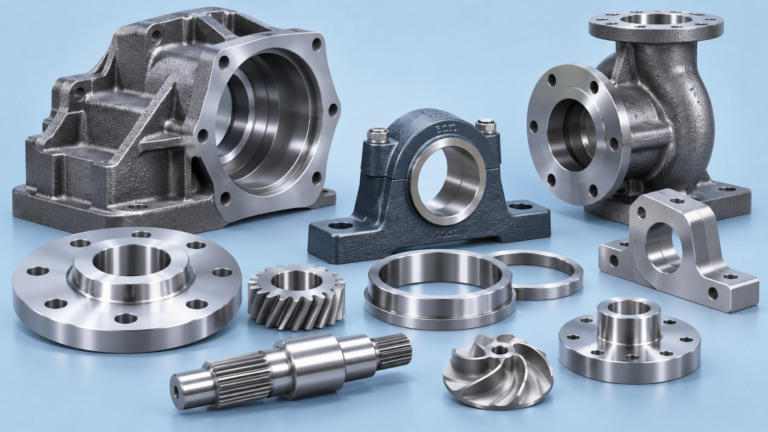
Common examples include:
- Precision shafts and spindles: Used to transmit rotational motion, support bearings, or connect mechanical assemblies.
- Bearing housings and support blocks: Provide accurate positioning and alignment for rotating components.
- Mounting plates and structural components: Connect machine assemblies and maintain dimensional relationships.
- Custom flanges and adapters: Connect mechanical systems, hydraulic equipment, and industrial assemblies.
- Bushings, sleeves, and spacers: Control positioning, alignment, movement, and wear.
- Hydraulic components: Such as manifolds, piston components, glands, and end caps.
- Machine-specific brackets and fixtures: Used in automated production equipment and assembly systems.
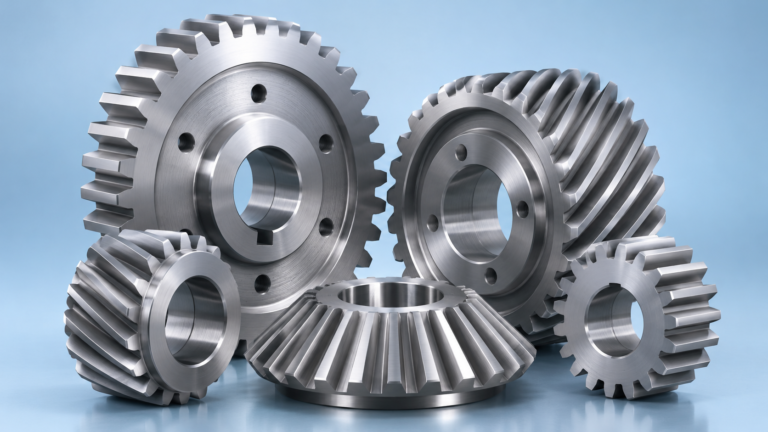
- Gear blanks, hubs, and couplings: Components used in mechanical power transmission.
Although these parts serve different functions, the sourcing considerations are often similar: material selection, machining capability, tolerance control, documentation, delivery reliability, and total manufacturing cost.
Standard components versus custom-machined parts
Standard catalogue parts generally offer shorter purchasing cycles, predictable pricing, and established specifications.
Custom machining becomes necessary when a component requires unique dimensions, non-standard features, specific materials, or integration with a proprietary machine design.
For instance, a machinery manufacturer may purchase standard bearings but require custom-machined bearing housings designed around the machine structure, available installation space, and expected mechanical loads.
Before specifying a custom component, engineers should consider whether a standard part could meet the functional requirements. Custom machining provides design freedom, but unnecessary customisation can increase procurement costs and replacement-part complexity.
2. Which CNC Machining Processes Are Used for Industrial Components?
Selecting the appropriate manufacturing process is one of the most important decisions affecting component cost, accuracy, and production efficiency.
Many industrial components require more than one machining process, particularly when combining rotational features with complex milled geometries.
CNC milling
CNC milling is commonly used for components with flat surfaces, pockets, slots, drilled holes, and complex three-dimensional shapes.
Typical industrial applications include:
- Machine mounting plates
- Precision bearing blocks
- Hydraulic manifolds
- Aluminium automation components
- Structural machine supports
- Complex equipment housings
Three-axis milling is suitable for many conventional components, while four-axis and five-axis machining can provide advantages when machining multiple faces or complicated geometries.
However, five-axis machining is not automatically the most economical option. A relatively simple component may be produced more efficiently using three-axis milling with appropriate fixtures.
The optimal process depends on geometry, accessibility, tolerances, quantities, and setup requirements.
CNC turning
CNC turning is generally suited to rotationally symmetrical components.
Examples include shafts, sleeves, bushings, pins, rollers, flanges, and threaded adapters.
For industrial machinery, turned components frequently include bearing seats, grooves, threaded sections, and precisely controlled diameters.
A shaft with several different diameters may require turning, milling of keyways, drilling, and grinding of critical bearing surfaces.
Mill-turn equipment can sometimes combine these operations in one setup, potentially reducing handling and alignment errors.
CNC grinding
Grinding is frequently used when a component requires tighter dimensional control, improved surface finish, or machining after heat treatment.
Common applications include:
- Hardened shaft bearing seats
- Precision cylindrical surfaces
- Ground guide components
- Flat reference surfaces
- Components requiring strict geometric tolerances
Grinding adds manufacturing operations and cost, so it should be specified where functional requirements justify it.
Additional manufacturing processes
Industrial components may also involve laser cutting, welding, casting, forging, heat treatment, surface coating, or assembly.
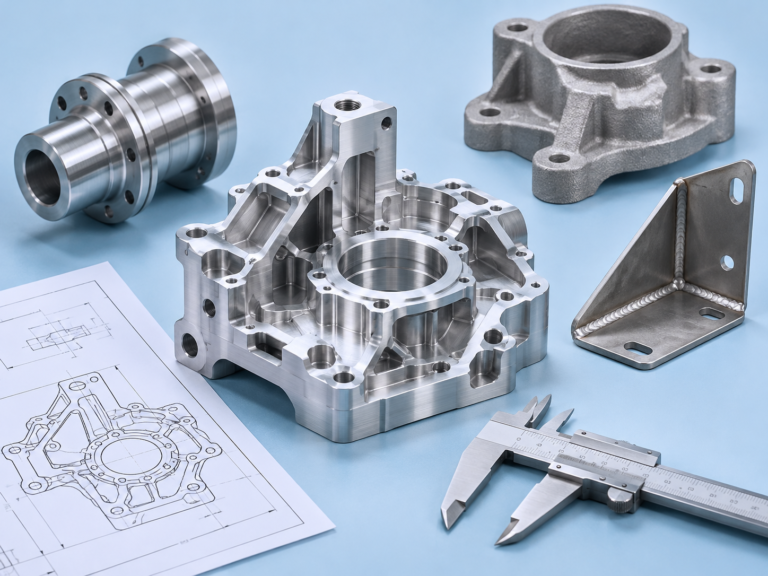
For example, a large machine bracket could be manufactured by laser cutting and welding steel plates before CNC machining the critical mounting surfaces.
This approach may be more economical than removing a substantial amount of material from one large steel block.
For buyers, evaluating these alternative manufacturing routes can provide significant cost advantages.
3. Material Selection: Choosing the Right Metal for the Application
Material selection influences mechanical strength, wear resistance, corrosion protection, machinability, and manufacturing cost.
The most expensive material is not necessarily the most suitable, and selecting material exclusively by purchase price can lead to avoidable manufacturing or operational costs.
Carbon and alloy steels
Carbon and alloy steels are widely used for industrial machinery components because they provide a useful balance between strength, availability, and cost.
C45 / 1.0503
C45 is commonly used for shafts, pins, hubs, and general mechanical components requiring moderate strength.
It offers reasonable machinability and can be heat-treated for selected applications.
42CrMo4 / 1.7225
42CrMo4 is a chromium-molybdenum alloy steel commonly selected for components requiring higher strength or toughness.
Typical applications include heavily loaded shafts, mechanical transmission components, and industrial equipment parts exposed to significant stresses.
However, its properties depend strongly on the supplied condition and heat treatment.
Specifying only the grade without the required condition may result in components with different mechanical properties than intended.
S355 structural steel
S355 is widely used for structural machine parts, welded assemblies, brackets, and frames.
It may be an economical choice for large components where weldability and structural strength are more important than high hardness or wear resistance.
Stainless steels
Stainless steels are frequently selected for machinery operating in wet, corrosive, or hygiene-sensitive environments.
1.4301 / AISI 304
Commonly used in food processing, packaging machinery, and general industrial equipment where corrosion resistance is important.
1.4404 / AISI 316L
Often chosen where improved corrosion resistance is required, particularly in environments involving certain chemicals or chlorides.
Neither grade is universally corrosion-proof. Environmental conditions, surface condition, cleaning chemicals, and operating temperatures must be considered.
Stainless steel components may also require careful machining strategies because of their work-hardening tendencies and heat generation during cutting.
Aluminium alloys
Aluminium is often selected for automation equipment, robotics, positioning systems, and machinery where reduced weight is beneficial.
EN AW-6082 and EN AW-7075 are common European machining alloys, although their properties and suitability differ considerably.
Aluminium can offer short machining cycles for many geometries, but its lower stiffness compared with steel may be a disadvantage in highly loaded structures.
Engineering plastics
Not every industrial component needs to be metallic.
POM, PA, PEEK, and other engineering plastics may be suitable for guides, spacers, sliding components, and selected wear applications.
When specifying plastics, dimensional stability, temperature exposure, moisture absorption, and mechanical loading should be evaluated.
A practical purchasing consideration
Material availability can influence the quotation as much as the nominal material price.
A component designed around an unusual bar diameter or uncommon alloy condition may require special material procurement, longer lead times, or additional rough machining.
Where design flexibility exists, standard European stock dimensions and readily available material conditions can help reduce manufacturing cost.
4. Understanding Tolerances and Their Impact on Manufacturing Cost
One of the most common reasons custom CNC machined parts become unnecessarily expensive is the excessive specification of tolerances.
Modern CNC machines can produce accurate components, but manufacturing cost increases when tighter tolerances require additional setups, slower finishing operations, specialised tools, temperature control, or extensive inspection.
The important question is not how accurately a supplier can machine a component, but how accurately it needs to be manufactured for the assembly to function reliably.
Not every dimension requires precision machining
Consider a steel mounting plate with several threaded holes and two precision locating holes.
The locating holes may need tightly controlled diameter and position tolerances, while the plate’s external dimensions may allow significantly greater variation.
Applying tight tolerances to every feature can increase machining and inspection costs without improving the final assembly.
A well-prepared drawing distinguishes between functional and non-functional dimensions.
Example: H7 hole tolerances
A drawing may specify a 20 H7 hole for a particular shaft or pin fit.
Under ISO 286, the permissible size range for a 20 mm H7 hole is:
- Minimum diameter: 20.000 mm
- Maximum diameter: 20.021 mm
This dimensional requirement may justify finishing operations such as precision boring or reaming.
However, the H7 designation alone does not define the complete assembled fit.
The mating shaft tolerance, geometry, surface finish, and operating conditions must also be considered.
Geometric tolerances
Industrial machinery components often rely on correct geometric relationships rather than individual dimensions alone.
Examples include:
- Perpendicularity of mounting faces
- Parallelism between guide surfaces
- Position of bearing bores
- Coaxiality of rotating features
- Flatness of machine interfaces
- Total runout of rotating components
A bearing housing may have correctly sized bores but still fail during assembly if the bearing axes are incorrectly positioned.
For this reason, appropriate geometric dimensioning and tolerancing can be more valuable than simply tightening every linear dimension.
Surface roughness
Surface roughness requirements should also reflect actual function.
For example, a sealing surface or bearing seat may require a more controlled finish than a non-contacting exterior surface.
Unnecessarily fine surface finishes may require extra machining or grinding operations.
Practical recommendation: Review tight tolerances, geometric requirements, and surface finishes before sending drawings for quotation. Confirm that each requirement serves an identifiable functional purpose.
5. How Production Quantity Influences CNC Machining Prices
Manufacturing cost does not increase linearly with quantity.
The cost per component depends on several factors, including programming, setup time, machining cycles, tooling, material utilisation, inspection, finishing, and order administration.
For custom components, initial setup expenses are particularly important.
Example: Cost distribution across different batch sizes
Consider a simplified hypothetical component with:
- Programming and setup cost: €300 per production batch
- Material, machining, and other variable manufacturing costs: €24 per component
The resulting cost structure would be:
| Order quantity | Setup cost per part | Total cost per part |
|---|---|---|
| 10 pieces | €30.00 | €54.00 |
| 25 pieces | €12.00 | €36.00 |
| 50 pieces | €6.00 | €30.00 |
| 100 pieces | €3.00 | €27.00 |
| 250 pieces | €1.20 | €25.20 |
| 500 pieces | €0.60 | €24.60 |
These figures are illustrative calculations, not actual supplier quotations. They exclude quantity-dependent tooling changes, logistics, and other possible cost differences.
The example demonstrates why increasing the order quantity from 10 to 100 pieces can produce a meaningful reduction in unit cost.
However, increasing the quantity from 250 to 500 pieces provides a much smaller improvement in this simplified scenario.
For buyers, this creates a useful opportunity: requesting quotations at several quantities can reveal the most economical purchasing range.
Prototype, low-volume, and serial production
Prototype production
Typically prioritises flexibility, short development cycles, and the ability to incorporate design changes.
Low-volume production
Often involves tens or hundreds of components, with a stronger emphasis on setup efficiency and repeatability.
Serial production
May justify dedicated fixtures, optimised tooling, automated handling, and more extensive process planning.
The boundaries between these categories are not fixed. A complex aerospace component and a simple turned spacer can have very different economically suitable batch sizes.
Annual demand versus individual order quantity
Suppose a machinery manufacturer requires 600 components annually but orders 50 pieces each month.
The supplier may quote differently depending on whether the full annual requirement is communicated.
A forecast can support material planning, fixture investment, and more efficient production scheduling.
Buyers should distinguish between a non-binding annual forecast and a contractual purchase commitment.
This allows realistic production planning without creating unnecessary stock or purchasing obligations.
6. Manufacturing from Solid Material, Castings, or Welded Structures
CNC machining does not always begin with a solid metal block.
The choice of starting material can have a major influence on cost, material utilisation, and manufacturing time.
Machining from solid material
This approach is attractive for prototypes, low-to-medium quantities, and relatively compact components.
Advantages include:
- No casting tooling requirement
- Good flexibility for design modifications
- Relatively straightforward material traceability
- Broad accessibility for many machine shops
The disadvantage is that complex components may require substantial material removal.
A large housing machined from a solid steel block could produce significant waste and require extensive rough machining.
Machining cast components
Casting can be advantageous when producing components with complex external shapes, internal cavities, or substantial material volumes.
The casting is manufactured near its final geometry, and CNC machining is used to finish the critical surfaces.
Common examples include pump housings, machine bodies, gearbox housings, and selected industrial brackets.
However, casting introduces additional considerations, including tooling investment, casting allowances, porosity risk, dimensional variation, and material-specific requirements.
For low quantities, tooling costs may outweigh the savings in machining time.
For repeat production, casting can become economically attractive.
Welded structures with finish machining
Large machine structures can sometimes be manufactured more economically from welded steel plates and sections.
After welding, critical surfaces and mounting interfaces are machined to final dimensions.
Potential advantages include reduced material waste and flexibility in producing large geometries.
The process requires careful planning because welding introduces heat and residual stresses that can cause distortion.
Depending on the structure, material, tolerances, and service conditions, controlled welding sequences, stress relief, intermediate machining, or additional inspection may be necessary.
Which manufacturing route is most economical?
There is no universal answer.
A purchasing manager should compare:
- Total manufacturing cost
- Tooling and non-recurring expenses
- Expected production quantity
- Dimensional and mechanical requirements
- Material utilisation
- Lead time
- Quality risks
- Future design changes
For expensive or complex components, requesting an alternative manufacturing proposal can be worthwhile.
A supplier capable of coordinating several manufacturing processes may be able to evaluate options beyond conventional CNC machining.
7. What Makes an Industrial CNC Component Difficult to Manufacture?
Component size is not always a reliable indicator of machining complexity.
A small component with deep internal features and tight positional tolerances may be more challenging than a much larger plate with simple holes.
Several characteristics consistently influence manufacturing difficulty.
Deep holes and cavities
Deep drilling requires appropriate tools, chip evacuation, coolant delivery, and process stability.
Deep milled cavities may require long cutting tools that are more susceptible to deflection and vibration.
These factors can increase machining time and affect achievable accuracy.
Where possible, reducing unnecessary depth-to-diameter ratios or allowing alternative manufacturing methods can improve feasibility.
Thin walls
Thin-walled components are vulnerable to deformation during clamping and machining.
This is especially relevant for aluminium housings, lightweight machine components, and large pocketed structures.
Additional setups, adapted fixtures, or staged material removal may be necessary.
Intersecting holes
Hydraulic manifolds and fluid distribution components often contain intersecting drilled channels.
Although the external geometry may appear simple, internal burrs can create serious functional problems.
Depending on the application, manufacturing may require controlled deburring, internal cleaning, and appropriate verification.
Tight positional relationships
A component containing several bearing bores may require strict positional relationships between features.
Producing accurate individual diameters does not guarantee correct overall geometry.
The machining setup, fixture design, and inspection method must support the functional requirements.
Heat treatment distortion
Heat treatment may improve mechanical properties but can also introduce dimensional changes.
Components requiring both high hardness and tight tolerances may need machining allowances followed by grinding or another suitable finishing process.
The manufacturing route should be planned before production begins, rather than treating heat treatment as a separate final step.
8. How to Evaluate a European CNC Machining Supplier
A competitive quotation is important, but it does not by itself establish that a supplier is suitable for repeat industrial production.
Machinery manufacturers should consider technical capability, production management, quality assurance, and communication.
Technical manufacturing capabilities
Assess whether the supplier can manufacture the actual component geometry and required quantity.
Questions worth asking include:
- What are the maximum machining dimensions?
- Which materials are regularly processed?
- Can the supplier produce both turned and milled features?
- Are critical tolerances achievable and verifiable?
- Can the supplier coordinate grinding, heat treatment, or coatings?
- Are larger or welded components within its production scope?
For complex components, previous experience with comparable geometry can be more meaningful than a broad list of machine types.
Quality assurance
Inspection requirements should be agreed before manufacturing.
Depending on component criticality, documentation may include:
- Dimensional inspection reports
- Material certificates
- First article inspection reports
- Surface roughness measurements
- Hardness verification
- Coating thickness measurements
- Traceability records
A coordinate measuring machine may be appropriate for complex geometric inspection, while simpler components may only require conventional measurement equipment.
The inspection method should be suitable for the tolerances and features being verified.
For European industrial customers, EN 10204 material inspection documents may be relevant. A 3.1 inspection certificate, for instance, has specific requirements and should not be confused with a generic supplier declaration.
Repeatability
A supplier may successfully manufacture five prototype components but encounter difficulties when producing several hundred units repeatedly.
Repeat production requires controlled processes, stable fixtures, tool management, inspection planning, and consistent manufacturing documentation.
Ask how the supplier manages process changes, nonconforming parts, and repeat orders.
Communication
Technical communication can significantly influence the total purchasing experience.
A competent manufacturing supplier should raise questions when drawings contain missing dimensions, conflicting specifications, impractical requirements, or ambiguous notes.
A quotation issued without resolving critical uncertainties may appear attractive initially but create expensive problems later.
Manufacturing responsibility
Some companies manufacture components using their own equipment, while others coordinate production through qualified subcontractors or manufacturing partners.
Neither structure is automatically superior.
What matters is knowing who controls production, inspection, subcontracted operations, and corrective actions.
For buyers, the important question is whether there is a clearly accountable organisation responsible for delivering conforming parts.
9. European Manufacturing: Cost, Lead Time, and Supply-Chain Considerations
For European machinery manufacturers, sourcing components within Europe can provide practical benefits, particularly when technical communication, repeated deliveries, and supply-chain responsiveness are important.
However, geographic proximity alone does not guarantee better pricing, faster delivery, or higher quality.
Total landed cost
Unit price is only one part of the purchasing calculation.
The total cost may also include:
- Freight and transport insurance
- Customs clearance where applicable
- Import duties
- Quality inspection
- Packaging
- Inventory financing
- Delivery delays
- Scrap and rework
- Supplier management
A component with a lower quoted manufacturing price may become more expensive once these costs are included.
Within the European Union, the absence of internal customs duties on goods in free circulation can simplify procurement between member states, although VAT, transport, documentation, and other requirements still need to be managed.
Delivery reliability
For industrial machinery manufacturers, predictable delivery can be more valuable than an optimistic lead-time commitment.
A delayed mechanical component may hold up the assembly of an entire machine.
Buyers should therefore assess realistic production scheduling, material procurement, subcontracted finishing operations, and transport arrangements.
Engineering changes
Custom machinery components often evolve during development.
Changes may involve hole positions, surface treatments, materials, or dimensional tolerances.
Before placing an order, clarify how revised drawings are managed and how engineering changes affect parts already in production.
Revision control is especially important for repeat orders.
Multi-process sourcing
A component may require milling, turning, heat treatment, grinding, and coating.
Sourcing these operations separately can increase coordination and transport requirements.
Using one accountable supplier for the complete manufacturing route may simplify purchasing, although the overall cost and technical suitability should still be compared.
10. Preparing an RFQ for Custom CNC Machined Parts
A complete request for quotation helps suppliers calculate realistic prices, identify manufacturing risks, and avoid unnecessary assumptions.
A well-prepared RFQ does not need to be complicated, but it should contain the information necessary to evaluate the component.
Technical documentation
Provide a current 2D drawing in PDF format with dimensions, tolerances, surface requirements, and applicable notes.
Where available, also include a 3D CAD model, preferably in a widely supported format such as STEP.
The 3D model helps suppliers evaluate geometry and develop manufacturing programs, while the controlled drawing should establish the contractual technical requirements unless another arrangement is agreed.
Material specification
State the required material grade, relevant standard, and supply or heat-treatment condition.
For instance, specifying 42CrMo4 without identifying the required condition may leave important mechanical requirements unresolved.
Include any required material certification.
Quantities
Indicate the initial batch size and, if known, the expected annual demand.
For uncertain quantities, request pricing at several volume levels.
This can reveal whether a modest adjustment to the order quantity significantly reduces unit cost.
Finishing requirements
Specify whether the components require:
- Heat treatment
- Grinding
- Anodising
- Zinc plating
- Black oxide treatment
- Painting
- Passivation
- Other coatings or finishing operations
For critical applications, reference the appropriate specification rather than relying on a broad finish description.
Quality and delivery requirements
Include required inspection documentation, packing instructions, delivery destination, and desired delivery date.
If the component is part of an urgent machinery repair or scheduled assembly project, communicate that context.
RFQ checklist
| Information | Why it matters |
|---|---|
| 2D technical drawing | Defines dimensions, tolerances, and specifications |
| 3D model | Helps suppliers evaluate and program the geometry |
| Material grade and condition | Determines raw material and processing requirements |
| Order quantity | Influences setup allocation and production planning |
| Annual forecast | Supports repeat-production planning |
| Surface finishing | Identifies additional manufacturing operations |
| Inspection requirements | Establishes quality verification and documentation |
| Delivery destination | Supports freight and logistics calculation |
| Required delivery date | Helps assess production feasibility |
| Drawing revision | Prevents production from obsolete documentation |
Providing this information early can reduce quotation delays and make competing supplier offers easier to compare.
11. Comparing CNC Machining Quotations: Look Beyond Unit Price
Suppose three manufacturers quote the same custom industrial component.
One supplier offers the lowest price, another provides a shorter lead time, and the third includes complete inspection documentation.
Choosing the best option requires understanding what each quotation actually includes.
Confirm the scope
Check whether the price covers the complete finished component.
A quotation may exclude heat treatment, coating, material certification, special packaging, or final inspection.
Comparing incomplete quotations can lead to misleading conclusions.
Review technical assumptions
Suppliers may interpret unclear drawings differently.
For example, one supplier might assume that a surface requires conventional machining, while another includes grinding.
The resulting prices may differ even though both suppliers believe they are quoting the same component.
Consider production risk
A very low price is not necessarily a warning sign, but unusually large price differences deserve investigation.
Possible explanations include different manufacturing routes, material sourcing, setup assumptions, inspection scope, or misunderstandings about the drawing.
Evaluate repeat orders
The lowest prototype quotation may not be the most economical solution over the product’s lifetime.
For components purchased regularly, consider whether the supplier can maintain consistent specifications, manage drawing revisions, and accommodate predictable production schedules.
Compare the complete value
A useful supplier comparison considers price, technical capability, quality documentation, responsiveness, lead time, and overall purchasing risk.
For machinery manufacturers, these factors can influence the total cost of equipment production more than a small difference in individual component prices.
12. Reducing the Cost of Custom CNC Machined Parts Without Compromising Function
The best opportunities for manufacturing cost reduction often emerge before the final design is released for production.
Small design changes can sometimes eliminate an additional machine setup, simplify inspection, or allow the use of standard tooling.
Use standard material dimensions
Where practical, design components around readily available stock sizes.
An unusual starting material dimension may generate unnecessary waste or require special procurement.
Avoid unnecessarily tight tolerances
Specify strict tolerances only where required for functionality.
General machining tolerances may be adequate for external shapes or non-critical features.
Reduce complex setups
Features that require access from multiple directions can increase setup time and alignment requirements.
Where design flexibility allows, grouping features into fewer machining orientations can improve efficiency.
Consider internal corner radii
Milled internal corners naturally have radii determined by the cutting tool.
Specifying unnecessarily small internal radii may require smaller tools, additional machining time, or alternative manufacturing methods.
Where appropriate, allowing larger internal corner radii can improve machining efficiency.
Standardise similar components
Machinery manufacturers frequently use multiple components with slightly different dimensions.
Where functional requirements allow, standardising hole patterns, material grades, or component families can reduce purchasing complexity and improve manufacturing repeatability.
Request manufacturing feedback
Before committing to a production batch, ask whether the supplier sees opportunities to simplify the manufacturing process.
A practical design-for-manufacturing review may reveal improvements that are not obvious from the CAD model alone.
Importantly, all design changes must be approved by the responsible engineering team before implementation.
13. Building a Reliable Long-Term Supply Chain for Industrial Components
For machinery manufacturers, individual orders are only one part of a broader supply-chain relationship.
A reliable component supplier should support continuity as the machinery design evolves and demand changes.
Start with a controlled initial order
For a new or technically demanding component, an initial production batch can help verify the manufacturing process and inspection requirements.
This reduces the risk of discovering technical problems after committing to a large quantity.
Maintain revision control
Each component should have a clear part number and drawing revision.
When drawings change, both buyer and supplier must understand whether the change applies to future orders, parts already in production, or existing inventory.
Forecast recurring requirements
Sharing reasonable demand forecasts allows suppliers to plan material purchasing and production capacity.
It can also reduce the risk of unexpected shortages.
Consolidate related components
Where commercially and technically appropriate, purchasing several related component types from one accountable supplier may reduce administrative work and simplify logistics.
However, buyers should balance consolidation benefits with supply-chain resilience and avoid unnecessary dependency on a single source for critical components.
Evaluate performance over time
Useful indicators include:
- On-time delivery performance
- Conformity of delivered components
- Responsiveness to technical questions
- Effectiveness of corrective actions
- Quotation accuracy
- Flexibility when demand changes
These indicators provide a more meaningful picture of supplier performance than unit price alone.
14. How MegaMETA Supports Custom Industrial Component Sourcing
MegaMETA supports companies seeking custom-manufactured metal components based on technical drawings and specific production requirements.
With manufacturing solutions covering CNC machining and related processes, MegaMETA can help customers evaluate production requirements involving different component geometries, materials, and manufacturing stages.
This is particularly relevant when a project includes several different components or requires a combination of machining, fabrication, finishing, and other manufacturing operations.
Rather than evaluating only the individual machining operation, an effective sourcing process considers the complete component: from material selection and manufacturing feasibility through to inspection requirements and delivery.
For machinery manufacturers, this approach can help simplify procurement while keeping attention on technical specifications and production consistency.
Actual manufacturing feasibility, available production capacity, documentation, and lead time should be confirmed for each RFQ.
Conclusion: Choosing the Right Supplier for Custom CNC Machined Industrial Parts
Custom CNC machined components play a critical role in the performance, reliability, and service life of industrial machinery.
Successful sourcing requires more than identifying a manufacturer offering an attractive unit price.
Material specifications, functional tolerances, machining methods, production quantities, heat treatment, inspection requirements, and supply-chain arrangements all influence the final outcome.
For purchasing managers, the most effective approach is to provide complete technical information, compare quotations on an equivalent basis, and select suppliers capable of managing both manufacturing quality and delivery requirements.
For engineers, the greatest opportunities often arise during the design stage, when thoughtful material selection and practical manufacturing tolerances can reduce cost without affecting functionality.
A component designed for efficient manufacturing, supplied with clear documentation, and produced through a controlled process provides value far beyond its individual purchase price.
Looking for a European Supplier for Custom CNC Machined Parts?
If your company requires custom-machined components for industrial machinery, production equipment, automation systems, or mechanical assemblies, MegaMETA can review your technical requirements and discuss suitable manufacturing options.
Send your technical drawings, material specifications, required quantities, and any relevant finishing or inspection requirements.
Contact MegaMETA to discuss your project and request a manufacturing quotation.