Aluminum 6061 is one of the most widely used engineering aluminum alloys because it offers a practical balance of strength, corrosion resistance, machinability, weldability, and cost. It is commonly selected for CNC machined parts, structural brackets, automotive components, aerospace fixtures, marine hardware, enclosures, heat sinks, and general-purpose mechanical parts.
However, when engineers, buyers, and machinists specify 6061 aluminum, the alloy number alone is not enough. The temper matters. Two of the most common tempers are 6061-T6 and 6061-T651. At first glance, they look almost identical because both come from the same base alloy and both are solution heat-treated and artificially aged. Their mechanical strength values are often very similar. The real difference is how the material behaves during machining, especially when tight tolerances, flatness, and dimensional stability are required.
In simple terms, 6061-T6 is a strong, general-purpose heat-treated aluminum, while 6061-T651 is a stress-relieved version of 6061-T6 that is better suited for precision machining and large flat parts. T651 achieves this improved stability through a controlled stretching process after solution heat treatment. This process helps reduce internal residual stress, which can otherwise cause parts to move, warp, or distort during machining.
This guide explains the difference between aluminum 6061-T6 and 6061-T651, including their heat treatment processes, mechanical properties, CNC machining performance, cost considerations, applications, and selection advice.
What Is Aluminum 6061?
Aluminum 6061 is a heat-treatable wrought aluminum alloy from the 6000 series. Its main alloying elements are magnesium and silicon, which help form magnesium silicide and allow the alloy to respond well to heat treatment. This gives 6061 a strong combination of moderate-to-high strength, good corrosion resistance, good weldability, and reliable machinability.
Because of this balanced performance, 6061 is often considered a general-purpose aluminum alloy for manufacturing. It is not the strongest aluminum grade, but it is versatile, widely available, cost-effective, and suitable for many industries. Compared with softer aluminum grades, 6061 provides better strength. Compared with higher-strength alloys such as 7075, it is usually easier to weld, more corrosion resistant, and more economical.
Typical uses of 6061 aluminum include:
- CNC machined prototypes and production parts
- Aerospace brackets and fixtures
- Automotive frames, mounts, and housings
- Marine fittings and hardware
- Bicycle frames and structural tubing
- Electronic enclosures and heat sinks
- Jigs, tooling plates, and machine components
- Consumer product housings and industrial equipment parts
The performance of 6061 depends heavily on its temper, which describes the mechanical and thermal processing used after the alloy is formed.
What Does Temper Mean in Aluminum 6061?
A temper designation is the suffix after the alloy number, such as -T6 or -T651. It tells engineers and manufacturers how the aluminum has been heat-treated, aged, cold-worked, or stress-relieved.
For 6061 aluminum, common tempers include:
| Temper | General Meaning | Typical Use |
|---|---|---|
| 6061-O | Annealed, soft condition | Forming, bending, deep drawing |
| 6061-T4 | Solution heat-treated and naturally aged | Moderate strength and better formability |
| 6061-T6 | Solution heat-treated and artificially aged | High strength and general machining |
| 6061-T651 | T6 plus stress relief by stretching | Precision machining and stable plates |
| 6061-T6511 | Stress-relieved extruded form | Extruded bars, rods, profiles, and tubes |
The base alloy composition remains 6061, but the temper changes how the material performs in real manufacturing conditions. For example, two parts made from 6061 may have similar chemistry but behave differently during milling if one is T6 and the other is T651.
What Is 6061-T6 Aluminum?
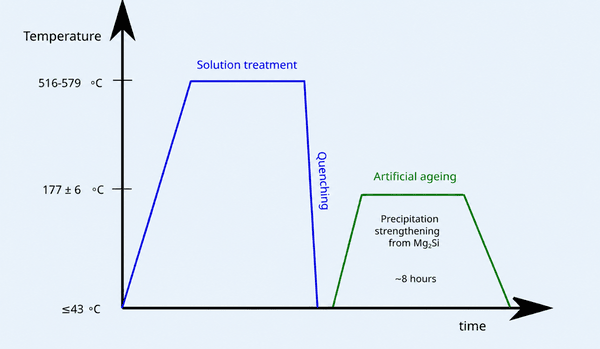
6061-T6 aluminum is 6061 alloy that has been solution heat-treated and artificially aged. This temper is designed to increase strength and hardness while maintaining good corrosion resistance and workability.
The T6 process generally includes three main steps:
1. Solution Heat Treatment
The aluminum is heated to a high temperature so that alloying elements dissolve into the aluminum matrix. This prepares the material for precipitation hardening.
2. Quenching
The material is rapidly cooled, usually with water or another quenching medium. Quenching locks the alloying elements in place and creates a supersaturated solid solution.
3. Artificial Aging
The aluminum is reheated at a lower controlled temperature. During aging, fine precipitates form inside the metal structure, improving strength and hardness.
This heat treatment gives 6061-T6 its well-known strength-to-weight ratio. Typical published values for 6061-T6/T651 include a yield strength around 276 MPa, tensile strength around 310 MPa, Brinell hardness around 95 HB, and thermal conductivity around 167 W/m·K, although exact values depend on product form, thickness, supplier, and standard.
Advantages of 6061-T6
6061-T6 is popular because it delivers strong all-around performance at a reasonable cost. It is widely stocked, easy to source, and suitable for many CNC machining and fabrication jobs. It offers good corrosion resistance, accepts anodizing well, and can be welded using appropriate procedures.
Main advantages include:
- Good strength-to-weight ratio
- Good corrosion resistance
- Good machinability
- Good weldability
- Wide availability
- Lower cost than many specialty aluminum tempers
- Suitable for prototypes and production parts
Limitations of 6061-T6
The main drawback of 6061-T6 is not its strength. The issue is residual stress. During quenching, internal stress can remain inside the material. When a machinist removes material unevenly, especially from thick plate, thin walls, or large flat parts, these stresses may release and cause distortion.
This does not mean 6061-T6 is poor for machining. It machines well for many parts. However, if the part requires excellent flatness, tight tolerances, or heavy material removal, T6 may be more likely to move compared with T651.
What Is 6061-T651 Aluminum?
6061-T651 aluminum is a stress-relieved version of 6061-T6. It undergoes solution heat treatment and artificial aging like T6, but it also includes an additional controlled stretching step to reduce internal stress.
The typical process is:
- Solution heat treatment
- Quenching
- Stress relief by controlled stretching
- Artificial aging
The stretching process is the key difference. By slightly stretching the material after heat treatment, manufacturers reduce residual stresses that were introduced during quenching. This makes the material more stable during machining.
Advantages of 6061-T651
6061-T651 keeps the major benefits of 6061-T6 while improving dimensional stability. It is especially useful when the part will undergo extensive CNC milling, face milling, pocketing, drilling, or finishing operations.
Main advantages include:
- Better dimensional stability than standard T6
- Lower risk of warping during machining
- Better choice for large plates and flat components
- More predictable machining behavior
- Good surface finish potential
- Good corrosion resistance
- Good strength and hardness
- Useful for precision components and tooling
Limitations of 6061-T651
The main disadvantage of 6061-T651 is cost. Because it requires additional processing, it is generally more expensive than standard 6061-T6. It may also be less available in certain shapes or sizes, depending on supplier inventory.
For simple brackets, low-risk housings, and general-purpose parts, the extra cost may not be necessary. But for large, flat, thin-walled, or high-tolerance CNC machined parts, the added stability can reduce scrap, rework, and inspection failures.
6061-T6 vs 6061-T651: Main Difference
The main difference between 6061-T6 and 6061-T651 is residual stress.
Both tempers are based on the same 6061 aluminum alloy. Both are heat-treated for high strength. Both offer good corrosion resistance, weldability, and machinability. However, 6061-T651 is stress-relieved by stretching, while 6061-T6 is not normally supplied with the same stress-relief step.
That single additional process makes T651 more stable when material is removed during machining. This is why 6061-T651 is commonly preferred for precision CNC machining, thick plates, tooling, fixtures, base plates, and components where flatness is important.
6061-T6 vs 6061-T651 Properties Comparison
| Property | 6061-T6 Aluminum | 6061-T651 Aluminum |
|---|---|---|
| Base alloy | 6061 aluminum | 6061 aluminum |
| Main alloying elements | Magnesium and silicon | Magnesium and silicon |
| Heat treatment | Solution heat-treated and artificially aged | Solution heat-treated, stress-relieved by stretching, artificially aged |
| Strength | High | High |
| Yield strength | Similar to T651 | Similar to T6 |
| Hardness | Similar to T651 | Similar to T6 |
| Corrosion resistance | Good | Good |
| Weldability | Good, but strength can reduce in heat-affected zone | Good, but strength can reduce in heat-affected zone |
| Machinability | Good | Better for precision machining |
| Residual stress | Higher | Lower |
| Dimensional stability | Good | Better |
| Warping risk during machining | Higher, especially in large/thin parts | Lower |
| Cost | Lower | Slightly higher |
| Best for | General machining and structural parts | Precision machined plates and tight-tolerance parts |
Machinability: Which One Machines Better?
Both 6061-T6 and 6061-T651 are machinable, but 6061-T651 is generally better for precision CNC machining.
6061-T6 cuts well, produces acceptable chips, and can achieve good surface finishes with the right tools, speeds, feeds, and coolant strategy. For many brackets, housings, mounts, and general mechanical parts, T6 performs well.
The issue appears when the machining operation removes a large amount of material or creates uneven wall thickness. As internal stresses are released, the part can bend, twist, or lose flatness. This is especially noticeable in:
- Large aluminum plates
- Thin-walled components
- Deep-pocketed parts
- Long parts with asymmetric material removal
- Precision mounting plates
- Parts requiring tight parallelism or flatness
- Components with extensive face milling
6061-T651 reduces this problem because it has already been stress-relieved by stretching. As a result, it is more predictable under the spindle and often easier to hold within tight dimensional tolerances.
For CNC shops, the choice between T6 and T651 can affect not only part quality but also machining strategy. With T6, machinists may need extra roughing passes, rest periods, stress-relief planning, more conservative fixturing, or additional finishing operations. With T651, the part is less likely to move unexpectedly, which can reduce setup complications and improve consistency.
Dimensional Stability: Why T651 Is Often Preferred
Dimensional stability means the material keeps its intended shape during and after machining. For aluminum parts, stability is crucial when the final component must remain flat, parallel, square, or accurately aligned.
6061-T6 has good dimensional stability for many normal applications, but the residual stress from quenching can become a problem in demanding parts. When a cutter removes material, the stress balance changes. The part may move after unclamping, after finishing, or even during inspection.
6061-T651 is designed to reduce that risk. The stretching process helps release internal stress before machining begins. This makes T651 a better choice for:
- Aerospace fixtures
- Optical and electronic mounting plates
- Machine base plates
- Mold plates
- Robotics components
- Precision housings
- Large CNC milled panels
- Heat sinks requiring flatness
- Parts with tight geometric tolerances
For parts where flatness is more important than raw material cost, T651 is often the safer selection.
Strength: Is 6061-T651 Stronger Than 6061-T6?
In most practical comparisons, 6061-T651 is not significantly stronger than 6061-T6. Their strength values are generally similar because both are heat-treated to a high-strength condition.
The advantage of T651 is not higher tensile strength. The advantage is lower residual stress and improved dimensional stability.
This distinction is important. If the part only needs high strength and does not involve heavy machining or strict flatness requirements, 6061-T6 may be sufficient. If the part must remain dimensionally accurate after machining, 6061-T651 is usually better.
Weldability: Can 6061-T6 and 6061-T651 Be Welded?
Both 6061-T6 and 6061-T651 can be welded, but welding changes the local heat-treated condition near the weld. The heat-affected zone can lose some of the strength created by the T6 or T651 aging process.
For welded assemblies, engineers should account for reduced strength near welds and may need post-weld heat treatment depending on the application. In many non-critical structures, welded 6061 performs well. For high-stress or certified applications, welding procedure, filler selection, inspection requirements, and design allowables should be reviewed carefully.
In terms of weldability, T651 does not provide a major advantage over T6. Its primary advantage remains machining stability.
Corrosion Resistance and Surface Finishing
6061 aluminum is known for good corrosion resistance in many environments. Both T6 and T651 perform similarly because they share the same base alloy chemistry. For improved corrosion protection, appearance, hardness, or wear resistance, 6061 can be anodized.
Common surface finishes for 6061-T6 and 6061-T651 include:
- Clear anodizing
- Color anodizing
- Hardcoat anodizing
- Bead blasting
- Brushing
- Polishing
- Powder coating
- Chemical conversion coating
- Painting
For visible CNC machined parts, T651 can sometimes help indirectly because better stability can support more consistent finishing results. If a part warps before finishing, it may be harder to achieve a uniform cosmetic or functional surface.
Cost Comparison: Is 6061-T651 More Expensive?
Yes, 6061-T651 is usually more expensive than 6061-T6 because it requires additional stress-relief processing. The price difference depends on supplier, stock form, plate thickness, order volume, certification requirements, and market conditions.
However, the lowest material price is not always the lowest total manufacturing cost.
If a T6 part warps during machining, the shop may spend more on:
- Extra setups
- Additional finishing passes
- Scrap and remakes
- Inspection failures
- Manual correction
- Longer lead times
- Customer quality issues
For simple parts, 6061-T6 is often the more economical choice. For precision parts, 6061-T651 can be more cost-effective overall because it reduces machining risk.
Applications of 6061-T6 Aluminum
6061-T6 is a good choice for general structural and machined parts where high strength, corrosion resistance, and availability are important.
Typical applications include:
- Automotive brackets and frames
- General CNC machined components
- Bicycle frames
- Marine fittings
- Pipe and tube structures
- Structural supports
- Housings and covers
- Consumer product parts
- Machinery components
- Electrical fittings
- Prototype parts
- Non-critical aerospace components
Use 6061-T6 when the part does not require extreme flatness or extensive material removal from thick stock.
Applications of 6061-T651 Aluminum
6061-T651 is preferred when dimensional stability is a priority. It is especially useful for machined plates, precision fixtures, and parts that must hold tight tolerances after heavy milling.
Typical applications include:
- Precision CNC machined plates
- Aerospace tooling and fixtures
- Machine base plates
- Mold and die support plates
- Robotics mounting structures
- Optical equipment mounts
- Electronic heat sinks
- High-accuracy housings
- Large flat panels
- Thin-walled machined parts
- Jigs and inspection fixtures
- Components requiring tight flatness or parallelism
Choose 6061-T651 when the part’s geometry, tolerance, or machining process makes distortion a concern.
6061-T6 vs 6061-T651 for CNC Machining
For CNC machining, the best choice depends on the part design.
Choose 6061-T6 when:
- The part is small or medium-sized
- Tolerances are moderate
- Material removal is balanced
- The design is not thin-walled
- Cost is a major concern
- Slight movement after machining is acceptable
- The part is a general bracket, cover, block, or housing
Choose 6061-T651 when:
- The part is large or flat
- Tight flatness is required
- The component has thin walls
- A lot of material will be removed
- The part has deep pockets
- The design includes asymmetric machining
- The part must hold tight tolerances after unclamping
- Scrap risk is expensive
- The component is used in aerospace, optical, robotics, or precision equipment
A useful rule is: use T6 for general-purpose machining and T651 for precision machining where stability matters.
Other 6061 Aluminum Tempers
Although T6 and T651 are among the most common, other 6061 tempers may be better for specific applications.
6061-O
6061-O is the annealed condition. It is soft, ductile, and easier to form or bend. It is not typically selected when high strength is required.
6061-T4
6061-T4 is solution heat-treated and naturally aged. It offers moderate strength and better formability than T6.
6061-T6511
6061-T6511 is commonly associated with extruded products such as bars, rods, profiles, and tubes. Like T651, it includes stress relief, but the designation is used for different product forms.
6061-T8 and T9
Some 6061 tempers may provide improved chipping characteristics compared with T6, depending on the product and processing route.
How to Specify 6061 Aluminum Correctly
When ordering aluminum for CNC machining or production, do not specify only “6061 aluminum.” Include the temper, product form, thickness, standard, and certification requirements.
A clear material callout may look like:
Aluminum 6061-T651 plate, thickness 25 mm, mill certificate required
or:
Aluminum 6061-T6 bar stock, anodized clear after machining
For precision parts, also specify:
- Flatness requirement
- Tolerance class
- Surface finish requirement
- Grain direction if relevant
- Heat treatment or certification standard
- Anodizing or coating requirement
- Critical inspection dimensions
Clear specifications help prevent material substitutions that may affect machining stability and final part quality.
Which Is Better: 6061-T6 or 6061-T651?
Neither temper is always better. The right choice depends on your part.
6061-T6 is better when you need a strong, versatile, widely available, cost-effective aluminum for general machining or structural applications.
6061-T651 is better when you need better dimensional stability, reduced warping, and more predictable results during CNC machining.
For simple parts, T6 is usually enough. For tight-tolerance machined plates or parts with heavy material removal, T651 is often the better engineering choice.
Quick Selection Guide
| Requirement | Recommended Temper |
|---|---|
| Lowest material cost | 6061-T6 |
| General CNC machining | 6061-T6 |
| Structural brackets | 6061-T6 |
| Precision milled plate | 6061-T651 |
| Large flat component | 6061-T651 |
| Thin-walled machined part | 6061-T651 |
| Heavy material removal | 6061-T651 |
| Tight flatness requirement | 6061-T651 |
| Better dimensional stability | 6061-T651 |
| Simple prototype | 6061-T6 |
| Aerospace fixture or tooling | 6061-T651 |
Conclusion
Aluminum 6061-T6 and 6061-T651 are closely related tempers of the same 6061 alloy. They share similar strength, corrosion resistance, weldability, and general mechanical properties. The key difference is that 6061-T651 is stress-relieved by stretching, which reduces residual stress and improves dimensional stability during machining.
For general-purpose machined parts, 6061-T6 is a reliable and economical choice. For precision CNC machining, large plates, thin-walled components, or parts that must maintain tight flatness and tolerance, 6061-T651 is usually the better option.