ABS plastic is one of the most widely used engineering thermoplastics in product design and manufacturing. It offers a practical mix of toughness, rigidity, processability, surface quality, and cost efficiency, which is why it appears in everything from electronic housings and automotive trim to toys, appliance parts, pipes, and 3D-printed prototypes.
For many projects, ABS is selected because it is strong enough for functional parts but still easy to mold, machine, paint, glue, and finish. It is not the best material for every environment, especially where strong UV exposure, high temperatures, or aggressive chemicals are involved, but for indoor products and durable consumer components, it remains one of the most dependable choices.
What Is ABS Plastic?
ABS stands for Acrylonitrile Butadiene Styrene. It is an amorphous thermoplastic made from three monomers, each contributing different performance characteristics.
Acrylonitrile improves hardness, chemical resistance, and thermal stability. Butadiene adds toughness and impact resistance. Styrene improves rigidity, gloss, and ease of processing. Together, these three components create a material that is strong, relatively light, dimensionally stable, and suitable for high-volume manufacturing.
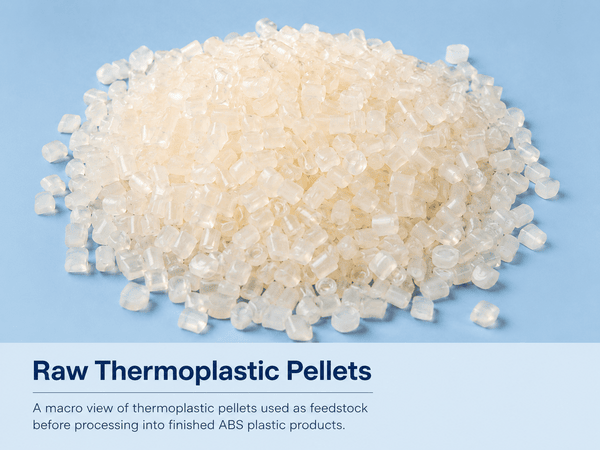
Because manufacturers can adjust the ratio of these monomers, ABS is available in many grades. Some are designed for high impact strength, some for better heat resistance, some for flame retardancy, and others for plating, extrusion, or 3D printing.
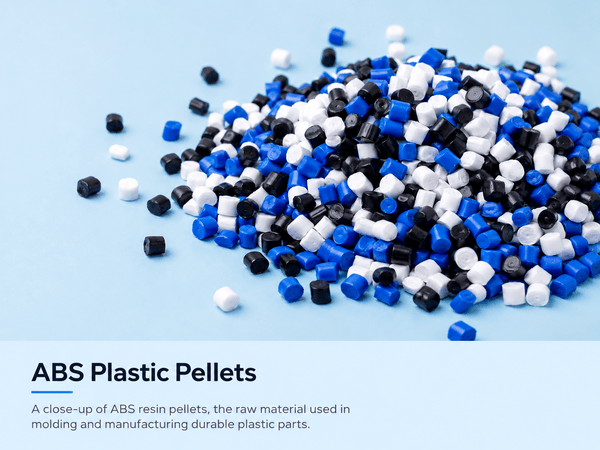
Photo placement: Add a close-up photo of plastic pellets here.
Suggested photo: Wikimedia Commons — “Plastic pellets for injection molding”
Key Properties of ABS Plastic
ABS is popular because it balances mechanical strength and manufacturing convenience. It is rigid enough for structural housings, tough enough to resist knocks and drops, and processable enough for injection molding, extrusion, thermoforming, CNC machining, and FDM 3D printing.
Typical ABS properties include good impact resistance, moderate heat resistance, low shrinkage, good electrical insulation, and a smooth surface finish. Exact values vary by grade, so final material selection should always be checked against the supplier’s datasheet. MatWeb lists ABS grades by properties such as density, flexural modulus, heat deflection temperature, and volume resistivity, which is useful when comparing candidate materials.
ABS is also an opaque material in most standard forms. It can be colored easily, accepts textures well, and is often used when the finished part needs a clean visual appearance without expensive secondary finishing.
Advantages of ABS Plastic
1. High impact resistance
ABS is known for toughness. The butadiene phase helps absorb impact energy, which reduces cracking and breakage when parts are dropped, bumped, or handled repeatedly. This makes ABS suitable for protective covers, tool bodies, appliance housings, and consumer products that need to survive everyday use.
2. Good rigidity and strength
ABS is not rubbery or overly flexible. It holds its shape well and provides a firm, solid feel. This is useful for parts that need dimensional stability, such as snap-fit housings, brackets, panels, covers, and internal supports.
3. Excellent processability
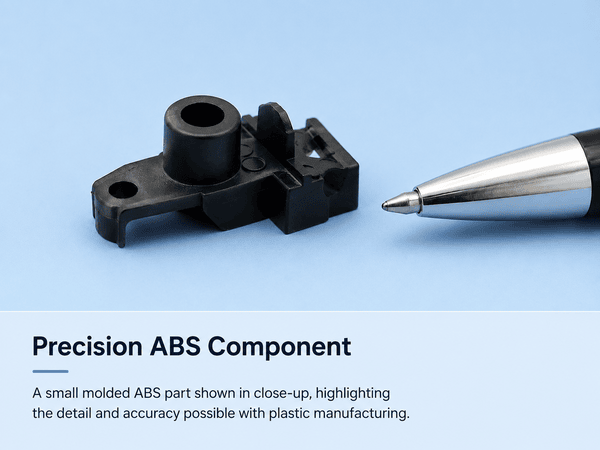
ABS flows well during injection molding and can produce complex shapes with ribs, bosses, clips, textures, and fine details. It is also widely used in extrusion, thermoforming, CNC machining, and 3D printing. SpecialChem describes ABS as an opaque engineering thermoplastic used across appliances, housings, and other product applications because of its useful balance of properties.
4. Smooth surface finish
ABS can produce attractive molded surfaces. It can be glossy, matte, textured, painted, printed, bonded, or plated. This makes it popular in visible parts where appearance matters, such as electronics, automotive interiors, consumer devices, and decorative covers.
5. Cost-effective performance
ABS is usually more affordable than higher-performance engineering plastics such as polycarbonate, nylon, PEEK, or PPS. It gives good performance for the price, especially when the product does not require extreme heat resistance, outdoor weatherability, or strong chemical resistance.
6. Good electrical insulation
ABS is often used for electrical and electronic housings because it provides good insulating behavior. Flame-retardant ABS grades are also available for applications where fire safety standards are required.
7. Easy post-processing
ABS can be machined, drilled, sanded, glued, solvent-welded, painted, vapor-smoothed in some processes, or electroplated when using the right grade. This makes it useful for both prototypes and finished production parts.
Disadvantages of ABS Plastic
ABS has many strengths, but it also has limitations that should be considered early in the design stage.
1. Poor UV resistance
Standard ABS is not ideal for long-term outdoor exposure. Sunlight can cause yellowing, loss of gloss, and brittleness over time. For outdoor parts, ASA, UV-stabilized ABS, painted ABS, or PC/ABS with protection may be better options.
2. Limited heat resistance
ABS performs well in many indoor applications, but it is not a high-temperature plastic. Heat-resistant grades are available, but for parts exposed to continuous heat, polycarbonate, nylon, PBT, or PC/ABS may be more suitable.
3. Limited resistance to some chemicals
ABS resists many mild chemicals but can be damaged by solvents such as acetone, ketones, esters, and some hydrocarbons. Chemical resistance charts should be checked before using ABS in contact with cleaners, fuels, oils, or industrial chemicals. U.S. Plastic Corp. notes that chemical resistance data should be treated as a guide because resistance depends on concentration, temperature, and exposure conditions.
4. Not naturally weatherproof
For parts exposed to rain, sunlight, temperature cycling, and outdoor wear, standard ABS may not be the best long-term option. ASA is often chosen when similar performance is needed with better UV resistance.
5. Moisture must be managed before processing
ABS can absorb moisture from the air. If resin is not dried correctly before molding or extrusion, the finished part may show bubbles, streaks, splay marks, or reduced surface quality.
6. Not food-safe by default
Standard ABS should not automatically be assumed safe for food contact. If a part will touch food, beverages, medical fluids, or skin for regulated uses, a certified grade and compliance documentation are required.
How ABS Plastic Parts Are Made
ABS is compatible with several manufacturing methods, which makes it useful from early prototyping to mass production.
Injection molding
Injection molding is the most common production method for ABS parts. Pellets are dried, melted, injected into a metal mold, cooled, and ejected as finished parts. This method is ideal for medium- to high-volume production because unit cost decreases significantly after the mold is made.
ABS injection molding is commonly used for housings, covers, clips, panels, handles, knobs, appliance parts, and electronic enclosures.
Photo placement: Add a factory or injection molding machine photo here.
Suggested photo: Wikimedia Commons — injection molding workshop photo
CNC machining
ABS is also available as sheet, rod, and block stock. CNC machining is useful for prototypes, fixtures, low-volume production, and parts that require accurate features without the cost of an injection mold.
Machined ABS cuts cleanly, but heat control is important. Too much friction can soften the plastic or create rough edges.
3D printing
ABS is a common FDM 3D printing material. It creates stronger and more heat-resistant parts than PLA in many cases, but it is more difficult to print. Warping, shrinkage, and odor are common challenges. An enclosed printer, heated bed, and proper ventilation are recommended.
Extrusion
ABS can be extruded into sheets, profiles, rods, and pipes. Extruded ABS sheet is often used for thermoforming, panels, signage, equipment covers, and fabricated parts.
Vacuum forming and thermoforming
ABS sheets can be heated and formed over a mold. This is useful for larger, thinner parts such as trays, covers, automotive interior panels, luggage shells, and equipment housings.
Common ABS Plastic Grades
Choosing the right ABS grade is important because “ABS” is not a single universal material. The best grade depends on the application, environment, finish, compliance needs, and manufacturing process.
Standard ABS
Standard ABS is suitable for many indoor products. It offers a balanced mix of toughness, rigidity, processability, and surface quality. It is often used for housings, covers, handles, panels, and general consumer parts.
High-impact ABS
High-impact ABS contains more rubber content or modified impact performance. It is used when parts must survive repeated knocks, drops, or mechanical stress.
Heat-resistant ABS
Heat-resistant ABS is designed for parts exposed to higher service temperatures than standard grades. It is common in automotive, appliance, and electrical applications where ordinary ABS may soften or deform.
Flame-retardant ABS
Flame-retardant ABS is used for electrical housings, appliance parts, power equipment, and components that must meet fire safety requirements. These grades may trade some impact strength or flow performance for improved flame resistance.
Plating-grade ABS
Plating-grade ABS is formulated for electroplating. It is used when a plastic part needs a metallic finish, such as chrome-look automotive trim, decorative hardware, or consumer product details.
Transparent ABS / MABS
Most ABS is opaque, but transparent ABS-like materials, often known as MABS, are available. These are used when clarity and impact resistance are needed, although they may not match the toughness of high-impact opaque ABS.
ABS filament for 3D printing
3D printing grades are formulated for extrusion consistency, layer adhesion, and reduced warping. Low-warp ABS blends are available for printers without fully industrial build chambers.
ABS Plastic vs Similar Materials
ABS vs PLA
PLA is easier to 3D print, warps less, and is often made from bio-based sources. ABS is tougher, more heat resistant, and generally better for functional parts. PLA is better for simple visual prototypes, while ABS is better when durability matters.
ABS vs PVC
PVC is widely used in pipes, profiles, and construction products. ABS is tougher and more impact resistant in many product applications, while PVC can offer better chemical resistance and is commonly used in plumbing and building materials.
ABS vs Polycarbonate
Polycarbonate is stronger, more impact resistant, and more heat resistant than ABS, but it is also more expensive and can be harder to process. PC/ABS blends combine some of the toughness and heat resistance of polycarbonate with the processability of ABS.
ABS vs ASA
ASA is similar to ABS but performs better outdoors. If a part will be exposed to sunlight, rain, or weathering, ASA is usually a stronger choice.
ABS vs Nylon
Nylon has better wear resistance, fatigue resistance, and mechanical strength in many demanding applications. However, nylon absorbs more moisture and is typically more expensive. ABS is easier to finish and often better for cosmetic housings.
ABS vs HIPS
HIPS is cheaper and easy to process but generally has lower mechanical performance than ABS. HIPS is suitable for low-stress packaging, displays, and disposable products, while ABS is better for durable functional parts.
Common Applications of ABS Plastic
ABS is used across many industries because it performs well in both functional and cosmetic parts.
Consumer electronics
ABS is widely used for computer housings, keyboards, mice, monitors, remote controls, chargers, speakers, routers, and small device enclosures. It provides good impact resistance and accepts attractive surface finishes.
Automotive parts
Automotive interiors often use ABS or PC/ABS for trim, dashboard components, pillar covers, vents, knobs, and decorative parts. ABS is useful where surface finish, dimensional stability, and moderate toughness are required.
Toys and recreational products
ABS is commonly used in toys because it is durable, rigid, colorful, and capable of holding tight details. It is suitable for snap-fit assemblies and products handled frequently.
Appliance housings
Vacuum cleaners, food processors, shavers, control panels, and appliance covers often use ABS because it can be molded into complex shapes and finished attractively.
Pipes and fittings
ABS is also used in drain, waste, and vent pipe systems. ASTM D2661 covers ABS plastic drain, waste, and vent pipe and fittings made to Schedule 40 iron pipe sizes.
Medical and laboratory equipment housings
ABS may be used for external housings and non-contact components in medical and diagnostic devices. For regulated applications, the correct certified grade must be selected.
Industrial products
Tool handles, machine covers, control boxes, instrument housings, protective guards, and fixtures can all be made from ABS when the operating environment is suitable.
Design Tips for ABS Plastic Parts
Good ABS part design can reduce defects, improve strength, and lower production cost.
Use uniform wall thickness where possible. Sudden changes in wall thickness can cause sink marks, warping, and uneven cooling. Add ribs instead of thick sections when extra stiffness is needed.
Use draft angles on molded parts so they release cleanly from the mold. Add radii to sharp corners to reduce stress concentration and improve flow. For snap-fit features, check the grade’s elongation and fatigue behavior before finalizing the geometry.
For cosmetic parts, decide early whether the surface will be painted, textured, polished, printed, or plated. The finishing method can affect mold design, material choice, and production cost.
When Should You Choose ABS Plastic?
Choose ABS when you need a tough, affordable, easy-to-process plastic for indoor functional parts. It is especially useful for housings, covers, prototypes, consumer products, automotive interior parts, appliance components, and injection molded assemblies.
ABS is a strong choice when the part needs good impact resistance, a clean finish, dimensional stability, and reasonable cost. It is also a good bridge material between prototype and production because it can be 3D printed, machined, and injection molded.
Avoid standard ABS when the part needs long-term outdoor exposure, high heat resistance, strong chemical resistance, food-contact compliance, or high-performance structural strength. In those cases, consider ASA, PC/ABS, polycarbonate, nylon, polypropylene, or another engineering plastic.
FAQ About ABS Plastic
What does ABS plastic stand for?
ABS stands for Acrylonitrile Butadiene Styrene. It is made from three monomers that combine hardness, toughness, rigidity, and processability.
Is ABS plastic strong?
Yes. ABS is strong for many consumer and industrial applications. It offers good impact resistance and rigidity, although it is not as strong as high-performance materials such as polycarbonate or nylon.
Is ABS plastic waterproof?
ABS does not dissolve in water and can handle normal moisture exposure, but it is not automatically suitable for every wet or outdoor environment. UV exposure, chemicals, temperature, and sealing requirements must be considered.
Is ABS plastic safe for food?
Standard ABS is not food-safe by default. Use a certified food-contact grade if the part will touch food or beverages.
Can ABS plastic be recycled?
ABS can be recycled, but local recycling availability varies. Industrial scrap is often easier to recycle than mixed post-consumer ABS.
Is ABS better than PLA?
For functional parts, ABS is usually tougher and more heat resistant than PLA. For simple 3D printing, PLA is easier to print and has less warping.
Is ABS good for outdoor use?
Standard ABS is not ideal for long-term outdoor use because UV exposure can cause yellowing and brittleness. ASA or UV-stabilized grades are better for outdoor parts.
What is ABS plastic used for?
ABS is used in electronics housings, automotive trim, toys, appliance parts, pipes, medical device housings, 3D-printed prototypes, tool handles, and industrial covers.
Conclusion
ABS plastic remains one of the most practical materials for product designers, engineers, and manufacturers. It is tough, rigid, affordable, easy to process, and capable of producing clean, professional-looking parts.
Its main weaknesses are UV exposure, high heat, aggressive chemicals, and certain regulated applications. When those limitations are understood, ABS can be an excellent choice for durable indoor products, prototypes, injection molded components, and consumer-facing parts.